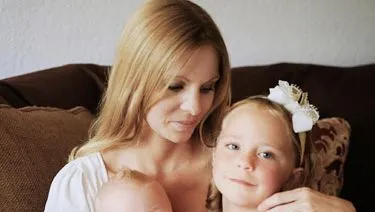
My first pregnancy was a breeze. I hung out at the beach near our Orange County home and exercised right up to the birth. My biggest complaint? I was too huge to lie on my stomach. Once the baby was 18 months old, my husband, Mike, and I began to plan for another. He was a law student, rising at dawn and not getting home until dinnertime, and I'd given up my full-time job as a preschool teacher to raise our daughter, Elise, and to work part-time as a nanny. Even though we were living paycheck to paycheck, we wanted to expand our family.
I became pregnant in July 2006, and at 18 weeks, I went for my first ultrasound. Mike had organized a celebratory dinner with family and friends for that night. When the first picture of the baby appeared on the screen, Mike, 3-year-old Elise, and I oohed and aahed over the baby's fingers and toes.
We waited for the technician to tell us the sex. But she was strangely quiet. Then she said, "I'm not getting the right readings." I told Mike to take Elise out of the room. "Is it something to do with the heart?" I asked. No, she said, the heart was fine—but something was severely wrong, and my OB/GYN would have to diagnose it. Still, I pressed for details. She said, "Your child is sick. I don't think it's going to survive." I broke into tears. I was 26. I was too young, too fit, too healthy for something like this to happen to me. The thought of abortion came to mind immediately, but along with it came a feeling of walking into the ocean and never coming back.

Mike was waiting outside. I told him we were having a little girl (whom we wanted to name Aubrielle), and that she might not be with us for very long. He hugged me, asked if I was OK, then called everyone to cancel the dinner.
That evening we told Elise. Mike and I were worried about how she would take the news, or whether she could even begin to understand, but she simply leaned over, kissed my belly, and said, "Aubrielle, you're sick, but you're going to heaven, and you'll get better there with Grandpa."
When I went to the hospital to see my OB/GYN, she diagnosed the baby with trisomy 13, also known as Patau syndrome—a genetic disorder involving multiple abnormalities, many of which are fatal. The disease occurs in about one out of every 10,000 newborns; more than 80 percent of children with it die within the first month. My doctor warned me that Aubrielle could die at any moment during the pregnancy, and certainly wouldn't live much beyond the birth. She concluded that abortion was the best option.[image id='c0912db9-f996-4a33-9fdb-e8c22557fffe' mediaId='08b5de63-cf06-4c15-a333-389b0dcfa1d3' loc='C'][/image]
Overwhelmed, I just cried. I didn't feel that terminating the pregnancy was the right option for me. My decision wasn't just about religion, although our family does go to church weekly; it was about my belief that this baby's life had meaning. I wanted to honor that.
Mike supported my decision, as did my mom and sisters. Naturally, there were times when I wrestled with my choice, especially when others questioned my sanity. They'd say, "What's the point of holding on to this baby? Have an abortion. Then you can try again in a few months." Moms I met in the park were often uneasy and wondered what I was doing. Some parents didn't want me around their children, because then they'd have to explain that my baby was going to die. And I could certainly understand how they felt.
Yet every time Aubrielle kicked, it was a thrill. I'd hold my belly and read stories to her and Elise. I started to think about what others were going through in life and what problems they had, instead of thinking so much about ours. My marriage gained strength, too: Mike focused, selflessly, on what we needed as a family. One night when I was feeling sad, he held me as I cried till dawn.
Before my due date, my perinatal nurse, Suzanne, paid us several visits, discussing my birth plan and how we wanted Aubrielle's first few hours documented—we chose photographs and hand- and footprints. I requested a Cesarean so we'd possibly have Aubrielle for a little longer, if she wasn't stillborn. I also asked for my family to have access to the recovery room. Suzanne helped us prepare Elise by showing her pictures of other babies with trisomy 13, so Elise wouldn't be shocked by Aubrielle's cleft lip and palate. Elise touched the pictures, saying the poor babies had "owwees."
A few nights before the scheduled delivery, my sisters and friends threw me a "relaxation party." We ate ice cream and listened to music, and they brought presents: picture frames, scrapbooks, toys for Elise, a pink blanket for Aubrielle.
The evening before I was due to deliver, I was taking a shower, and this terrible feeling came over me—that I was going to the hospital to die myself. I fell to the ground, sobbing. What was I doing? Was I crazy to have chosen this? I wondered. I felt such raw pain; I was paralyzed by it. But afterward, exhausted and spent, I felt a sense of peace, and the despair that had gripped me began to evaporate. This was the right choice, not just for us, but for Aubrielle. I would give her everything I could as a mother.
The next day, I went to the hospital, and my OB/GYN said she couldn't find Aubrielle's heartbeat. Mike and I looked at each other as if to say, "Well, that's it, she's gone." But then my doctor saw that she was breeched, and we went ahead with the C-section.
The first time I saw Aubrielle, Mike was holding her. I'll never forget her first cry, so tiny and faint. Mike kept saying, "She's here! She's alive!" He handed her to me, and I told her how much I loved her. As if in response, she squeezed my finger. Mike gave the baby to Elise, and as she held Aubrielle, she sang a lullaby, the same one she had sung to my belly during pregnancy.
Aubrielle, who weighed 5 pounds, lived four-and-a-half hours. During that time, our family had a small party with flowers, pink cupcakes with sprinkles, a balloon that said "Happy Birthday Princess," and bracelets for Elise, the baby, and me. Aubrielle wore a white cotton dress that my mother had made and a bow in her brown hair. But about an hour after the birthday party, back in my private room, Aubrielle was starting to fade. Her chest, face, and hands were turning blue. I'd never lost anyone before. I looked down at my baby and watched her take her last breath. Then she was gone.
The funeral was a few days later. Aubrielle was wearing her special dress, and about 50 close friends and family members came to pay their respects. Both Mike and I gave speeches, as did a few others; then we sang songs and celebrated her life.
I still miss Aubrielle. I have no regrets about what I did, and I'll always have that extraordinary time I spent with my daughter. We visit her grave every week, where we sit on a picnic blanket and eat cupcakes. Mike and I waited for my body to recover from the C-section before trying again for another baby. Our son Luke was born in January. Now when I look at Elise and Luke playing together, I can't help but picture Aubrielle with them. She is always with us in our minds and our hearts.
As told to Juliette Dominguez, a freelance writer based in New York. She has written for the L.A. Times Magazine, Harper's Bazaar, and the Daily Mail, among others.[image id='a98b358c-0139-41cb-84f1-757049682c62' mediaId='1164b498-de34-4f90-86e6-c7a5096c7998' loc='C'][/image]
I'd always dreamed of having four children in a traditional French Quarter home near a streetcar line.
My husband and I had been married for six months when we decided we were ready to have kids. I was 28 and about to finish grad school, and we had just moved into a three-bedroom starter house in the suburbs of New Orleans. It didn't take long to get pregnant, and I still remember the morning we knew we had conceived, in November of 2006. I had woken up at 5 a.m. and taken a digital pregnancy test. "Pregnant." My heart stopped—I was overwhelmed with excitement. I ran to the bedroom to show my husband, who smiled from ear to ear. He pulled me down for a hug, and as we lay in bed together, we talked about how, by this time next year, we'd have a baby with us to celebrate the holidays.
I have a mild form of cerebral palsy, and my doctors had warned me that I might not be able to carry the baby to term. And yet, other than morning sickness, the first trimester was going smoothly. When I was about 10 weeks pregnant, I went for my regular OB checkup. There was no prenatal testing, no ultrasound—it was still too early in the pregnancy—but my doctor said the baby's heartbeat was excellent, that I was measuring well, and that I wouldn't need to come back until my second trimester examination.
My father-in-law happens to be a perinatologist. His office is right across the street from my doctor, so after my appointment, my husband and I thought we'd stop by to get an ultrasound and take a peek at the baby. It was just for fun. My father-in-law spread the cold, wet jelly on my tummy, and my husband and I were giddy as we pointed to an outline of the baby's skeleton on the screen; we giggled as we pretended to know whom the baby looked like. But 20 minutes later, I noticed my father-in-law staring at the machine intently, pausing now and again to write something down. He never stopped to point out the baby's heart or its nose. He would not look at us or speak. When I tried to break the uncomfortable silence, he shushed me.
When my father-in-law pulled us into the patient room, he was very serious—too serious—and I was somewhat offended that he seemed to have gone into doctor mode instead of dad mode. That's when he said, quite frankly and directly, "There is something wrong." He never said that the problem might be "something else" or that it could be a mistake—there was something wrong. My husband and I just nodded in silence. My father-in-law said I would need a slightly more invasive test called a CVS to determine what we were dealing with. Then he picked up the phone to make an appointment with his partner for the same week.[image id='e7371532-6101-4e9b-9397-2f7650736fc4' mediaId='5bfcb49b-3982-4aba-a79f-fbc39640d3ae' loc='C'][/image]
Over the next six weeks, I subjected myself to three tests: the CVS, which draws a sample from the placenta; a blood test; and an amnio—each one followed by an agonizing two-week period when my husband and I would have to wait for results; this being right after Katrina, the samples had to be sent out of state. I spent that time in a fog. I barely slept. I had to force myself to eat, even though I should have been famished from the pregnancy.
I was in my last semester of school, but I lost focus. I sat in class practically comatose. I didn't take notes; I just waited for class to end. I'm usually the kind of person who holds my feelings in, but I was crying all the time—in the car, in between classes, in the bathroom. I prayed to God and asked him, Why me? I closed the door to the nursery, where I'd filled the shelves with my old children's books such as Where the Wild Things Are and The Giving Tree that my parents had given me. To make things worse, I was starting to show. I began to wear baggier clothes—I didn't want friends congratulating me when I knew in my heart that I was going to lose the baby.
I was 16 weeks pregnant when the last set of test results came in. My husband and I were at home, and I made him take the 6 p.m. call while I just hid, sobbing in bed under the covers. The doctor told my husband that the baby had trisomy 2, a fatal chromosomal abnormality that occurs in 0.016 of pregnancies.
When we went for our follow-up appointment, the doctor gave us a list of the problems our baby could face: It could be born with congenital heart defects; structural brain abnormalities; lung deformation; or suffer from seizures. The doctor couldn't even say if the baby would survive the pregnancy, but the best-case scenario was that it would live for two weeks.
Our doctor didn't talk to us about our options outright. But we knew what they were. The doctor slipped us a piece of paper with the names of two clinics—one was Dr. George Tiller's in Kansas, the other was in Dallas—and left the room.
That night, I curled up in a ball in the bathtub for two hours, my husband sitting next to me on the cold tile floor. I didn't let him touch me. I didn't want to be touched. As we discussed our options, our religious upbringings pressed down on us. Having grown up in the Catholic city of New Orleans and having gone to a Catholic high school, college, and graduate school, I'd always thought of abortion as a decision made by a woman who didn't want her baby, or by someone who had been raped. I'd always known I would become pregnant purposefully, when I was married. And that's exactly what I had done. I had no plan for this. In all of the discussions we had in Catholic school about terminating pregnancies, we'd never once addressed reasons such as my own. There was nobody to ask what to do.
Our first option was to have the baby. And yet, that seemed implausible. There was already the possibility that I wouldn't be able to carry a healthy baby to term, let alone one that may not even survive in the womb. But even if I could, I didn't know how I would tell people who wanted to celebrate with showers and baby gifts that the baby was fatally ill. Most of all, I couldn't bear the idea of watching my baby suffer once born. I would have to watch it die.
Our second option was to terminate the pregnancy. I've never used the word abortion.
When I called my parents, I was mostly scared of what my father would say, since he was the most religious person in my family. My father has never been a man of many words, and while he was upset, he didn't object. I'll never know whether his sadness was out of sympathy, or because I'd already made the decision. We never told my mother-in-law, a devout Catholic who has expressed very passionate views on this issue. I knew our decision would hurt her. And I knew she would judge us.
Of the two clinics, my husband and I chose the one in Dallas because it was closer. So one day at 5:30 a.m., we got in the car, drove 10 hours, and checked ourselves into a Hampton Inn.
The next morning, we drove to the clinic. There was a long driveway that led to the building, almost as if they were trying to hide it from view. As we walked from the parking lot to the front door, I remember a protestor holding up a sign, trying to lure us over to discuss adoption. She wanted to help us find someone for our baby, someone who could take care of it, give it a loving home. I was angry. I wanted my baby. I had a loving home for it. I wanted to say something to her, but I didn't. Instead, I just looked at my feet.
The clinic's waiting room had 10 dingy couches lined up in rows, facing each other—you had to sit across from someone experiencing the same trauma as you were. Some people were just lounging around, lying on them; others had brought in food, even though patients aren't supposed to eat before the procedure. There were women who talked about getting their nails done afterward. But there were also mothers with their teenage daughters, and women who were much further along in their pregnancies than I was, sobbing. We sat there for 10 hours, a forced waiting period meant to give us time to change our minds.
We finally met with the doctor at 4 p.m. In cold, clinical terms, he explained there would be two procedures—one to dilate the cervix, a second to remove the fetus—and that I'd have to pay an extra few hundred dollars for a general anesthesia if I wanted more than the local, which would leave me awake. I paid the extra money. I didn't want any memory of what was happening.
When I went into an examination room, they inserted sticks called laminaria that slowly dilate the cervix. When I woke up, they gave me a bottle of Advil and sent me back to the hotel. That night, my mother-in-law called. She wanted us to turn on channel 4 so that I could see my cousin, who is an actor, on television. As far as she knew, there was nothing out of the ordinary going on. She didn't even know we were out of town. That's when the burden of having this secret really hit me. To have to hide our pain and sorrow made it feel like punishment.
The next morning, I went in for the second procedure. When I woke up, I was in a room with about six recliners lined up in a row. When I looked down at myself, at the pad beneath me, I saw that I was sitting in a pool of my own blood. A woman came by to help me clean up. Once I was dressed, she walked me to the back door.
OVER THE NEXT TWO months, my hormones were raging. At school, I would start bawling in the middle of the dining hall. One time, it was so uncontrollable, a counselor who worked for the campus ministry asked me if I wanted to talk in her office. (I declined.) If people asked about the pregnancy, I just told them I'd lost the baby. Luckily, most people just assumed I had miscarried—I saw that as a blessing and left it at that. Eventually, with finals coming up, I went to talk to the dean. I told her that my baby had died, and she arranged it with my professors for me to work at my own pace.
Back in May, I cried when I saw the news of Dr. Tiller's murder and had to listen to all the rhetoric on television vilifying women like me.
Looking back, I know I made the right decision—I wanted to prevent my child from a painful death. But because of my religion, I feel I will never be forgiven for making the choice I made. I no longer feel I can even be called Catholic, another loss altogether.
About a month after I terminated my first pregnancy, my husband and I started trying again. I naively believed that having a healthy child would heal all wounds. But you never forget. Now I have an 18-month-old girl and another baby on the way. And while my daughter didn't erase what happened, she did make it easier to feel hopeful about life.
As told to Yael Kohen.