These Women Are the Last Thing Standing Between You and Nuclear War
As tensions rise between the United States and North Korea, an elite squad of Air Force officers wait for the call the world hopes never comes.

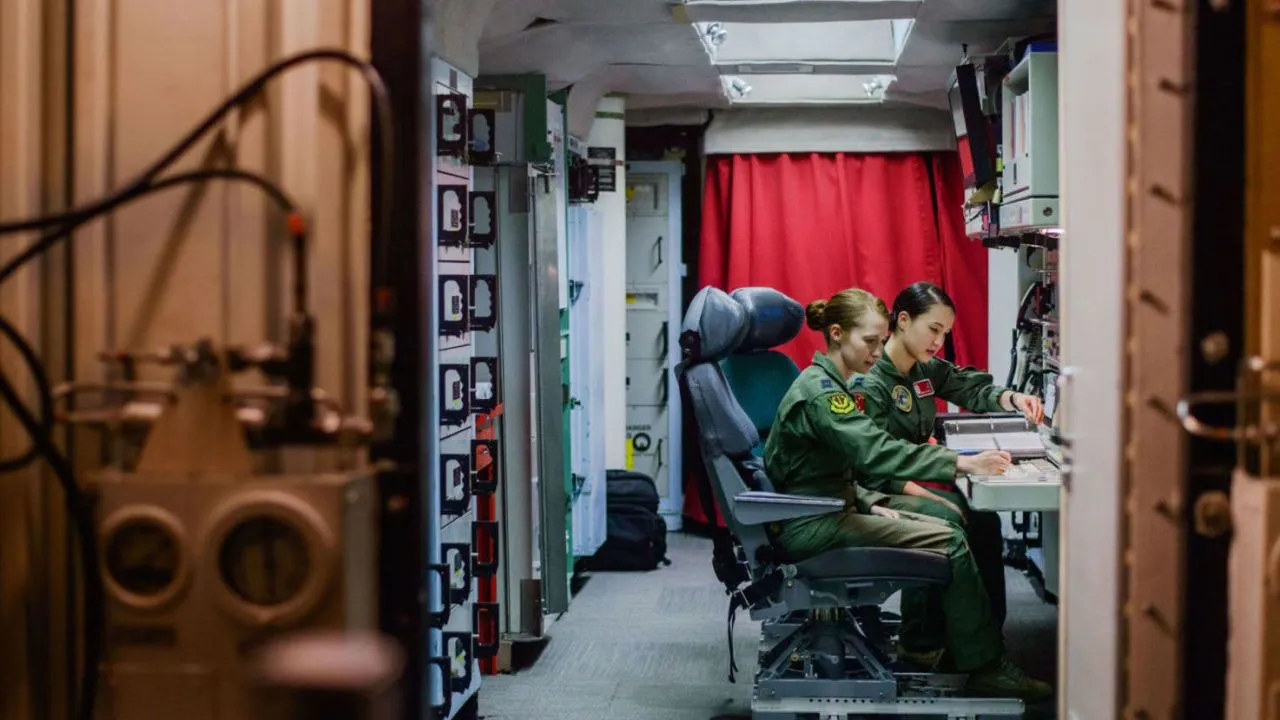
The capsule is the size of a shipping container. At one end is a single bunk sectioned off by a red blackout curtain. At the other is a stall with a toilet and sink, like an airplane bathroom. The air feels that way, too: recycled and somewhat stale.
When you're inside these walls, you're 60- to 80-feet below ground, down a groaning freight elevator and through two blast doors, the second of which weighs eight tons and can only be opened from the inside. You've crossed from a dank antechamber over a small walkway into a completely isolated space, suspended within the Earth's crust so it can survive a near-miss blast.
It's from this capsule (and dozens of others exactly like it, spread across the Western United States) that the Air Force's Nuclear and Missile Operations Officers, more casually known as "missileers," monitor and control our country's collection of 450 nuclear-capable intercontinental ballistic missiles (ICBMs). The officers who do this job work rotating 24-hour shifts, seven days a week, 365 days a year.
The missileers' mission: Ensure that our nuclear weapons are ready to launch on command—a gentle reminder to our adversaries that it would be, to put it mildly, a really bad idea to attack us.
At any given moment, 90 missileers are sitting on alert, or "pulling crew," as it's known in Air Force parlance. Though women are notoriously underrepresented in the U.S. Military, the Air Force is better at gender equality than the other branches—there's a disproportionally high number of women in this role. By March 2016, the Air Force had enough of them to schedule an all-female alert.

It requires a lot of discipline, Captain Marian Dinkha (left) says of the job.
The missileers' mission: Ensure that the world's most consequential weapons are infallible and ready to launch on command—a not-so-gentle reminder to our adversaries that it would be, to put it mildly, a really bad idea to attack the United States.
Air Force troops have been doing this job for generations—since 1970, without interruption—and yet the average American probably thought very little about our nuclear weapons, let alone who controls them, from 1991 until approximately January 20th of this year. (Or perhaps November 9th, 2016.) But the topic of nuclear war leapt much further forward in our collective conscious when, in July, North Korea conducted two tests of its own intercontinental ballistic missile system: one on July 4th (no coincidence there, certainly) and a second three weeks later, which experts say had the potential to reach California. Over Labor Day weekend, the hermit kingdom's state-run media released a photo of Kim Jung-un inspecting what appears to be a nuclear device.
For his part, President Donald Trump said that North Korea's continued threats would be "met with fire and fury, and, frankly, power the likes of which this world has never seen before." The next day, Pyongyang announced plans to volley missiles towards the nearby U.S. territory of Guam.
Should either world leader decide to end this troubling game of chicken with an attack, the missileers will receive the call they train for their entire career. "We defend the United States with combat-ready nuclear forces, and, on order, we'll conduct global strike," says Colonel Cathy Barrington, operations group commander of the 91st Missile Wing at Minot Air Force Base in North Dakota. Barrington took over just three months ago, but began as a missileer herself in 1998. The protocol hasn't changed since then: Copy. Decode. Validate. Authenticate.
You always have it in the back of your mind that maybe tomorrow is the day.
To do so, both missileers—they always work in teams of two, the capsule they occupy emblazoned with the words "no-lone zone"—would open a safe located between their workstations. It's secured with two padlocks, one fastened on by each missileer at the beginning of the shift, the combinations known only to the owner. Inside is a code that the incoming encrypted message must match. But there's an A-side and a B-side and neither missileer knows both; they must be put together like opposite sides of an equation. It's all part of Two-Person Control—a system that ensures a rogue missileer can't start World War III on her own.
"It is a very precise method," Barrington explains. "It's not haphazard. It is exacting. Missileers have to know all kinds of rules. They have to know it cold."

A group of the female missileers at Minot Air Force base before going out on an all-woman alert.
Once the officers determine that they've received a valid order, each member of the pair would have to enter an "enable" code simultaneously. They would then "vote" to launch by turning their launch keys (also stored in the safe) in unison. At least one other capsule in their squadron of five would have to do the exact same thing. Then, as many as 50 ICBMs would blast off into the sky.
Waiting for that call today are Captain Amber Moore and Captain Marian Dinkha. Both are in their late-20s (Moore is 28; Dinkha, 27) and both are from the Midwest (Oklahoma and Illinois, respectively). Neither wanted to be a missileer. Moore was hoping to go to medical school, and Dinkha, whose mother is South Korean and whose father is Iraqi, and who herself speaks English, Japanese, and Aramaic, wanted to be a foreign area officer. Around the time they both commissioned, however, the military was going through a reduction in force, and both women were lucky to be able to move forward with their careers in the Air Force at all.

The Pentagon regularly sends test messages to make sure that, when The Call does come through, the crew can recognize what is a correct order and what is not.
"When I got assigned to missiles, my commander was shocked. I was shocked. I cried a little bit," says Dinkha. "I thought, I studied math and linguistics—what am I going to do with missiles? But then you have to kick your ass into gear." Dinkha recalls how she would listen to her dad, who immigrated when he was 16 and enlisted in the U.S. army, talk about the traveling he did in the military. Missileers, however, are relegated to just three bases out west. "Once you get into higher positions, you can start doing the squirrely stuff—that's what they call it—get assigned to Hawaii maybe, or Europe. I'll still have the opportunity to travel, I'll just be older. Hopefully I'll still be sparkly enough to enjoy it."
Newbie missileers are assigned to eight shifts a month. There are no weekends. There are no holidays. It's easy to see why it's not the most desirable assignment.
When I got assigned to missiles, I was shocked. I cried a little bit.
It is, on the other hand, one of the most honorable: "As an American taxpayer, who do you want out there taking care of our nuclear weapons?" asks Barrington. "You want highly capable people who have the highest level of integrity."
Perhaps it's the tight quarters and the 24-hour shifts, but both women mention the sense of community as something they've come to love about being a missileer. "There's a lot of time to mentor one-on-one, to provide that leadership," Moore says, adding that "not everyone makes it through the training. It's a rigorous course: learning the weapons system itself, the history, all the codes, the emergency war orders. You go through a number of screenings, a number of background checks."

Captain Amber Moore adjusts one of the capsule's myriad communications systems, all of which—with their floppy disks and landlines—are from another era.
The strict elimination process is part of something known as the Personnel Reliability Program (PRP). Encompassing security, medical, and psychological evaluations, PRP is described by Barrington as a way to "ensure that we have the most trustworthy people on alert, and that they can focus on the task at hand."
"You are constantly assessing yourself. If someone dies in the family, or there's a breakup…for some people if their dog dies, that's a PRP down," Dinkha explains of PRP's continued function even after you've gotten the job. "It's up to you to say, 'I cannot pull alert because I am mentally or emotionally unstable right now.' I'm a very private person, so that was definitely a hump for me to get over."
PRP isn't just about telling your commander that you need to take a mental health day. There's a laundry list of restrictions that come with it: Within eight to 12 hours of your shift, you can't drink alcohol or even take a Sudafed—anything that might impair you. You have to fill out a "danger form" if you're planning to go paragliding or shark-diving while on leave. You can't be on PRP if you've been hypnotized even once in your life.
According to a DOD directive, "Only those personnel who have demonstrated the highest degree of individual reliability for allegiance, trustworthiness, conduct, behavior, and responsibility shall be allowed to perform duties associated with nuclear weapons, and they shall be continuously evaluated for adherence to PRP standards." It's all very sensical and comforting until you remember that the order to launch a nuclear missile can only come from the President of the United States, a man who should ostensibly be held to PRP standards...but seemingly is not.
Former director of national intelligence James Clapper recently said that he worries about Trump's access to the nuclear-launch codes.
Regarding allegiance, a special counsel is currently investigating potential collusion between the Trump campaign and the Russian government to influence the 2016 election. Regarding trustworthiness, Trump made a demonstrably false statement at least once a day for his first 40 days in office (a running tally of all his lies since the inauguration can be found on the New York Times' website). Regarding conduct, behavior, and responsibility, we'll let his Twitter feed speak for itself. Former director of national intelligence James Clapper even recently said that he worries about Trump's access to the nuclear-launch codes: "There's very little in the way of controls over exercising a nuclear option, which is pretty damn scary."

The missile facilities, which take up 12% of North Dakota, are surrounded by farm land.
When asked about the current president's temperament, the missileers are predictably tight-lipped. Colonel Barrington does offer this bit of peace of mind, perhaps surprisingly by way of the 2013 thriller White House Down starring Channing Tatum and Jamie Foxx: "That idea's not at all accurate. You have a president who opens up his box and he's [she mimes someone typing] sending out the messages, he's launched…that's not how it works at all."
Older missileers thought for sure during the Cold War that they would get the order to launch, but it never came," says Dinkha. And she's right: America hasn't used a nuke since 1945. So what exactly goes on down in those capsules?
"Our mission every day is to provide deterrence," offers Moore. "Every day we try to make our enemies ask themselves the question, Does the benefit of attacking the U.S. outweigh the cost? Because they know that we're always prepared to fire back." Readiness is imperative. A missileer's day-to-day is a lot of maintenance, a lot of making sure each ICBM is in tip-top shape, able to sail over the arctic circle instantaneously.

Their technical orders are an approximately 1,000-page manual that they have to become proficient in by the end of their six-month training.
Barrington likens our missiles to a car in idle mode. But the analogy actually goes a bit further: It's like the U.S. government left a car in a lot (okay, an underground lot) with the keys in the ignition and the engine running...and these officers are trying to keep tabs on it remotely…and, actually, they're dealing with quite a few cars.
Each missile is three nautical miles from a capsule, and each team of two missileers is responsible for 10. The missiles are also buried below ground, surrounded by fields of sunflowers and flax—by cattle farms, oil rigs, and wind turbines. Fifteen-hundred miles of cabling connects the missileers to their missiles, though they can also communicate with the machines via satellite or low-frequency waves—myriad redundancies are in place in case of emergency or catastrophe or, hell, just a North Dakotan winter storm. Constantly these troopers ping their weapons, gathering status updates: Are they overheating? Too cold? Low on fuel? Did the power go out? Is there a security breach near the missile silo? When an issue arises, they fix it immediately or dispatch another airman to do so.
Missileers have to know all kinds of rules. They have to know it cold.
"There are definitely those shifts that make up for all the quiet ones you've ever had," laments Dinkha. "Where you just stay up for 30 hours because everything that could go wrong does go wrong." (Both women say the longest they've pulled crew is 48 hours, though they know missileers who have worked a 72. Sometimes the snow is just too heavy and the roads too treacherous to get another crew out to the capsule.)

As a new missileer you're scheduled with the same partner every alert, and you 'form a very strong bond with them,' says Moore (right).
They're doing all of this, by the way, on a computer that looks like it should be part of a history exhibit at the National Air and Space Museum. Aside from a few "programs to refurbish and rebuild," the equipment is the same as it was in the 1970s—the missileers code their commands using 0s and 1s. At first it seems like another example of the government being behind the times, but then you remember Sony and the DNC and you realize, Maybe updating the systems would actually be more dangerous than doing things the old-fashioned way. "You can't just stick laptops down there and say, 'Now you are going to get messages via email,'" Barrington says.
I know I won't be away for six months or a year. You know you'll be gone for 24-hour periods, but then you get to come back home.
Being cut off from modern tech can make slow days in the capsule feel even slower. "At first you're both awake and you're going over your inspections, and it gives you time to get to know that person, because you may not really ever talk to that person and then you are expected to go hang out in close quarters for 24 hours," says Moore, adding that later they break the day into shifts. Whoever's on the night shift naps early, then takes the console around 10 p.m. while the other sleeps until about 5:30 in the morning. That's a lot of time to fill and—thanks to the moratorium on wifi-capable electronics—you can't exactly spend it scrolling Instagram.
"I got my master's in education done while I was down there," Moore says. "Once I retire from the Air Force, I plan to teach 5th or 6th grade science." She used to bring art supplies down and paint (watercolors only—you don't want to be that person using oils in a confined space). Ditto for riding the exercise bike that's stashed in a corner, especially since there isn't a shower. "I do a lot of push-ups and sit-ups," she adds, noting that "they're not gonna get you extremely sweaty if you do them in small doses."

Clockwise from left: MAF support staff play ping pong in their off time; A cook is on staff to prepare meals; The MAF is heavily guarded by security forces who work three-day shifts.
She taught herself to crochet during quiet alerts, as well, and is currently working on a camo-patterned blanket for her husband, who is in the Army reserves. They have a baby boy, Jacob, who's six months old. The job is a bit different now that she's a mom: "Sometimes during the night, I'm like, 'Ah, I wish I was home cuddling my baby instead of sitting here,'" Moore says. But from the perspective of a parent, the role has at least one major perk: Missileers are not deployable. "It's comforting. I know I won't be away for six months or a year. You know you'll be gone for 24-hour periods, but then you get to come back home."
When hunger strikes, missileers can order food from a cook stationed at the missile alert facility (MAF) directly above them. But the menu is mostly sports-bar fare, and many airmen choose to pack their own meals instead. Dinkha says she's trying to eat better, but "it's a struggle." There's a joke among the missileers about gaining the "Minot 15." There is also a joke that, because many officers tote sleeping bags and pajamas with them, their enemies will suffer "death by bunny slippers."
Death—inflicting it, anyway—isn't something the missileers seem to think about much. Neither woman has a moral objection to using nuclear weapons (if she did, she'd have been assigned to a different career field). During their training at Vandenberg Air Force Base near Santa Barbara, California, all potential missileers are grilled about their capacity to "key-turn on command." "If it were to happen, we would do it because that's what expected of us," says Dinkha. "I don't really see a difference between boots on the ground, guy with a gun in his hand, expected to shoot someone if the need arises, and me with my ICBM."

Moore, here with her six-month-old son Jacob, boards horses on-base and rides in her off-duty time.
The difference, of course, is the scope of damage that could be levied. According to Barrington, each ICBM is 60 feet tall, weighs 79,000 pounds, and has a range of 8,000 miles. The missiles travel at 15,000 miles per hour—seven times faster than a speeding bullet. That means if you were to fly on one from New York to L.A., you'd get there in under 10 minutes. And, perhaps most importantly, each can be outfitted with a nuclear warhead. (The official Air Force line is that the missiles are "nuclear-capable," hence the "can be," but with readiness and rapidity as their objective it seems safe to assume that the missiles' rocket-like bodies are mated to nukes.) The bombs dropped over Japan during World War II released roughly the same amount of energy as 20,000 tons of TNT and killed more than 100,000 people in the process. Today's weapons are far more powerful.
I don't really see a difference between boots on the ground, guy with a gun in his hand, and me with my ICBM.
But the missileers are more defense than offense, Moore and Dinkha insist. Their mere presence keeps enemies at bay. "It's almost a silent peace," says Dinkha. "The reason we haven't had any attacks by weapons of mass destruction is because of the deterrence we provide. I think it would just be different if we didn't have them."
Even the recent heightened tensions between Donald Trump and Kim Jong-un don't rattle them. "You always have it in the back of your mind that maybe tomorrow is the day," says Moore. "But North Korea testing more missiles doesn't really affect how I do my job."

From left: Dinkha opens the eight-ton blast door that seals off the capsule; The REACT console, the missileers' computer system, is largely the same as it was in 1970.
"We watch the news. I think it gives an added motivation and it helps underline, yup, this is why my job is still relevant," says Barrington. Because the Soviet Union, the Cold War—that all ended decades ago. And pilots are what people envision when they think of the Air Force. Fighter jets. Aviator sunglasses. Not two women quietly toiling away in an unglamorous underground bunker. "It's okay that nobody thinks about us on a regular basis—it means what we're doing is working," she says. "Let everybody else get the glory."
With any luck, that's exactly how it stays.
The capsule is the size of a shipping container. At one end is a single bunk sectioned off by a red blackout curtain. At the other is a stall with a toilet and sink, like an airplane bathroom. The air feels that way, too: recycled and somewhat stale.
When you're inside these walls, you're 60- to 80-feet below ground, down a groaning freight elevator and through two blast doors, the second of which weighs eight tons and can only be opened from the inside. You've crossed from a dank antechamber over a small walkway into a completely isolated space, suspended within the Earth's crust so it can survive a near-miss blast.
It's from this capsule (and dozens of others exactly like it, spread across the Western United States) that the Air Force's Nuclear and Missile Operations Officers, more casually known as "missileers," monitor and control our country's collection of 450 nuclear-capable intercontinental ballistic missiles (ICBMs). The officers who do this job work rotating 24-hour shifts, seven days a week, 365 days a year.
The missileers' mission: Ensure that our nuclear weapons are ready to launch on command—a gentle reminder to our adversaries that it would be, to put it mildly, a really bad idea to attack us.
At any given moment, 90 missileers are sitting on alert, or "pulling crew," as it's known in Air Force parlance. Though women are notoriously underrepresented in the U.S. Military, the Air Force is better at gender equality than the other branches—there's a disproportionally high number of women in this role. By March 2016, the Air Force had enough of them to schedule an all-female alert.
It requires a lot of discipline, Captain Marian Dinkha (left) says of the job.
The missileers' mission: Ensure that the world's most consequential weapons are infallible and ready to launch on command—a not-so-gentle reminder to our adversaries that it would be, to put it mildly, a really bad idea to attack the United States.
Air Force troops have been doing this job for generations—since 1970, without interruption—and yet the average American probably thought very little about our nuclear weapons, let alone who controls them, from 1991 until approximately January 20th of this year. (Or perhaps November 9th, 2016.) But the topic of nuclear war leapt much further forward in our collective conscious when, in July, North Korea conducted two tests of its own intercontinental ballistic missile system: one on July 4th (no coincidence there, certainly) and a second three weeks later, which experts say had the potential to reach California. Over Labor Day weekend, the hermit kingdom's state-run media released a photo of Kim Jung-un inspecting what appears to be a nuclear device.
For his part, President Donald Trump said that North Korea's continued threats would be "met with fire and fury, and, frankly, power the likes of which this world has never seen before." The next day, Pyongyang announced plans to volley missiles towards the nearby U.S. territory of Guam.
Should either world leader decide to end this troubling game of chicken with an attack, the missileers will receive the call they train for their entire career. "We defend the United States with combat-ready nuclear forces, and, on order, we'll conduct global strike," says Colonel Cathy Barrington, operations group commander of the 91st Missile Wing at Minot Air Force Base in North Dakota. Barrington took over just three months ago, but began as a missileer herself in 1998. The protocol hasn't changed since then: Copy. Decode. Validate. Authenticate.
You always have it in the back of your mind that maybe tomorrow is the day.
To do so, both missileers—they always work in teams of two, the capsule they occupy emblazoned with the words "no-lone zone"—would open a safe located between their workstations. It's secured with two padlocks, one fastened on by each missileer at the beginning of the shift, the combinations known only to the owner. Inside is a code that the incoming encrypted message must match. But there's an A-side and a B-side and neither missileer knows both; they must be put together like opposite sides of an equation. It's all part of Two-Person Control—a system that ensures a rogue missileer can't start World War III on her own.
"It is a very precise method," Barrington explains. "It's not haphazard. It is exacting. Missileers have to know all kinds of rules. They have to know it cold."
A group of the female missileers at Minot Air Force base before going out on an all-woman alert.
Once the officers determine that they've received a valid order, each member of the pair would have to enter an "enable" code simultaneously. They would then "vote" to launch by turning their launch keys (also stored in the safe) in unison. At least one other capsule in their squadron of five would have to do the exact same thing. Then, as many as 50 ICBMs would blast off into the sky.
Waiting for that call today are Captain Amber Moore and Captain Marian Dinkha. Both are in their late-20s (Moore is 28; Dinkha, 27) and both are from the Midwest (Oklahoma and Illinois, respectively). Neither wanted to be a missileer. Moore was hoping to go to medical school, and Dinkha, whose mother is South Korean and whose father is Iraqi, and who herself speaks English, Japanese, and Aramaic, wanted to be a foreign area officer. Around the time they both commissioned, however, the military was going through a reduction in force, and both women were lucky to be able to move forward with their careers in the Air Force at all.
The Pentagon regularly sends test messages to make sure that, when The Call does come through, the crew can recognize what is a correct order and what is not.
"When I got assigned to missiles, my commander was shocked. I was shocked. I cried a little bit," says Dinkha. "I thought, I studied math and linguistics—what am I going to do with missiles? But then you have to kick your ass into gear." Dinkha recalls how she would listen to her dad, who immigrated when he was 16 and enlisted in the U.S. army, talk about the traveling he did in the military. Missileers, however, are relegated to just three bases out west. "Once you get into higher positions, you can start doing the squirrely stuff—that's what they call it—get assigned to Hawaii maybe, or Europe. I'll still have the opportunity to travel, I'll just be older. Hopefully I'll still be sparkly enough to enjoy it."
Newbie missileers are assigned to eight shifts a month. There are no weekends. There are no holidays. It's easy to see why it's not the most desirable assignment.
When I got assigned to missiles, I was shocked. I cried a little bit.
It is, on the other hand, one of the most honorable: "As an American taxpayer, who do you want out there taking care of our nuclear weapons?" asks Barrington. "You want highly capable people who have the highest level of integrity."
Perhaps it's the tight quarters and the 24-hour shifts, but both women mention the sense of community as something they've come to love about being a missileer. "There's a lot of time to mentor one-on-one, to provide that leadership," Moore says, adding that "not everyone makes it through the training. It's a rigorous course: learning the weapons system itself, the history, all the codes, the emergency war orders. You go through a number of screenings, a number of background checks."
Captain Amber Moore adjusts one of the capsule's myriad communications systems, all of which—with their floppy disks and landlines—are from another era.
The strict elimination process is part of something known as the Personnel Reliability Program (PRP). Encompassing security, medical, and psychological evaluations, PRP is described by Barrington as a way to "ensure that we have the most trustworthy people on alert, and that they can focus on the task at hand."
"You are constantly assessing yourself. If someone dies in the family, or there's a breakup…for some people if their dog dies, that's a PRP down," Dinkha explains of PRP's continued function even after you've gotten the job. "It's up to you to say, 'I cannot pull alert because I am mentally or emotionally unstable right now.' I'm a very private person, so that was definitely a hump for me to get over."
PRP isn't just about telling your commander that you need to take a mental health day. There's a laundry list of restrictions that come with it: Within eight to 12 hours of your shift, you can't drink alcohol or even take a Sudafed—anything that might impair you. You have to fill out a "danger form" if you're planning to go paragliding or shark-diving while on leave. You can't be on PRP if you've been hypnotized even once in your life.
According to a DOD directive, "Only those personnel who have demonstrated the highest degree of individual reliability for allegiance, trustworthiness, conduct, behavior, and responsibility shall be allowed to perform duties associated with nuclear weapons, and they shall be continuously evaluated for adherence to PRP standards." It's all very sensical and comforting until you remember that the order to launch a nuclear missile can only come from the President of the United States, a man who should ostensibly be held to PRP standards...but seemingly is not.
Former director of national intelligence James Clapper recently said that he worries about Trump's access to the nuclear-launch codes.
Regarding allegiance, a special counsel is currently investigating potential collusion between the Trump campaign and the Russian government to influence the 2016 election. Regarding trustworthiness, Trump made a demonstrably false statement at least once a day for his first 40 days in office (a running tally of all his lies since the inauguration can be found on the New York Times' website). Regarding conduct, behavior, and responsibility, we'll let his Twitter feed speak for itself. Former director of national intelligence James Clapper even recently said that he worries about Trump's access to the nuclear-launch codes: "There's very little in the way of controls over exercising a nuclear option, which is pretty damn scary."
The missile facilities, which take up 12% of North Dakota, are surrounded by farm land.
When asked about the current president's temperament, the missileers are predictably tight-lipped. Colonel Barrington does offer this bit of peace of mind, perhaps surprisingly by way of the 2013 thriller White House Down starring Channing Tatum and Jamie Foxx: "That idea's not at all accurate. You have a president who opens up his box and he's [she mimes someone typing] sending out the messages, he's launched…that's not how it works at all."
Older missileers thought for sure during the Cold War that they would get the order to launch, but it never came," says Dinkha. And she's right: America hasn't used a nuke since 1945. So what exactly goes on down in those capsules?
"Our mission every day is to provide deterrence," offers Moore. "Every day we try to make our enemies ask themselves the question, Does the benefit of attacking the U.S. outweigh the cost? Because they know that we're always prepared to fire back." Readiness is imperative. A missileer's day-to-day is a lot of maintenance, a lot of making sure each ICBM is in tip-top shape, able to sail over the arctic circle instantaneously.
Their technical orders are an approximately 1,000-page manual that they have to become proficient in by the end of their six-month training.
Barrington likens our missiles to a car in idle mode. But the analogy actually goes a bit further: It's like the U.S. government left a car in a lot (okay, an underground lot) with the keys in the ignition and the engine running...and these officers are trying to keep tabs on it remotely…and, actually, they're dealing with quite a few cars.
Each missile is three nautical miles from a capsule, and each team of two missileers is responsible for 10. The missiles are also buried below ground, surrounded by fields of sunflowers and flax—by cattle farms, oil rigs, and wind turbines. Fifteen-hundred miles of cabling connects the missileers to their missiles, though they can also communicate with the machines via satellite or low-frequency waves—myriad redundancies are in place in case of emergency or catastrophe or, hell, just a North Dakotan winter storm. Constantly these troopers ping their weapons, gathering status updates: Are they overheating? Too cold? Low on fuel? Did the power go out? Is there a security breach near the missile silo? When an issue arises, they fix it immediately or dispatch another airman to do so.
Missileers have to know all kinds of rules. They have to know it cold.
"There are definitely those shifts that make up for all the quiet ones you've ever had," laments Dinkha. "Where you just stay up for 30 hours because everything that could go wrong does go wrong." (Both women say the longest they've pulled crew is 48 hours, though they know missileers who have worked a 72. Sometimes the snow is just too heavy and the roads too treacherous to get another crew out to the capsule.)
As a new missileer you're scheduled with the same partner every alert, and you 'form a very strong bond with them,' says Moore (right).
They're doing all of this, by the way, on a computer that looks like it should be part of a history exhibit at the National Air and Space Museum. Aside from a few "programs to refurbish and rebuild," the equipment is the same as it was in the 1970s—the missileers code their commands using 0s and 1s. At first it seems like another example of the government being behind the times, but then you remember Sony and the DNC and you realize, Maybe updating the systems would actually be more dangerous than doing things the old-fashioned way. "You can't just stick laptops down there and say, 'Now you are going to get messages via email,'" Barrington says.
I know I won't be away for six months or a year. You know you'll be gone for 24-hour periods, but then you get to come back home.
Being cut off from modern tech can make slow days in the capsule feel even slower. "At first you're both awake and you're going over your inspections, and it gives you time to get to know that person, because you may not really ever talk to that person and then you are expected to go hang out in close quarters for 24 hours," says Moore, adding that later they break the day into shifts. Whoever's on the night shift naps early, then takes the console around 10 p.m. while the other sleeps until about 5:30 in the morning. That's a lot of time to fill and—thanks to the moratorium on wifi-capable electronics—you can't exactly spend it scrolling Instagram.
"I got my master's in education done while I was down there," Moore says. "Once I retire from the Air Force, I plan to teach 5th or 6th grade science." She used to bring art supplies down and paint (watercolors only—you don't want to be that person using oils in a confined space). Ditto for riding the exercise bike that's stashed in a corner, especially since there isn't a shower. "I do a lot of push-ups and sit-ups," she adds, noting that "they're not gonna get you extremely sweaty if you do them in small doses."
Clockwise from left: MAF support staff play ping pong in their off time; A cook is on staff to prepare meals; The MAF is heavily guarded by security forces who work three-day shifts.
She taught herself to crochet during quiet alerts, as well, and is currently working on a camo-patterned blanket for her husband, who is in the Army reserves. They have a baby boy, Jacob, who's six months old. The job is a bit different now that she's a mom: "Sometimes during the night, I'm like, 'Ah, I wish I was home cuddling my baby instead of sitting here,'" Moore says. But from the perspective of a parent, the role has at least one major perk: Missileers are not deployable. "It's comforting. I know I won't be away for six months or a year. You know you'll be gone for 24-hour periods, but then you get to come back home."
When hunger strikes, missileers can order food from a cook stationed at the missile alert facility (MAF) directly above them. But the menu is mostly sports-bar fare, and many airmen choose to pack their own meals instead. Dinkha says she's trying to eat better, but "it's a struggle." There's a joke among the missileers about gaining the "Minot 15." There is also a joke that, because many officers tote sleeping bags and pajamas with them, their enemies will suffer "death by bunny slippers."
Death—inflicting it, anyway—isn't something the missileers seem to think about much. Neither woman has a moral objection to using nuclear weapons (if she did, she'd have been assigned to a different career field). During their training at Vandenberg Air Force Base near Santa Barbara, California, all potential missileers are grilled about their capacity to "key-turn on command." "If it were to happen, we would do it because that's what expected of us," says Dinkha. "I don't really see a difference between boots on the ground, guy with a gun in his hand, expected to shoot someone if the need arises, and me with my ICBM."
Moore, here with her six-month-old son Jacob, boards horses on-base and rides in her off-duty time.
The difference, of course, is the scope of damage that could be levied. According to Barrington, each ICBM is 60 feet tall, weighs 79,000 pounds, and has a range of 8,000 miles. The missiles travel at 15,000 miles per hour—seven times faster than a speeding bullet. That means if you were to fly on one from New York to L.A., you'd get there in under 10 minutes. And, perhaps most importantly, each can be outfitted with a nuclear warhead. (The official Air Force line is that the missiles are "nuclear-capable," hence the "can be," but with readiness and rapidity as their objective it seems safe to assume that the missiles' rocket-like bodies are mated to nukes.) The bombs dropped over Japan during World War II released roughly the same amount of energy as 20,000 tons of TNT and killed more than 100,000 people in the process. Today's weapons are far more powerful.
I don't really see a difference between boots on the ground, guy with a gun in his hand, and me with my ICBM.
But the missileers are more defense than offense, Moore and Dinkha insist. Their mere presence keeps enemies at bay. "It's almost a silent peace," says Dinkha. "The reason we haven't had any attacks by weapons of mass destruction is because of the deterrence we provide. I think it would just be different if we didn't have them."
Even the recent heightened tensions between Donald Trump and Kim Jong-un don't rattle them. "You always have it in the back of your mind that maybe tomorrow is the day," says Moore. "But North Korea testing more missiles doesn't really affect how I do my job."
From left: Dinkha opens the eight-ton blast door that seals off the capsule; The REACT console, the missileers' computer system, is largely the same as it was in 1970.
"We watch the news. I think it gives an added motivation and it helps underline, yup, this is why my job is still relevant," says Barrington. Because the Soviet Union, the Cold War—that all ended decades ago. And pilots are what people envision when they think of the Air Force. Fighter jets. Aviator sunglasses. Not two women quietly toiling away in an unglamorous underground bunker. "It's okay that nobody thinks about us on a regular basis—it means what we're doing is working," she says. "Let everybody else get the glory."
With any luck, that's exactly how it stays.
The capsule is the size of a shipping container. At one end is a single bunk sectioned off by a red blackout curtain. At the other is a stall with a toilet and sink, like an airplane bathroom. The air feels that way, too: recycled and somewhat stale.
When you're inside these walls, you're 60- to 80-feet below ground, down a groaning freight elevator and through two blast doors, the second of which weighs eight tons and can only be opened from the inside. You've crossed from a dank antechamber over a small walkway into a completely isolated space, suspended within the Earth's crust so it can survive a near-miss blast.
It's from this capsule (and dozens of others exactly like it, spread across the Western United States) that the Air Force's Nuclear and Missile Operations Officers, more casually known as "missileers," monitor and control our country's collection of 450 nuclear-capable intercontinental ballistic missiles (ICBMs). The officers who do this job work rotating 24-hour shifts, seven days a week, 365 days a year.
The missileers' mission: Ensure that our nuclear weapons are ready to launch on command—a gentle reminder to our adversaries that it would be, to put it mildly, a really bad idea to attack us.
At any given moment, 90 missileers are sitting on alert, or "pulling crew," as it's known in Air Force parlance. Though women are notoriously underrepresented in the U.S. Military, the Air Force is better at gender equality than the other branches—there's a disproportionally high number of women in this role. By March 2016, the Air Force had enough of them to schedule an all-female alert.
It requires a lot of discipline, Captain Marian Dinkha (left) says of the job.
The missileers' mission: Ensure that the world's most consequential weapons are infallible and ready to launch on command—a not-so-gentle reminder to our adversaries that it would be, to put it mildly, a really bad idea to attack the United States.
Air Force troops have been doing this job for generations—since 1970, without interruption—and yet the average American probably thought very little about our nuclear weapons, let alone who controls them, from 1991 until approximately January 20th of this year. (Or perhaps November 9th, 2016.) But the topic of nuclear war leapt much further forward in our collective conscious when, in July, North Korea conducted two tests of its own intercontinental ballistic missile system: one on July 4th (no coincidence there, certainly) and a second three weeks later, which experts say had the potential to reach California. Over Labor Day weekend, the hermit kingdom's state-run media released a photo of Kim Jung-un inspecting what appears to be a nuclear device.
For his part, President Donald Trump said that North Korea's continued threats would be "met with fire and fury, and, frankly, power the likes of which this world has never seen before." The next day, Pyongyang announced plans to volley missiles towards the nearby U.S. territory of Guam.
Should either world leader decide to end this troubling game of chicken with an attack, the missileers will receive the call they train for their entire career. "We defend the United States with combat-ready nuclear forces, and, on order, we'll conduct global strike," says Colonel Cathy Barrington, operations group commander of the 91st Missile Wing at Minot Air Force Base in North Dakota. Barrington took over just three months ago, but began as a missileer herself in 1998. The protocol hasn't changed since then: Copy. Decode. Validate. Authenticate.
You always have it in the back of your mind that maybe tomorrow is the day.
To do so, both missileers—they always work in teams of two, the capsule they occupy emblazoned with the words "no-lone zone"—would open a safe located between their workstations. It's secured with two padlocks, one fastened on by each missileer at the beginning of the shift, the combinations known only to the owner. Inside is a code that the incoming encrypted message must match. But there's an A-side and a B-side and neither missileer knows both; they must be put together like opposite sides of an equation. It's all part of Two-Person Control—a system that ensures a rogue missileer can't start World War III on her own.
"It is a very precise method," Barrington explains. "It's not haphazard. It is exacting. Missileers have to know all kinds of rules. They have to know it cold."
A group of the female missileers at Minot Air Force base before going out on an all-woman alert.
Once the officers determine that they've received a valid order, each member of the pair would have to enter an "enable" code simultaneously. They would then "vote" to launch by turning their launch keys (also stored in the safe) in unison. At least one other capsule in their squadron of five would have to do the exact same thing. Then, as many as 50 ICBMs would blast off into the sky.
Waiting for that call today are Captain Amber Moore and Captain Marian Dinkha. Both are in their late-20s (Moore is 28; Dinkha, 27) and both are from the Midwest (Oklahoma and Illinois, respectively). Neither wanted to be a missileer. Moore was hoping to go to medical school, and Dinkha, whose mother is South Korean and whose father is Iraqi, and who herself speaks English, Japanese, and Aramaic, wanted to be a foreign area officer. Around the time they both commissioned, however, the military was going through a reduction in force, and both women were lucky to be able to move forward with their careers in the Air Force at all.
The Pentagon regularly sends test messages to make sure that, when The Call does come through, the crew can recognize what is a correct order and what is not.
"When I got assigned to missiles, my commander was shocked. I was shocked. I cried a little bit," says Dinkha. "I thought, I studied math and linguistics—what am I going to do with missiles? But then you have to kick your ass into gear." Dinkha recalls how she would listen to her dad, who immigrated when he was 16 and enlisted in the U.S. army, talk about the traveling he did in the military. Missileers, however, are relegated to just three bases out west. "Once you get into higher positions, you can start doing the squirrely stuff—that's what they call it—get assigned to Hawaii maybe, or Europe. I'll still have the opportunity to travel, I'll just be older. Hopefully I'll still be sparkly enough to enjoy it."
Newbie missileers are assigned to eight shifts a month. There are no weekends. There are no holidays. It's easy to see why it's not the most desirable assignment.
When I got assigned to missiles, I was shocked. I cried a little bit.
It is, on the other hand, one of the most honorable: "As an American taxpayer, who do you want out there taking care of our nuclear weapons?" asks Barrington. "You want highly capable people who have the highest level of integrity."
Perhaps it's the tight quarters and the 24-hour shifts, but both women mention the sense of community as something they've come to love about being a missileer. "There's a lot of time to mentor one-on-one, to provide that leadership," Moore says, adding that "not everyone makes it through the training. It's a rigorous course: learning the weapons system itself, the history, all the codes, the emergency war orders. You go through a number of screenings, a number of background checks."
Captain Amber Moore adjusts one of the capsule's myriad communications systems, all of which—with their floppy disks and landlines—are from another era.
The strict elimination process is part of something known as the Personnel Reliability Program (PRP). Encompassing security, medical, and psychological evaluations, PRP is described by Barrington as a way to "ensure that we have the most trustworthy people on alert, and that they can focus on the task at hand."
"You are constantly assessing yourself. If someone dies in the family, or there's a breakup…for some people if their dog dies, that's a PRP down," Dinkha explains of PRP's continued function even after you've gotten the job. "It's up to you to say, 'I cannot pull alert because I am mentally or emotionally unstable right now.' I'm a very private person, so that was definitely a hump for me to get over."
PRP isn't just about telling your commander that you need to take a mental health day. There's a laundry list of restrictions that come with it: Within eight to 12 hours of your shift, you can't drink alcohol or even take a Sudafed—anything that might impair you. You have to fill out a "danger form" if you're planning to go paragliding or shark-diving while on leave. You can't be on PRP if you've been hypnotized even once in your life.
According to a DOD directive, "Only those personnel who have demonstrated the highest degree of individual reliability for allegiance, trustworthiness, conduct, behavior, and responsibility shall be allowed to perform duties associated with nuclear weapons, and they shall be continuously evaluated for adherence to PRP standards." It's all very sensical and comforting until you remember that the order to launch a nuclear missile can only come from the President of the United States, a man who should ostensibly be held to PRP standards...but seemingly is not.
Former director of national intelligence James Clapper recently said that he worries about Trump's access to the nuclear-launch codes.
Regarding allegiance, a special counsel is currently investigating potential collusion between the Trump campaign and the Russian government to influence the 2016 election. Regarding trustworthiness, Trump made a demonstrably false statement at least once a day for his first 40 days in office (a running tally of all his lies since the inauguration can be found on the New York Times' website). Regarding conduct, behavior, and responsibility, we'll let his Twitter feed speak for itself. Former director of national intelligence James Clapper even recently said that he worries about Trump's access to the nuclear-launch codes: "There's very little in the way of controls over exercising a nuclear option, which is pretty damn scary."
The missile facilities, which take up 12% of North Dakota, are surrounded by farm land.
When asked about the current president's temperament, the missileers are predictably tight-lipped. Colonel Barrington does offer this bit of peace of mind, perhaps surprisingly by way of the 2013 thriller White House Down starring Channing Tatum and Jamie Foxx: "That idea's not at all accurate. You have a president who opens up his box and he's [she mimes someone typing] sending out the messages, he's launched…that's not how it works at all."
Older missileers thought for sure during the Cold War that they would get the order to launch, but it never came," says Dinkha. And she's right: America hasn't used a nuke since 1945. So what exactly goes on down in those capsules?
"Our mission every day is to provide deterrence," offers Moore. "Every day we try to make our enemies ask themselves the question, Does the benefit of attacking the U.S. outweigh the cost? Because they know that we're always prepared to fire back." Readiness is imperative. A missileer's day-to-day is a lot of maintenance, a lot of making sure each ICBM is in tip-top shape, able to sail over the arctic circle instantaneously.
Their technical orders are an approximately 1,000-page manual that they have to become proficient in by the end of their six-month training.
Barrington likens our missiles to a car in idle mode. But the analogy actually goes a bit further: It's like the U.S. government left a car in a lot (okay, an underground lot) with the keys in the ignition and the engine running...and these officers are trying to keep tabs on it remotely…and, actually, they're dealing with quite a few cars.
Each missile is three nautical miles from a capsule, and each team of two missileers is responsible for 10. The missiles are also buried below ground, surrounded by fields of sunflowers and flax—by cattle farms, oil rigs, and wind turbines. Fifteen-hundred miles of cabling connects the missileers to their missiles, though they can also communicate with the machines via satellite or low-frequency waves—myriad redundancies are in place in case of emergency or catastrophe or, hell, just a North Dakotan winter storm. Constantly these troopers ping their weapons, gathering status updates: Are they overheating? Too cold? Low on fuel? Did the power go out? Is there a security breach near the missile silo? When an issue arises, they fix it immediately or dispatch another airman to do so.
Missileers have to know all kinds of rules. They have to know it cold.
"There are definitely those shifts that make up for all the quiet ones you've ever had," laments Dinkha. "Where you just stay up for 30 hours because everything that could go wrong does go wrong." (Both women say the longest they've pulled crew is 48 hours, though they know missileers who have worked a 72. Sometimes the snow is just too heavy and the roads too treacherous to get another crew out to the capsule.)
As a new missileer you're scheduled with the same partner every alert, and you 'form a very strong bond with them,' says Moore (right).
They're doing all of this, by the way, on a computer that looks like it should be part of a history exhibit at the National Air and Space Museum. Aside from a few "programs to refurbish and rebuild," the equipment is the same as it was in the 1970s—the missileers code their commands using 0s and 1s. At first it seems like another example of the government being behind the times, but then you remember Sony and the DNC and you realize, Maybe updating the systems would actually be more dangerous than doing things the old-fashioned way. "You can't just stick laptops down there and say, 'Now you are going to get messages via email,'" Barrington says.
I know I won't be away for six months or a year. You know you'll be gone for 24-hour periods, but then you get to come back home.
Being cut off from modern tech can make slow days in the capsule feel even slower. "At first you're both awake and you're going over your inspections, and it gives you time to get to know that person, because you may not really ever talk to that person and then you are expected to go hang out in close quarters for 24 hours," says Moore, adding that later they break the day into shifts. Whoever's on the night shift naps early, then takes the console around 10 p.m. while the other sleeps until about 5:30 in the morning. That's a lot of time to fill and—thanks to the moratorium on wifi-capable electronics—you can't exactly spend it scrolling Instagram.
"I got my master's in education done while I was down there," Moore says. "Once I retire from the Air Force, I plan to teach 5th or 6th grade science." She used to bring art supplies down and paint (watercolors only—you don't want to be that person using oils in a confined space). Ditto for riding the exercise bike that's stashed in a corner, especially since there isn't a shower. "I do a lot of push-ups and sit-ups," she adds, noting that "they're not gonna get you extremely sweaty if you do them in small doses."
Clockwise from left: MAF support staff play ping pong in their off time; A cook is on staff to prepare meals; The MAF is heavily guarded by security forces who work three-day shifts.
She taught herself to crochet during quiet alerts, as well, and is currently working on a camo-patterned blanket for her husband, who is in the Army reserves. They have a baby boy, Jacob, who's six months old. The job is a bit different now that she's a mom: "Sometimes during the night, I'm like, 'Ah, I wish I was home cuddling my baby instead of sitting here,'" Moore says. But from the perspective of a parent, the role has at least one major perk: Missileers are not deployable. "It's comforting. I know I won't be away for six months or a year. You know you'll be gone for 24-hour periods, but then you get to come back home."
When hunger strikes, missileers can order food from a cook stationed at the missile alert facility (MAF) directly above them. But the menu is mostly sports-bar fare, and many airmen choose to pack their own meals instead. Dinkha says she's trying to eat better, but "it's a struggle." There's a joke among the missileers about gaining the "Minot 15." There is also a joke that, because many officers tote sleeping bags and pajamas with them, their enemies will suffer "death by bunny slippers."
Death—inflicting it, anyway—isn't something the missileers seem to think about much. Neither woman has a moral objection to using nuclear weapons (if she did, she'd have been assigned to a different career field). During their training at Vandenberg Air Force Base near Santa Barbara, California, all potential missileers are grilled about their capacity to "key-turn on command." "If it were to happen, we would do it because that's what expected of us," says Dinkha. "I don't really see a difference between boots on the ground, guy with a gun in his hand, expected to shoot someone if the need arises, and me with my ICBM."
Moore, here with her six-month-old son Jacob, boards horses on-base and rides in her off-duty time.
The difference, of course, is the scope of damage that could be levied. According to Barrington, each ICBM is 60 feet tall, weighs 79,000 pounds, and has a range of 8,000 miles. The missiles travel at 15,000 miles per hour—seven times faster than a speeding bullet. That means if you were to fly on one from New York to L.A., you'd get there in under 10 minutes. And, perhaps most importantly, each can be outfitted with a nuclear warhead. (The official Air Force line is that the missiles are "nuclear-capable," hence the "can be," but with readiness and rapidity as their objective it seems safe to assume that the missiles' rocket-like bodies are mated to nukes.) The bombs dropped over Japan during World War II released roughly the same amount of energy as 20,000 tons of TNT and killed more than 100,000 people in the process. Today's weapons are far more powerful.
I don't really see a difference between boots on the ground, guy with a gun in his hand, and me with my ICBM.
But the missileers are more defense than offense, Moore and Dinkha insist. Their mere presence keeps enemies at bay. "It's almost a silent peace," says Dinkha. "The reason we haven't had any attacks by weapons of mass destruction is because of the deterrence we provide. I think it would just be different if we didn't have them."
Even the recent heightened tensions between Donald Trump and Kim Jong-un don't rattle them. "You always have it in the back of your mind that maybe tomorrow is the day," says Moore. "But North Korea testing more missiles doesn't really affect how I do my job."
From left: Dinkha opens the eight-ton blast door that seals off the capsule; The REACT console, the missileers' computer system, is largely the same as it was in 1970.
"We watch the news. I think it gives an added motivation and it helps underline, yup, this is why my job is still relevant," says Barrington. Because the Soviet Union, the Cold War—that all ended decades ago. And pilots are what people envision when they think of the Air Force. Fighter jets. Aviator sunglasses. Not two women quietly toiling away in an unglamorous underground bunker. "It's okay that nobody thinks about us on a regular basis—it means what we're doing is working," she says. "Let everybody else get the glory."
With any luck, that's exactly how it stays.
The capsule is the size of a shipping container. At one end is a single bunk sectioned off by a red blackout curtain. At the other is a stall with a toilet and sink, like an airplane bathroom. The air feels that way, too: recycled and somewhat stale.
When you're inside these walls, you're 60- to 80-feet below ground, down a groaning freight elevator and through two blast doors, the second of which weighs eight tons and can only be opened from the inside. You've crossed from a dank antechamber over a small walkway into a completely isolated space, suspended within the Earth's crust so it can survive a near-miss blast.
It's from this capsule (and dozens of others exactly like it, spread across the Western United States) that the Air Force's Nuclear and Missile Operations Officers, more casually known as "missileers," monitor and control our country's collection of 450 nuclear-capable intercontinental ballistic missiles (ICBMs). The officers who do this job work rotating 24-hour shifts, seven days a week, 365 days a year.
The missileers' mission: Ensure that our nuclear weapons are ready to launch on command—a gentle reminder to our adversaries that it would be, to put it mildly, a really bad idea to attack us.
At any given moment, 90 missileers are sitting on alert, or "pulling crew," as it's known in Air Force parlance. Though women are notoriously underrepresented in the U.S. Military, the Air Force is better at gender equality than the other branches—there's a disproportionally high number of women in this role. By March 2016, the Air Force had enough of them to schedule an all-female alert.
It requires a lot of discipline, Captain Marian Dinkha (left) says of the job.
The missileers' mission: Ensure that the world's most consequential weapons are infallible and ready to launch on command—a not-so-gentle reminder to our adversaries that it would be, to put it mildly, a really bad idea to attack the United States.
Air Force troops have been doing this job for generations—since 1970, without interruption—and yet the average American probably thought very little about our nuclear weapons, let alone who controls them, from 1991 until approximately January 20th of this year. (Or perhaps November 9th, 2016.) But the topic of nuclear war leapt much further forward in our collective conscious when, in July, North Korea conducted two tests of its own intercontinental ballistic missile system: one on July 4th (no coincidence there, certainly) and a second three weeks later, which experts say had the potential to reach California. Over Labor Day weekend, the hermit kingdom's state-run media released a photo of Kim Jung-un inspecting what appears to be a nuclear device.
For his part, President Donald Trump said that North Korea's continued threats would be "met with fire and fury, and, frankly, power the likes of which this world has never seen before." The next day, Pyongyang announced plans to volley missiles towards the nearby U.S. territory of Guam.
Should either world leader decide to end this troubling game of chicken with an attack, the missileers will receive the call they train for their entire career. "We defend the United States with combat-ready nuclear forces, and, on order, we'll conduct global strike," says Colonel Cathy Barrington, operations group commander of the 91st Missile Wing at Minot Air Force Base in North Dakota. Barrington took over just three months ago, but began as a missileer herself in 1998. The protocol hasn't changed since then: Copy. Decode. Validate. Authenticate.
You always have it in the back of your mind that maybe tomorrow is the day.
To do so, both missileers—they always work in teams of two, the capsule they occupy emblazoned with the words "no-lone zone"—would open a safe located between their workstations. It's secured with two padlocks, one fastened on by each missileer at the beginning of the shift, the combinations known only to the owner. Inside is a code that the incoming encrypted message must match. But there's an A-side and a B-side and neither missileer knows both; they must be put together like opposite sides of an equation. It's all part of Two-Person Control—a system that ensures a rogue missileer can't start World War III on her own.
"It is a very precise method," Barrington explains. "It's not haphazard. It is exacting. Missileers have to know all kinds of rules. They have to know it cold."
A group of the female missileers at Minot Air Force base before going out on an all-woman alert.
Once the officers determine that they've received a valid order, each member of the pair would have to enter an "enable" code simultaneously. They would then "vote" to launch by turning their launch keys (also stored in the safe) in unison. At least one other capsule in their squadron of five would have to do the exact same thing. Then, as many as 50 ICBMs would blast off into the sky.
Waiting for that call today are Captain Amber Moore and Captain Marian Dinkha. Both are in their late-20s (Moore is 28; Dinkha, 27) and both are from the Midwest (Oklahoma and Illinois, respectively). Neither wanted to be a missileer. Moore was hoping to go to medical school, and Dinkha, whose mother is South Korean and whose father is Iraqi, and who herself speaks English, Japanese, and Aramaic, wanted to be a foreign area officer. Around the time they both commissioned, however, the military was going through a reduction in force, and both women were lucky to be able to move forward with their careers in the Air Force at all.
The Pentagon regularly sends test messages to make sure that, when The Call does come through, the crew can recognize what is a correct order and what is not.
"When I got assigned to missiles, my commander was shocked. I was shocked. I cried a little bit," says Dinkha. "I thought, I studied math and linguistics—what am I going to do with missiles? But then you have to kick your ass into gear." Dinkha recalls how she would listen to her dad, who immigrated when he was 16 and enlisted in the U.S. army, talk about the traveling he did in the military. Missileers, however, are relegated to just three bases out west. "Once you get into higher positions, you can start doing the squirrely stuff—that's what they call it—get assigned to Hawaii maybe, or Europe. I'll still have the opportunity to travel, I'll just be older. Hopefully I'll still be sparkly enough to enjoy it."
Newbie missileers are assigned to eight shifts a month. There are no weekends. There are no holidays. It's easy to see why it's not the most desirable assignment.
When I got assigned to missiles, I was shocked. I cried a little bit.
It is, on the other hand, one of the most honorable: "As an American taxpayer, who do you want out there taking care of our nuclear weapons?" asks Barrington. "You want highly capable people who have the highest level of integrity."
Perhaps it's the tight quarters and the 24-hour shifts, but both women mention the sense of community as something they've come to love about being a missileer. "There's a lot of time to mentor one-on-one, to provide that leadership," Moore says, adding that "not everyone makes it through the training. It's a rigorous course: learning the weapons system itself, the history, all the codes, the emergency war orders. You go through a number of screenings, a number of background checks."
Captain Amber Moore adjusts one of the capsule's myriad communications systems, all of which—with their floppy disks and landlines—are from another era.
The strict elimination process is part of something known as the Personnel Reliability Program (PRP). Encompassing security, medical, and psychological evaluations, PRP is described by Barrington as a way to "ensure that we have the most trustworthy people on alert, and that they can focus on the task at hand."
"You are constantly assessing yourself. If someone dies in the family, or there's a breakup…for some people if their dog dies, that's a PRP down," Dinkha explains of PRP's continued function even after you've gotten the job. "It's up to you to say, 'I cannot pull alert because I am mentally or emotionally unstable right now.' I'm a very private person, so that was definitely a hump for me to get over."
PRP isn't just about telling your commander that you need to take a mental health day. There's a laundry list of restrictions that come with it: Within eight to 12 hours of your shift, you can't drink alcohol or even take a Sudafed—anything that might impair you. You have to fill out a "danger form" if you're planning to go paragliding or shark-diving while on leave. You can't be on PRP if you've been hypnotized even once in your life.
According to a DOD directive, "Only those personnel who have demonstrated the highest degree of individual reliability for allegiance, trustworthiness, conduct, behavior, and responsibility shall be allowed to perform duties associated with nuclear weapons, and they shall be continuously evaluated for adherence to PRP standards." It's all very sensical and comforting until you remember that the order to launch a nuclear missile can only come from the President of the United States, a man who should ostensibly be held to PRP standards...but seemingly is not.
Former director of national intelligence James Clapper recently said that he worries about Trump's access to the nuclear-launch codes.
Regarding allegiance, a special counsel is currently investigating potential collusion between the Trump campaign and the Russian government to influence the 2016 election. Regarding trustworthiness, Trump made a demonstrably false statement at least once a day for his first 40 days in office (a running tally of all his lies since the inauguration can be found on the New York Times' website). Regarding conduct, behavior, and responsibility, we'll let his Twitter feed speak for itself. Former director of national intelligence James Clapper even recently said that he worries about Trump's access to the nuclear-launch codes: "There's very little in the way of controls over exercising a nuclear option, which is pretty damn scary."
The missile facilities, which take up 12% of North Dakota, are surrounded by farm land.
When asked about the current president's temperament, the missileers are predictably tight-lipped. Colonel Barrington does offer this bit of peace of mind, perhaps surprisingly by way of the 2013 thriller White House Down starring Channing Tatum and Jamie Foxx: "That idea's not at all accurate. You have a president who opens up his box and he's [she mimes someone typing] sending out the messages, he's launched…that's not how it works at all."
Older missileers thought for sure during the Cold War that they would get the order to launch, but it never came," says Dinkha. And she's right: America hasn't used a nuke since 1945. So what exactly goes on down in those capsules?
"Our mission every day is to provide deterrence," offers Moore. "Every day we try to make our enemies ask themselves the question, Does the benefit of attacking the U.S. outweigh the cost? Because they know that we're always prepared to fire back." Readiness is imperative. A missileer's day-to-day is a lot of maintenance, a lot of making sure each ICBM is in tip-top shape, able to sail over the arctic circle instantaneously.
Their technical orders are an approximately 1,000-page manual that they have to become proficient in by the end of their six-month training.
Barrington likens our missiles to a car in idle mode. But the analogy actually goes a bit further: It's like the U.S. government left a car in a lot (okay, an underground lot) with the keys in the ignition and the engine running...and these officers are trying to keep tabs on it remotely…and, actually, they're dealing with quite a few cars.
Each missile is three nautical miles from a capsule, and each team of two missileers is responsible for 10. The missiles are also buried below ground, surrounded by fields of sunflowers and flax—by cattle farms, oil rigs, and wind turbines. Fifteen-hundred miles of cabling connects the missileers to their missiles, though they can also communicate with the machines via satellite or low-frequency waves—myriad redundancies are in place in case of emergency or catastrophe or, hell, just a North Dakotan winter storm. Constantly these troopers ping their weapons, gathering status updates: Are they overheating? Too cold? Low on fuel? Did the power go out? Is there a security breach near the missile silo? When an issue arises, they fix it immediately or dispatch another airman to do so.
Missileers have to know all kinds of rules. They have to know it cold.
"There are definitely those shifts that make up for all the quiet ones you've ever had," laments Dinkha. "Where you just stay up for 30 hours because everything that could go wrong does go wrong." (Both women say the longest they've pulled crew is 48 hours, though they know missileers who have worked a 72. Sometimes the snow is just too heavy and the roads too treacherous to get another crew out to the capsule.)
As a new missileer you're scheduled with the same partner every alert, and you 'form a very strong bond with them,' says Moore (right).
They're doing all of this, by the way, on a computer that looks like it should be part of a history exhibit at the National Air and Space Museum. Aside from a few "programs to refurbish and rebuild," the equipment is the same as it was in the 1970s—the missileers code their commands using 0s and 1s. At first it seems like another example of the government being behind the times, but then you remember Sony and the DNC and you realize, Maybe updating the systems would actually be more dangerous than doing things the old-fashioned way. "You can't just stick laptops down there and say, 'Now you are going to get messages via email,'" Barrington says.
I know I won't be away for six months or a year. You know you'll be gone for 24-hour periods, but then you get to come back home.
Being cut off from modern tech can make slow days in the capsule feel even slower. "At first you're both awake and you're going over your inspections, and it gives you time to get to know that person, because you may not really ever talk to that person and then you are expected to go hang out in close quarters for 24 hours," says Moore, adding that later they break the day into shifts. Whoever's on the night shift naps early, then takes the console around 10 p.m. while the other sleeps until about 5:30 in the morning. That's a lot of time to fill and—thanks to the moratorium on wifi-capable electronics—you can't exactly spend it scrolling Instagram.
"I got my master's in education done while I was down there," Moore says. "Once I retire from the Air Force, I plan to teach 5th or 6th grade science." She used to bring art supplies down and paint (watercolors only—you don't want to be that person using oils in a confined space). Ditto for riding the exercise bike that's stashed in a corner, especially since there isn't a shower. "I do a lot of push-ups and sit-ups," she adds, noting that "they're not gonna get you extremely sweaty if you do them in small doses."
Clockwise from left: MAF support staff play ping pong in their off time; A cook is on staff to prepare meals; The MAF is heavily guarded by security forces who work three-day shifts.
She taught herself to crochet during quiet alerts, as well, and is currently working on a camo-patterned blanket for her husband, who is in the Army reserves. They have a baby boy, Jacob, who's six months old. The job is a bit different now that she's a mom: "Sometimes during the night, I'm like, 'Ah, I wish I was home cuddling my baby instead of sitting here,'" Moore says. But from the perspective of a parent, the role has at least one major perk: Missileers are not deployable. "It's comforting. I know I won't be away for six months or a year. You know you'll be gone for 24-hour periods, but then you get to come back home."
When hunger strikes, missileers can order food from a cook stationed at the missile alert facility (MAF) directly above them. But the menu is mostly sports-bar fare, and many airmen choose to pack their own meals instead. Dinkha says she's trying to eat better, but "it's a struggle." There's a joke among the missileers about gaining the "Minot 15." There is also a joke that, because many officers tote sleeping bags and pajamas with them, their enemies will suffer "death by bunny slippers."
Death—inflicting it, anyway—isn't something the missileers seem to think about much. Neither woman has a moral objection to using nuclear weapons (if she did, she'd have been assigned to a different career field). During their training at Vandenberg Air Force Base near Santa Barbara, California, all potential missileers are grilled about their capacity to "key-turn on command." "If it were to happen, we would do it because that's what expected of us," says Dinkha. "I don't really see a difference between boots on the ground, guy with a gun in his hand, expected to shoot someone if the need arises, and me with my ICBM."
Moore, here with her six-month-old son Jacob, boards horses on-base and rides in her off-duty time.
The difference, of course, is the scope of damage that could be levied. According to Barrington, each ICBM is 60 feet tall, weighs 79,000 pounds, and has a range of 8,000 miles. The missiles travel at 15,000 miles per hour—seven times faster than a speeding bullet. That means if you were to fly on one from New York to L.A., you'd get there in under 10 minutes. And, perhaps most importantly, each can be outfitted with a nuclear warhead. (The official Air Force line is that the missiles are "nuclear-capable," hence the "can be," but with readiness and rapidity as their objective it seems safe to assume that the missiles' rocket-like bodies are mated to nukes.) The bombs dropped over Japan during World War II released roughly the same amount of energy as 20,000 tons of TNT and killed more than 100,000 people in the process. Today's weapons are far more powerful.
I don't really see a difference between boots on the ground, guy with a gun in his hand, and me with my ICBM.
But the missileers are more defense than offense, Moore and Dinkha insist. Their mere presence keeps enemies at bay. "It's almost a silent peace," says Dinkha. "The reason we haven't had any attacks by weapons of mass destruction is because of the deterrence we provide. I think it would just be different if we didn't have them."
Even the recent heightened tensions between Donald Trump and Kim Jong-un don't rattle them. "You always have it in the back of your mind that maybe tomorrow is the day," says Moore. "But North Korea testing more missiles doesn't really affect how I do my job."
From left: Dinkha opens the eight-ton blast door that seals off the capsule; The REACT console, the missileers' computer system, is largely the same as it was in 1970.
"We watch the news. I think it gives an added motivation and it helps underline, yup, this is why my job is still relevant," says Barrington. Because the Soviet Union, the Cold War—that all ended decades ago. And pilots are what people envision when they think of the Air Force. Fighter jets. Aviator sunglasses. Not two women quietly toiling away in an unglamorous underground bunker. "It's okay that nobody thinks about us on a regular basis—it means what we're doing is working," she says. "Let everybody else get the glory."
With any luck, that's exactly how it stays.
The capsule is the size of a shipping container. At one end is a single bunk sectioned off by a red blackout curtain. At the other is a stall with a toilet and sink, like an airplane bathroom. The air feels that way, too: recycled and somewhat stale.
When you're inside these walls, you're 60- to 80-feet below ground, down a groaning freight elevator and through two blast doors, the second of which weighs eight tons and can only be opened from the inside. You've crossed from a dank antechamber over a small walkway into a completely isolated space, suspended within the Earth's crust so it can survive a near-miss blast.
It's from this capsule (and dozens of others exactly like it, spread across the Western United States) that the Air Force's Nuclear and Missile Operations Officers, more casually known as "missileers," monitor and control our country's collection of 450 nuclear-capable intercontinental ballistic missiles (ICBMs). The officers who do this job work rotating 24-hour shifts, seven days a week, 365 days a year.
The missileers' mission: Ensure that our nuclear weapons are ready to launch on command—a gentle reminder to our adversaries that it would be, to put it mildly, a really bad idea to attack us.
At any given moment, 90 missileers are sitting on alert, or "pulling crew," as it's known in Air Force parlance. Though women are notoriously underrepresented in the U.S. Military, the Air Force is better at gender equality than the other branches—there's a disproportionally high number of women in this role. By March 2016, the Air Force had enough of them to schedule an all-female alert.
It requires a lot of discipline, Captain Marian Dinkha (left) says of the job.
The missileers' mission: Ensure that the world's most consequential weapons are infallible and ready to launch on command—a not-so-gentle reminder to our adversaries that it would be, to put it mildly, a really bad idea to attack the United States.
Air Force troops have been doing this job for generations—since 1970, without interruption—and yet the average American probably thought very little about our nuclear weapons, let alone who controls them, from 1991 until approximately January 20th of this year. (Or perhaps November 9th, 2016.) But the topic of nuclear war leapt much further forward in our collective conscious when, in July, North Korea conducted two tests of its own intercontinental ballistic missile system: one on July 4th (no coincidence there, certainly) and a second three weeks later, which experts say had the potential to reach California. Over Labor Day weekend, the hermit kingdom's state-run media released a photo of Kim Jung-un inspecting what appears to be a nuclear device.
For his part, President Donald Trump said that North Korea's continued threats would be "met with fire and fury, and, frankly, power the likes of which this world has never seen before." The next day, Pyongyang announced plans to volley missiles towards the nearby U.S. territory of Guam.
Should either world leader decide to end this troubling game of chicken with an attack, the missileers will receive the call they train for their entire career. "We defend the United States with combat-ready nuclear forces, and, on order, we'll conduct global strike," says Colonel Cathy Barrington, operations group commander of the 91st Missile Wing at Minot Air Force Base in North Dakota. Barrington took over just three months ago, but began as a missileer herself in 1998. The protocol hasn't changed since then: Copy. Decode. Validate. Authenticate.
You always have it in the back of your mind that maybe tomorrow is the day.
To do so, both missileers—they always work in teams of two, the capsule they occupy emblazoned with the words "no-lone zone"—would open a safe located between their workstations. It's secured with two padlocks, one fastened on by each missileer at the beginning of the shift, the combinations known only to the owner. Inside is a code that the incoming encrypted message must match. But there's an A-side and a B-side and neither missileer knows both; they must be put together like opposite sides of an equation. It's all part of Two-Person Control—a system that ensures a rogue missileer can't start World War III on her own.
"It is a very precise method," Barrington explains. "It's not haphazard. It is exacting. Missileers have to know all kinds of rules. They have to know it cold."
A group of the female missileers at Minot Air Force base before going out on an all-woman alert.
Once the officers determine that they've received a valid order, each member of the pair would have to enter an "enable" code simultaneously. They would then "vote" to launch by turning their launch keys (also stored in the safe) in unison. At least one other capsule in their squadron of five would have to do the exact same thing. Then, as many as 50 ICBMs would blast off into the sky.
Waiting for that call today are Captain Amber Moore and Captain Marian Dinkha. Both are in their late-20s (Moore is 28; Dinkha, 27) and both are from the Midwest (Oklahoma and Illinois, respectively). Neither wanted to be a missileer. Moore was hoping to go to medical school, and Dinkha, whose mother is South Korean and whose father is Iraqi, and who herself speaks English, Japanese, and Aramaic, wanted to be a foreign area officer. Around the time they both commissioned, however, the military was going through a reduction in force, and both women were lucky to be able to move forward with their careers in the Air Force at all.
The Pentagon regularly sends test messages to make sure that, when The Call does come through, the crew can recognize what is a correct order and what is not.
"When I got assigned to missiles, my commander was shocked. I was shocked. I cried a little bit," says Dinkha. "I thought, I studied math and linguistics—what am I going to do with missiles? But then you have to kick your ass into gear." Dinkha recalls how she would listen to her dad, who immigrated when he was 16 and enlisted in the U.S. army, talk about the traveling he did in the military. Missileers, however, are relegated to just three bases out west. "Once you get into higher positions, you can start doing the squirrely stuff—that's what they call it—get assigned to Hawaii maybe, or Europe. I'll still have the opportunity to travel, I'll just be older. Hopefully I'll still be sparkly enough to enjoy it."
Newbie missileers are assigned to eight shifts a month. There are no weekends. There are no holidays. It's easy to see why it's not the most desirable assignment.
When I got assigned to missiles, I was shocked. I cried a little bit.
It is, on the other hand, one of the most honorable: "As an American taxpayer, who do you want out there taking care of our nuclear weapons?" asks Barrington. "You want highly capable people who have the highest level of integrity."
Perhaps it's the tight quarters and the 24-hour shifts, but both women mention the sense of community as something they've come to love about being a missileer. "There's a lot of time to mentor one-on-one, to provide that leadership," Moore says, adding that "not everyone makes it through the training. It's a rigorous course: learning the weapons system itself, the history, all the codes, the emergency war orders. You go through a number of screenings, a number of background checks."
Captain Amber Moore adjusts one of the capsule's myriad communications systems, all of which—with their floppy disks and landlines—are from another era.
The strict elimination process is part of something known as the Personnel Reliability Program (PRP). Encompassing security, medical, and psychological evaluations, PRP is described by Barrington as a way to "ensure that we have the most trustworthy people on alert, and that they can focus on the task at hand."
"You are constantly assessing yourself. If someone dies in the family, or there's a breakup…for some people if their dog dies, that's a PRP down," Dinkha explains of PRP's continued function even after you've gotten the job. "It's up to you to say, 'I cannot pull alert because I am mentally or emotionally unstable right now.' I'm a very private person, so that was definitely a hump for me to get over."
PRP isn't just about telling your commander that you need to take a mental health day. There's a laundry list of restrictions that come with it: Within eight to 12 hours of your shift, you can't drink alcohol or even take a Sudafed—anything that might impair you. You have to fill out a "danger form" if you're planning to go paragliding or shark-diving while on leave. You can't be on PRP if you've been hypnotized even once in your life.
According to a DOD directive, "Only those personnel who have demonstrated the highest degree of individual reliability for allegiance, trustworthiness, conduct, behavior, and responsibility shall be allowed to perform duties associated with nuclear weapons, and they shall be continuously evaluated for adherence to PRP standards." It's all very sensical and comforting until you remember that the order to launch a nuclear missile can only come from the President of the United States, a man who should ostensibly be held to PRP standards...but seemingly is not.
Former director of national intelligence James Clapper recently said that he worries about Trump's access to the nuclear-launch codes.
Regarding allegiance, a special counsel is currently investigating potential collusion between the Trump campaign and the Russian government to influence the 2016 election. Regarding trustworthiness, Trump made a demonstrably false statement at least once a day for his first 40 days in office (a running tally of all his lies since the inauguration can be found on the New York Times' website). Regarding conduct, behavior, and responsibility, we'll let his Twitter feed speak for itself. Former director of national intelligence James Clapper even recently said that he worries about Trump's access to the nuclear-launch codes: "There's very little in the way of controls over exercising a nuclear option, which is pretty damn scary."
The missile facilities, which take up 12% of North Dakota, are surrounded by farm land.
When asked about the current president's temperament, the missileers are predictably tight-lipped. Colonel Barrington does offer this bit of peace of mind, perhaps surprisingly by way of the 2013 thriller White House Down starring Channing Tatum and Jamie Foxx: "That idea's not at all accurate. You have a president who opens up his box and he's [she mimes someone typing] sending out the messages, he's launched…that's not how it works at all."
Older missileers thought for sure during the Cold War that they would get the order to launch, but it never came," says Dinkha. And she's right: America hasn't used a nuke since 1945. So what exactly goes on down in those capsules?
"Our mission every day is to provide deterrence," offers Moore. "Every day we try to make our enemies ask themselves the question, Does the benefit of attacking the U.S. outweigh the cost? Because they know that we're always prepared to fire back." Readiness is imperative. A missileer's day-to-day is a lot of maintenance, a lot of making sure each ICBM is in tip-top shape, able to sail over the arctic circle instantaneously.
Their technical orders are an approximately 1,000-page manual that they have to become proficient in by the end of their six-month training.
Barrington likens our missiles to a car in idle mode. But the analogy actually goes a bit further: It's like the U.S. government left a car in a lot (okay, an underground lot) with the keys in the ignition and the engine running...and these officers are trying to keep tabs on it remotely…and, actually, they're dealing with quite a few cars.
Each missile is three nautical miles from a capsule, and each team of two missileers is responsible for 10. The missiles are also buried below ground, surrounded by fields of sunflowers and flax—by cattle farms, oil rigs, and wind turbines. Fifteen-hundred miles of cabling connects the missileers to their missiles, though they can also communicate with the machines via satellite or low-frequency waves—myriad redundancies are in place in case of emergency or catastrophe or, hell, just a North Dakotan winter storm. Constantly these troopers ping their weapons, gathering status updates: Are they overheating? Too cold? Low on fuel? Did the power go out? Is there a security breach near the missile silo? When an issue arises, they fix it immediately or dispatch another airman to do so.
Missileers have to know all kinds of rules. They have to know it cold.
"There are definitely those shifts that make up for all the quiet ones you've ever had," laments Dinkha. "Where you just stay up for 30 hours because everything that could go wrong does go wrong." (Both women say the longest they've pulled crew is 48 hours, though they know missileers who have worked a 72. Sometimes the snow is just too heavy and the roads too treacherous to get another crew out to the capsule.)
As a new missileer you're scheduled with the same partner every alert, and you 'form a very strong bond with them,' says Moore (right).
They're doing all of this, by the way, on a computer that looks like it should be part of a history exhibit at the National Air and Space Museum. Aside from a few "programs to refurbish and rebuild," the equipment is the same as it was in the 1970s—the missileers code their commands using 0s and 1s. At first it seems like another example of the government being behind the times, but then you remember Sony and the DNC and you realize, Maybe updating the systems would actually be more dangerous than doing things the old-fashioned way. "You can't just stick laptops down there and say, 'Now you are going to get messages via email,'" Barrington says.
I know I won't be away for six months or a year. You know you'll be gone for 24-hour periods, but then you get to come back home.
Being cut off from modern tech can make slow days in the capsule feel even slower. "At first you're both awake and you're going over your inspections, and it gives you time to get to know that person, because you may not really ever talk to that person and then you are expected to go hang out in close quarters for 24 hours," says Moore, adding that later they break the day into shifts. Whoever's on the night shift naps early, then takes the console around 10 p.m. while the other sleeps until about 5:30 in the morning. That's a lot of time to fill and—thanks to the moratorium on wifi-capable electronics—you can't exactly spend it scrolling Instagram.
"I got my master's in education done while I was down there," Moore says. "Once I retire from the Air Force, I plan to teach 5th or 6th grade science." She used to bring art supplies down and paint (watercolors only—you don't want to be that person using oils in a confined space). Ditto for riding the exercise bike that's stashed in a corner, especially since there isn't a shower. "I do a lot of push-ups and sit-ups," she adds, noting that "they're not gonna get you extremely sweaty if you do them in small doses."
Clockwise from left: MAF support staff play ping pong in their off time; A cook is on staff to prepare meals; The MAF is heavily guarded by security forces who work three-day shifts.
She taught herself to crochet during quiet alerts, as well, and is currently working on a camo-patterned blanket for her husband, who is in the Army reserves. They have a baby boy, Jacob, who's six months old. The job is a bit different now that she's a mom: "Sometimes during the night, I'm like, 'Ah, I wish I was home cuddling my baby instead of sitting here,'" Moore says. But from the perspective of a parent, the role has at least one major perk: Missileers are not deployable. "It's comforting. I know I won't be away for six months or a year. You know you'll be gone for 24-hour periods, but then you get to come back home."
When hunger strikes, missileers can order food from a cook stationed at the missile alert facility (MAF) directly above them. But the menu is mostly sports-bar fare, and many airmen choose to pack their own meals instead. Dinkha says she's trying to eat better, but "it's a struggle." There's a joke among the missileers about gaining the "Minot 15." There is also a joke that, because many officers tote sleeping bags and pajamas with them, their enemies will suffer "death by bunny slippers."
Death—inflicting it, anyway—isn't something the missileers seem to think about much. Neither woman has a moral objection to using nuclear weapons (if she did, she'd have been assigned to a different career field). During their training at Vandenberg Air Force Base near Santa Barbara, California, all potential missileers are grilled about their capacity to "key-turn on command." "If it were to happen, we would do it because that's what expected of us," says Dinkha. "I don't really see a difference between boots on the ground, guy with a gun in his hand, expected to shoot someone if the need arises, and me with my ICBM."
Moore, here with her six-month-old son Jacob, boards horses on-base and rides in her off-duty time.
The difference, of course, is the scope of damage that could be levied. According to Barrington, each ICBM is 60 feet tall, weighs 79,000 pounds, and has a range of 8,000 miles. The missiles travel at 15,000 miles per hour—seven times faster than a speeding bullet. That means if you were to fly on one from New York to L.A., you'd get there in under 10 minutes. And, perhaps most importantly, each can be outfitted with a nuclear warhead. (The official Air Force line is that the missiles are "nuclear-capable," hence the "can be," but with readiness and rapidity as their objective it seems safe to assume that the missiles' rocket-like bodies are mated to nukes.) The bombs dropped over Japan during World War II released roughly the same amount of energy as 20,000 tons of TNT and killed more than 100,000 people in the process. Today's weapons are far more powerful.
I don't really see a difference between boots on the ground, guy with a gun in his hand, and me with my ICBM.
But the missileers are more defense than offense, Moore and Dinkha insist. Their mere presence keeps enemies at bay. "It's almost a silent peace," says Dinkha. "The reason we haven't had any attacks by weapons of mass destruction is because of the deterrence we provide. I think it would just be different if we didn't have them."
Even the recent heightened tensions between Donald Trump and Kim Jong-un don't rattle them. "You always have it in the back of your mind that maybe tomorrow is the day," says Moore. "But North Korea testing more missiles doesn't really affect how I do my job."
From left: Dinkha opens the eight-ton blast door that seals off the capsule; The REACT console, the missileers' computer system, is largely the same as it was in 1970.
"We watch the news. I think it gives an added motivation and it helps underline, yup, this is why my job is still relevant," says Barrington. Because the Soviet Union, the Cold War—that all ended decades ago. And pilots are what people envision when they think of the Air Force. Fighter jets. Aviator sunglasses. Not two women quietly toiling away in an unglamorous underground bunker. "It's okay that nobody thinks about us on a regular basis—it means what we're doing is working," she says. "Let everybody else get the glory."
With any luck, that's exactly how it stays.
The capsule is the size of a shipping container. At one end is a single bunk sectioned off by a red blackout curtain. At the other is a stall with a toilet and sink, like an airplane bathroom. The air feels that way, too: recycled and somewhat stale.
When you're inside these walls, you're 60- to 80-feet below ground, down a groaning freight elevator and through two blast doors, the second of which weighs eight tons and can only be opened from the inside. You've crossed from a dank antechamber over a small walkway into a completely isolated space, suspended within the Earth's crust so it can survive a near-miss blast.
It's from this capsule (and dozens of others exactly like it, spread across the Western United States) that the Air Force's Nuclear and Missile Operations Officers, more casually known as "missileers," monitor and control our country's collection of 450 nuclear-capable intercontinental ballistic missiles (ICBMs). The officers who do this job work rotating 24-hour shifts, seven days a week, 365 days a year.
The missileers' mission: Ensure that our nuclear weapons are ready to launch on command—a gentle reminder to our adversaries that it would be, to put it mildly, a really bad idea to attack us.
At any given moment, 90 missileers are sitting on alert, or "pulling crew," as it's known in Air Force parlance. Though women are notoriously underrepresented in the U.S. Military, the Air Force is better at gender equality than the other branches—there's a disproportionally high number of women in this role. By March 2016, the Air Force had enough of them to schedule an all-female alert.
It requires a lot of discipline, Captain Marian Dinkha (left) says of the job.
The missileers' mission: Ensure that the world's most consequential weapons are infallible and ready to launch on command—a not-so-gentle reminder to our adversaries that it would be, to put it mildly, a really bad idea to attack the United States.
Air Force troops have been doing this job for generations—since 1970, without interruption—and yet the average American probably thought very little about our nuclear weapons, let alone who controls them, from 1991 until approximately January 20th of this year. (Or perhaps November 9th, 2016.) But the topic of nuclear war leapt much further forward in our collective conscious when, in July, North Korea conducted two tests of its own intercontinental ballistic missile system: one on July 4th (no coincidence there, certainly) and a second three weeks later, which experts say had the potential to reach California. Over Labor Day weekend, the hermit kingdom's state-run media released a photo of Kim Jung-un inspecting what appears to be a nuclear device.
For his part, President Donald Trump said that North Korea's continued threats would be "met with fire and fury, and, frankly, power the likes of which this world has never seen before." The next day, Pyongyang announced plans to volley missiles towards the nearby U.S. territory of Guam.
Should either world leader decide to end this troubling game of chicken with an attack, the missileers will receive the call they train for their entire career. "We defend the United States with combat-ready nuclear forces, and, on order, we'll conduct global strike," says Colonel Cathy Barrington, operations group commander of the 91st Missile Wing at Minot Air Force Base in North Dakota. Barrington took over just three months ago, but began as a missileer herself in 1998. The protocol hasn't changed since then: Copy. Decode. Validate. Authenticate.
You always have it in the back of your mind that maybe tomorrow is the day.
To do so, both missileers—they always work in teams of two, the capsule they occupy emblazoned with the words "no-lone zone"—would open a safe located between their workstations. It's secured with two padlocks, one fastened on by each missileer at the beginning of the shift, the combinations known only to the owner. Inside is a code that the incoming encrypted message must match. But there's an A-side and a B-side and neither missileer knows both; they must be put together like opposite sides of an equation. It's all part of Two-Person Control—a system that ensures a rogue missileer can't start World War III on her own.
"It is a very precise method," Barrington explains. "It's not haphazard. It is exacting. Missileers have to know all kinds of rules. They have to know it cold."
A group of the female missileers at Minot Air Force base before going out on an all-woman alert.
Once the officers determine that they've received a valid order, each member of the pair would have to enter an "enable" code simultaneously. They would then "vote" to launch by turning their launch keys (also stored in the safe) in unison. At least one other capsule in their squadron of five would have to do the exact same thing. Then, as many as 50 ICBMs would blast off into the sky.
Waiting for that call today are Captain Amber Moore and Captain Marian Dinkha. Both are in their late-20s (Moore is 28; Dinkha, 27) and both are from the Midwest (Oklahoma and Illinois, respectively). Neither wanted to be a missileer. Moore was hoping to go to medical school, and Dinkha, whose mother is South Korean and whose father is Iraqi, and who herself speaks English, Japanese, and Aramaic, wanted to be a foreign area officer. Around the time they both commissioned, however, the military was going through a reduction in force, and both women were lucky to be able to move forward with their careers in the Air Force at all.
The Pentagon regularly sends test messages to make sure that, when The Call does come through, the crew can recognize what is a correct order and what is not.
"When I got assigned to missiles, my commander was shocked. I was shocked. I cried a little bit," says Dinkha. "I thought, I studied math and linguistics—what am I going to do with missiles? But then you have to kick your ass into gear." Dinkha recalls how she would listen to her dad, who immigrated when he was 16 and enlisted in the U.S. army, talk about the traveling he did in the military. Missileers, however, are relegated to just three bases out west. "Once you get into higher positions, you can start doing the squirrely stuff—that's what they call it—get assigned to Hawaii maybe, or Europe. I'll still have the opportunity to travel, I'll just be older. Hopefully I'll still be sparkly enough to enjoy it."
Newbie missileers are assigned to eight shifts a month. There are no weekends. There are no holidays. It's easy to see why it's not the most desirable assignment.
When I got assigned to missiles, I was shocked. I cried a little bit.
It is, on the other hand, one of the most honorable: "As an American taxpayer, who do you want out there taking care of our nuclear weapons?" asks Barrington. "You want highly capable people who have the highest level of integrity."
Perhaps it's the tight quarters and the 24-hour shifts, but both women mention the sense of community as something they've come to love about being a missileer. "There's a lot of time to mentor one-on-one, to provide that leadership," Moore says, adding that "not everyone makes it through the training. It's a rigorous course: learning the weapons system itself, the history, all the codes, the emergency war orders. You go through a number of screenings, a number of background checks."
Captain Amber Moore adjusts one of the capsule's myriad communications systems, all of which—with their floppy disks and landlines—are from another era.
The strict elimination process is part of something known as the Personnel Reliability Program (PRP). Encompassing security, medical, and psychological evaluations, PRP is described by Barrington as a way to "ensure that we have the most trustworthy people on alert, and that they can focus on the task at hand."
"You are constantly assessing yourself. If someone dies in the family, or there's a breakup…for some people if their dog dies, that's a PRP down," Dinkha explains of PRP's continued function even after you've gotten the job. "It's up to you to say, 'I cannot pull alert because I am mentally or emotionally unstable right now.' I'm a very private person, so that was definitely a hump for me to get over."
PRP isn't just about telling your commander that you need to take a mental health day. There's a laundry list of restrictions that come with it: Within eight to 12 hours of your shift, you can't drink alcohol or even take a Sudafed—anything that might impair you. You have to fill out a "danger form" if you're planning to go paragliding or shark-diving while on leave. You can't be on PRP if you've been hypnotized even once in your life.
According to a DOD directive, "Only those personnel who have demonstrated the highest degree of individual reliability for allegiance, trustworthiness, conduct, behavior, and responsibility shall be allowed to perform duties associated with nuclear weapons, and they shall be continuously evaluated for adherence to PRP standards." It's all very sensical and comforting until you remember that the order to launch a nuclear missile can only come from the President of the United States, a man who should ostensibly be held to PRP standards...but seemingly is not.
Former director of national intelligence James Clapper recently said that he worries about Trump's access to the nuclear-launch codes.
Regarding allegiance, a special counsel is currently investigating potential collusion between the Trump campaign and the Russian government to influence the 2016 election. Regarding trustworthiness, Trump made a demonstrably false statement at least once a day for his first 40 days in office (a running tally of all his lies since the inauguration can be found on the New York Times' website). Regarding conduct, behavior, and responsibility, we'll let his Twitter feed speak for itself. Former director of national intelligence James Clapper even recently said that he worries about Trump's access to the nuclear-launch codes: "There's very little in the way of controls over exercising a nuclear option, which is pretty damn scary."
The missile facilities, which take up 12% of North Dakota, are surrounded by farm land.
When asked about the current president's temperament, the missileers are predictably tight-lipped. Colonel Barrington does offer this bit of peace of mind, perhaps surprisingly by way of the 2013 thriller White House Down starring Channing Tatum and Jamie Foxx: "That idea's not at all accurate. You have a president who opens up his box and he's [she mimes someone typing] sending out the messages, he's launched…that's not how it works at all."
Older missileers thought for sure during the Cold War that they would get the order to launch, but it never came," says Dinkha. And she's right: America hasn't used a nuke since 1945. So what exactly goes on down in those capsules?
"Our mission every day is to provide deterrence," offers Moore. "Every day we try to make our enemies ask themselves the question, Does the benefit of attacking the U.S. outweigh the cost? Because they know that we're always prepared to fire back." Readiness is imperative. A missileer's day-to-day is a lot of maintenance, a lot of making sure each ICBM is in tip-top shape, able to sail over the arctic circle instantaneously.
Their technical orders are an approximately 1,000-page manual that they have to become proficient in by the end of their six-month training.
Barrington likens our missiles to a car in idle mode. But the analogy actually goes a bit further: It's like the U.S. government left a car in a lot (okay, an underground lot) with the keys in the ignition and the engine running...and these officers are trying to keep tabs on it remotely…and, actually, they're dealing with quite a few cars.
Each missile is three nautical miles from a capsule, and each team of two missileers is responsible for 10. The missiles are also buried below ground, surrounded by fields of sunflowers and flax—by cattle farms, oil rigs, and wind turbines. Fifteen-hundred miles of cabling connects the missileers to their missiles, though they can also communicate with the machines via satellite or low-frequency waves—myriad redundancies are in place in case of emergency or catastrophe or, hell, just a North Dakotan winter storm. Constantly these troopers ping their weapons, gathering status updates: Are they overheating? Too cold? Low on fuel? Did the power go out? Is there a security breach near the missile silo? When an issue arises, they fix it immediately or dispatch another airman to do so.
Missileers have to know all kinds of rules. They have to know it cold.
"There are definitely those shifts that make up for all the quiet ones you've ever had," laments Dinkha. "Where you just stay up for 30 hours because everything that could go wrong does go wrong." (Both women say the longest they've pulled crew is 48 hours, though they know missileers who have worked a 72. Sometimes the snow is just too heavy and the roads too treacherous to get another crew out to the capsule.)
As a new missileer you're scheduled with the same partner every alert, and you 'form a very strong bond with them,' says Moore (right).
They're doing all of this, by the way, on a computer that looks like it should be part of a history exhibit at the National Air and Space Museum. Aside from a few "programs to refurbish and rebuild," the equipment is the same as it was in the 1970s—the missileers code their commands using 0s and 1s. At first it seems like another example of the government being behind the times, but then you remember Sony and the DNC and you realize, Maybe updating the systems would actually be more dangerous than doing things the old-fashioned way. "You can't just stick laptops down there and say, 'Now you are going to get messages via email,'" Barrington says.
I know I won't be away for six months or a year. You know you'll be gone for 24-hour periods, but then you get to come back home.
Being cut off from modern tech can make slow days in the capsule feel even slower. "At first you're both awake and you're going over your inspections, and it gives you time to get to know that person, because you may not really ever talk to that person and then you are expected to go hang out in close quarters for 24 hours," says Moore, adding that later they break the day into shifts. Whoever's on the night shift naps early, then takes the console around 10 p.m. while the other sleeps until about 5:30 in the morning. That's a lot of time to fill and—thanks to the moratorium on wifi-capable electronics—you can't exactly spend it scrolling Instagram.
"I got my master's in education done while I was down there," Moore says. "Once I retire from the Air Force, I plan to teach 5th or 6th grade science." She used to bring art supplies down and paint (watercolors only—you don't want to be that person using oils in a confined space). Ditto for riding the exercise bike that's stashed in a corner, especially since there isn't a shower. "I do a lot of push-ups and sit-ups," she adds, noting that "they're not gonna get you extremely sweaty if you do them in small doses."
Clockwise from left: MAF support staff play ping pong in their off time; A cook is on staff to prepare meals; The MAF is heavily guarded by security forces who work three-day shifts.
She taught herself to crochet during quiet alerts, as well, and is currently working on a camo-patterned blanket for her husband, who is in the Army reserves. They have a baby boy, Jacob, who's six months old. The job is a bit different now that she's a mom: "Sometimes during the night, I'm like, 'Ah, I wish I was home cuddling my baby instead of sitting here,'" Moore says. But from the perspective of a parent, the role has at least one major perk: Missileers are not deployable. "It's comforting. I know I won't be away for six months or a year. You know you'll be gone for 24-hour periods, but then you get to come back home."
When hunger strikes, missileers can order food from a cook stationed at the missile alert facility (MAF) directly above them. But the menu is mostly sports-bar fare, and many airmen choose to pack their own meals instead. Dinkha says she's trying to eat better, but "it's a struggle." There's a joke among the missileers about gaining the "Minot 15." There is also a joke that, because many officers tote sleeping bags and pajamas with them, their enemies will suffer "death by bunny slippers."
Death—inflicting it, anyway—isn't something the missileers seem to think about much. Neither woman has a moral objection to using nuclear weapons (if she did, she'd have been assigned to a different career field). During their training at Vandenberg Air Force Base near Santa Barbara, California, all potential missileers are grilled about their capacity to "key-turn on command." "If it were to happen, we would do it because that's what expected of us," says Dinkha. "I don't really see a difference between boots on the ground, guy with a gun in his hand, expected to shoot someone if the need arises, and me with my ICBM."
Moore, here with her six-month-old son Jacob, boards horses on-base and rides in her off-duty time.
The difference, of course, is the scope of damage that could be levied. According to Barrington, each ICBM is 60 feet tall, weighs 79,000 pounds, and has a range of 8,000 miles. The missiles travel at 15,000 miles per hour—seven times faster than a speeding bullet. That means if you were to fly on one from New York to L.A., you'd get there in under 10 minutes. And, perhaps most importantly, each can be outfitted with a nuclear warhead. (The official Air Force line is that the missiles are "nuclear-capable," hence the "can be," but with readiness and rapidity as their objective it seems safe to assume that the missiles' rocket-like bodies are mated to nukes.) The bombs dropped over Japan during World War II released roughly the same amount of energy as 20,000 tons of TNT and killed more than 100,000 people in the process. Today's weapons are far more powerful.
I don't really see a difference between boots on the ground, guy with a gun in his hand, and me with my ICBM.
But the missileers are more defense than offense, Moore and Dinkha insist. Their mere presence keeps enemies at bay. "It's almost a silent peace," says Dinkha. "The reason we haven't had any attacks by weapons of mass destruction is because of the deterrence we provide. I think it would just be different if we didn't have them."
Even the recent heightened tensions between Donald Trump and Kim Jong-un don't rattle them. "You always have it in the back of your mind that maybe tomorrow is the day," says Moore. "But North Korea testing more missiles doesn't really affect how I do my job."
From left: Dinkha opens the eight-ton blast door that seals off the capsule; The REACT console, the missileers' computer system, is largely the same as it was in 1970.
"We watch the news. I think it gives an added motivation and it helps underline, yup, this is why my job is still relevant," says Barrington. Because the Soviet Union, the Cold War—that all ended decades ago. And pilots are what people envision when they think of the Air Force. Fighter jets. Aviator sunglasses. Not two women quietly toiling away in an unglamorous underground bunker. "It's okay that nobody thinks about us on a regular basis—it means what we're doing is working," she says. "Let everybody else get the glory."
With any luck, that's exactly how it stays.
