Sheryl Crow Would Rather Make Protest Music Than Chase a Hit
The legendary singer-songwriter dishes on her hopeful, new record 'Pick You Up,' and what she's been listening to.


If you ever wanted to know who is on your favorite singer's playlist, or what albums inspired the latest “it girl” the most, tune in for Marie Claire’s resident music franchise Listen Up. In this interview series, we ask musicians about their listening habits and the specific records that informed their taste—and inherently their journey as an artist.
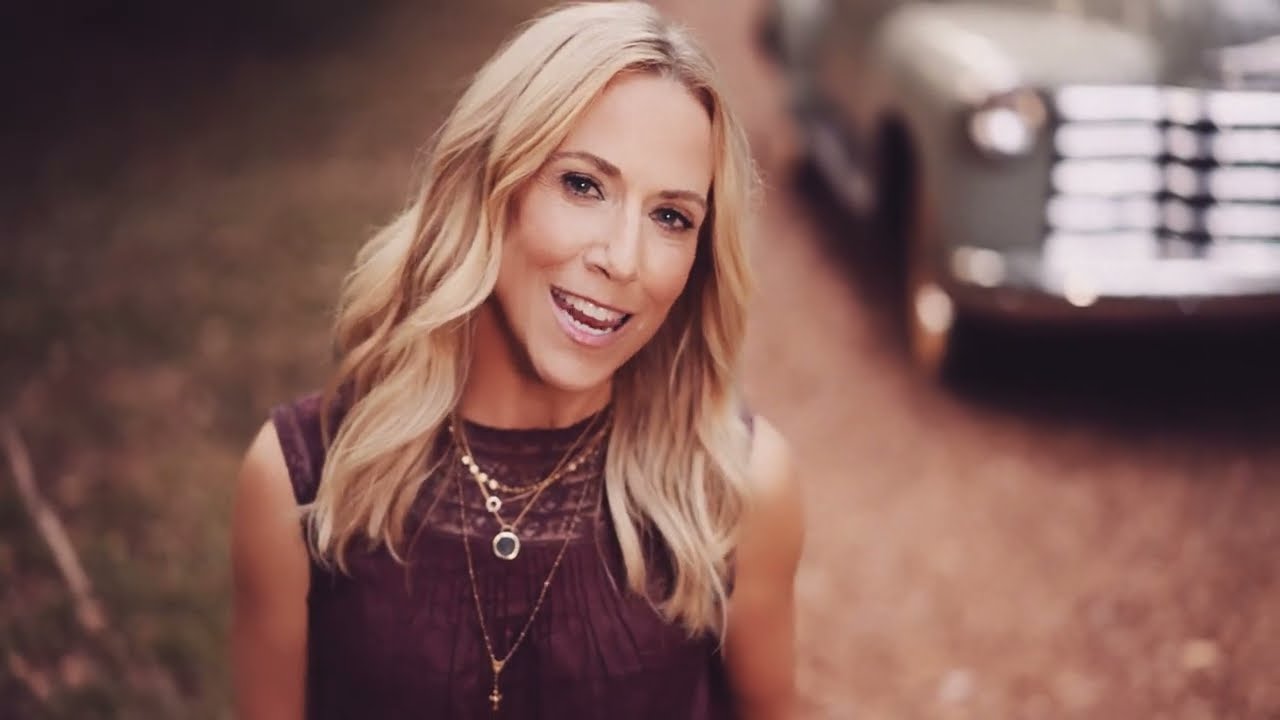
Sheryl Crow makes one thing very clear on her new album: She'll always be there to “Pick You Up.”
It’s a sentiment the legendary singer-songwriter has shown throughout her career through her tender Americana-inspired music and philanthropy. Especially in recent years, as she’s become an ardent supporter of female musicians who’ve followed in her footsteps, from Olivia Rodrigo to Maren Morris. But on Crow’s new album—titled Pick You Up—she aims to offer optimism amid our distraught political moment with what’s ultimately a collection of protest songs.
“I have to have hope. I mean, I am raising two people,” the Rock and Roll Hall of Famer tells Marie Claire over the phone, while preparing dinner for her sons from her Nashville kitchen. “When you are an artist who's been doing it for a long time, you look at life differently, and it becomes much more personal when you think about the decisions that are being made or ones that your kids are going to inherit.”
The new record—Crow’s 12th studio LP—features songs about topics like political polarization (“Freedom Bus”) and climate change denial (“Flat Earth”), but at its core explores our need for connection (“Pick You Up,” “Freight Train”). She says, “At a certain point, you do start thinking about the little stamp you're leaving behind. Especially if you're raising young people, your footprint does eventually become the motivating factor for the decisions that you make and the things you stand up for.”

Sheryl Crow released Pick You Up on October 9, 2026.
The hitmaker, 64, explains she’s tried to foster community and uplift women who’ve come after her, since there weren’t many female rock veterans to champion her and her peers, like Sarah McLachlan and Alanis Morissette, back in the day. “A few years back, there were a lot of statements made around the Grammys about women [needing to “step up”], and it got kind of ugly,” she says. “I look at what's going on now, and so I'm stoked. I'm not even hopeful. I'm beyond hopeful. I'm blown away that some of the best musicianship out there is coming from women.”
“There are so many young women that are making music that inspire me and that make me want to keep going, make me want to keep writing.”
Below, Crow shares which contemporary artists she can’t stop listening to, the classics that she grew up on, and which icon she still wants to collaborate with.

I really, truly wanted to be Stevie Nicks. I got the shag, I had a few scarves, so I felt like I was! The Fleetwood Mac record and Rumours—particularly the Stevie songs like "Landslide" and "The Chain"—there was so much emotion. She, for me, was a beautiful illustration of a feminine artist who had something to say and who could rock, who could have her own.
The thing I love most about her, though—I could not have predicted my life, but I've been fortunate enough to get to know her—beyond what you think she's going to be, she's a true artist through and through. She looks at life as an art. If she isn't writing poetry, she's drawing, she's singing, she's listening to other people's music. She really is a true artist, but she's also very generous. She was a huge mentor and still is a mentor to me. She walks the walk, talks the talk, and she's authentic all the way
She and Linda Ronstadt both—I feel like I've stood on their shoulders a lot. Even Rickie Lee Jones. I don't think Rickie Lee gets enough attention, but she's an incredible artist, as well.

I've done a deep dive into all of Joy Oladokun's work—great writer, incredible voice, and she has a perspective on her journey that a lot of people would relate to.
I love Olivia Rodrigo. I love her like my freaking daughter. I'm so proud of her, and I love her writing. Obviously, it's youthful, so some of it doesn't necessarily pertain to me, but I am always amazed at the way she sees things and the way she's able to put it in an artful way that is clever and bright and intelligent and cutting.
I love Molly Tuttle—love her to pieces. I love everything about her—her musicianship, her writing, her singing. I love her audacity, her courage. She's insanely inspiring. I love Brandi [Carlile]. I love what Brandi stands for. I love her music, the way she really inspires people. There are a lot of young artists that people don't even know, like Larkin Poe. [They're] sisters that are just incredible musicians.

I absolutely love Noah Kahan's last record, [The Great Divide]. He's very open. Joy [Oladokun]'s new record, [Hope Is A Heavy Thing], is this way for me, as well.
They both address having bouts of depression. There was a long time when no one would speak of that. It was very taboo, but they've been so open about it, and I think so many people relate to that, and it gives them a feeling of being seen and not being alone. [Kahan's] music has really done that. His lyrics make you stop and go, "Oh, my gosh, I would not have thought to say it that way, but I love that." It's interesting when you find somebody who is unique in the way they see life, and they're able to bring that to music.

When I was in college, I got to see Stevie on her solo tour, and Joe Walsh opened. There were pivotal moments for me where I walked out going, "That's what I want to do, and that's who I want to be."
As far as productions go, I mean, who didn't want to be on Woodstock? I did get to be on the second and the third Woodstocks, which were very interesting in their own right. I've gotten to play Glastonbury a couple of times, and that was also epically game-changing. When you're on those giant festivals—and you get to see not only peers playing, but you get to see the older generation like Van Morrison— you come away from it feeling humbled, but at the same time, wanting to find a way to leave your mark too.

The album art for Pick You Up.

I have a whole ton of vintage T-shirts that are the originals—from Peter Frampton's concert in Memphis, Tennessee, that I went to when I was 16, I have a vintage Rolling Stones T-shirt. It's got these giant pot leaves on it. It's one of my favorite T-shirts.
My very favorite T-shirt is Willie Nelson. I bought it in a vintage place, and I believe it is from the '70s. I have a picture of him walking on stage with me wearing that T-shirt, with his arm around me. I'm not sure there's anything that gets better than that.

Stevie Wonder. When I was a kid, his and Elton John's music was really the first that I learned because I played piano. I still dig deep into his records, like Intervisions, Talking Book, and Songs In The Key Of Life, and I'm always blown away by his ability to document the moments through that period, the civil rights movement, all of it in such an incredibly inspired way. To me, it's like a masterclass. It's what makes me want to keep writing.

"Yesterday" by The Beatles. It's one of those songs that's super simple, but then it's the most gut-wrenching, memorable song of all time.

"Yesterday" [and] "Blackbird" [by The Beatles], "Can We Still Be Friends," Todd Rundgren, "Someone Saved Me Live Tonight" and "Sorry Seems to Be the Hardest Word" [by Elton John]. I go back to the people who wrote the epic songs that me as a kid felt I was seen in. When you hear a song, and you go, Oh, gosh, I relate to that, or how do they know I even exist? It feels like they wrote that song for me. Those are the ones that you immediately get back in touch with.

I love the old funk stuff that came out of the late '70s. The stuff I grew up with: "Celebration" [by Kool & The Gang] and "We Are Family" by Sister Sledge.

I listen to what's on the radio. I enjoy John Mayer's SiriusXM station, Tom Petty's station, and I listen to the Country Outlaw station a ton. Or sometimes I'll put on yacht rock because it's back, and I know every single song, every lyric from that period—Todd Rundgren, Hall & Oates, Gerry Rafferty, Michael McDonald, all the greats.

My dad used to always say, "It's not having what you want. It's wanting what you have." And that is in "Soak Up the Sun." Every single time I sing it, I think about my dad, who is 95.
Also "Everyday Is a Winding Road," there's a lyric that is, "I feel like a stranger in my own life." That has a lot of meaning for me because I've felt like that periodically. It's a weird thing to grow up loving music and writing, and then suddenly it's less about that and more about the red carpets. It was really hard for me during the height of my popularity, and I did start to feel like a stranger. I couldn't figure out where I fit into my own life. I've had people come up to me throughout the years and say that they relate to that, and I think we all have moments where we do feel like strangers in our own lives.
I think most artists would attest to the fact that when you write, you're pretty selfish—unless you're crafting what you think is going to be a hit with the hit writers. You do write from a place that is very personal, and your life at any given moment informs your art. I think the best songs are not necessarily the hits. They're usually the deep tracks that you're bearing your soul on.

I have a song on this record that's called "Heaven Help Us." I wrote it during the California Fires because my old assistant, who worked for me in L.A., called me and said, "Turn on the TV." The only fire in Hollywood, which was evidently started by arson, was my property. It was a house that I had lived in for 20 years, and it was heartbreaking. After days and days of watching what was happening out there, that experience really inspired the lyric for the song: "That from a burn out tree / A flower finds a bee." We all start over, but it takes forgiveness. Whenever there's a broken heart, the only way to start is with forgiveness.
For me, it is really where I'm at. I look at where we are right now in our humanity, and I think there's going to be a moment where we'll have to take accountability; we'll have to come back to ourselves, the human part of ourselves, and really think about the world that we're leaving for our kids. I'm not going to lose hope about that. I'm looking at everything now going, "How can I be more like Dolly Parton?"
This interview was edited and condensed for clarity.