High in the Hindu Kush Mountains, a 16-year-old girl named Badia used to lie awake at night, sharing a wool blanket with her newborn daughter and 40-year-old husband. She had become this man's bride at age 12. Almost every day after their wedding, he had beaten her with the broom she used to sweep the dirt floor. "A healthy boy will never come from such a worthless girl," he would say. It was Badia's fault that he had to take a second wife, he announced. She was lucky he was a kind man: No one in the village would have condemned him for killing her, and her child.
Welcome to Afghanistan, one of the worst places on earth for women.
Badia eventually escaped, sort of. One snowy night, the shivering teenager slipped from her bed, baby pressed to her chest. Then she ran, barefoot, up a footpath as old as Genghis Khan. But she didn't get far. She got sent to prison, convicted of the "moral crime" of leaving her husband's home without his permission. She recounts her story while staring at a concrete wall surrounding the women's prison in remote Nangarhar Province. "I'm a criminal in my village," she says, stroking the raven hair of her daughter, now 2. Together, mother and child have served two years of their 10-year sentence.

In Afghanistan, the most commonly practiced form of judicial "due process" simply requires two men to accuse a woman of a crime. Case closed. No burden of proof or defense. A group of respected male elders hands down the sentence. (Men also appear before this council, or jirga, but usually to settle debts or property disputes. Their wives and daughters are often traded and enslaved to resolve such debts.) For women, typical "moral crimes" punishable by prison—or death—include refusing to marry a rapist, having an affair (or simply getting accused of having an affair), and murder-by-proxy, wherein a male family member kills someone and assigns the prison sentence to a female.
An estimated 860 women are currently behind bars in the country, along with 620 girls between the ages of 12 and 17, and 280 children, according to the U.S. State Department and the Corrections System Support Program, or CSSP, a private U.S. contractor tasked with reforming Afghan prisons. Ninety-five percent of these women are convicted of "moral crimes."
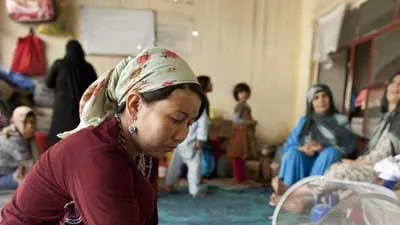
Kinah, 21, is a striking beauty with the black-coffee eyes of many in Balkh Province. She sits in one of two rooms that imprison 40 women and 18 children, rocking her 6-month-old daughter, who is nestled in a sheet tied to a chair and bedpost. At age 6, Kinah was promised in marriage to a 40-year-old man, but at 16, she ran away, marrying a young man she loved. She is now a convicted adulteress and widow, as her former fiancé tracked her down and shot her husband. The murderer was sentenced to 10 years; Kinah was sentenced to 12. The room echoes incessantly with children's coughing. The courtyard offers the only escape, where tents serve as shelter from below-freezing temperatures. "Sometimes we have no milk for the children," Kinah says, holding her baby close.
Mercifully, CSSP and a handful of nonprofit groups such as the Afghan Women's Education Center, or AWEC, are working to improve imprisoned women and children's lives. CSSP works in eight of the country's 34 provinces, repairing crumbling buildings, raising operating standards, and training Afghan wardens. Says Rita Thomas, a CSSP on-site adviser, "What's most heartbreaking are the girls." When funds allow, nonprofits will provide literacy classes, emergency medical services, and counseling.
Mike Runnells, CSSP director in Kabul, says the group plans to be in every district by the end of 2011. He admits that these intentions could prove difficult where insurgents still rule with impunity, adding, "Our first priority is the safety of our workers." One adviser was killed in 2007, when her vehicle was targeted in a suicide bombing.
For aid groups in the region, yearly budgets are slim. These groups stay afloat thanks to donations, intermittent federal grants, and iron-willed directors who often work without salaries. But you can help.
What you can do: Buy a "Not Guilty" T-shirt ($25 ). The Afghan Women's Justice Project will send the proceeds to the nonprofits helping Afghan women and kids in prison. One shirt purchase buys a child's milk for a month or school supplies for 10 prisoners.