Can Two Women Take the Toxic Masculinity Out of New York Politics?
Governor Kathy Hochul and her running mate Adrienne Adams are making a case for a different kind of political power. In an exclusive joint interview with Marie Claire, the duo behind New York’s first all-woman ticket pull back the curtain.


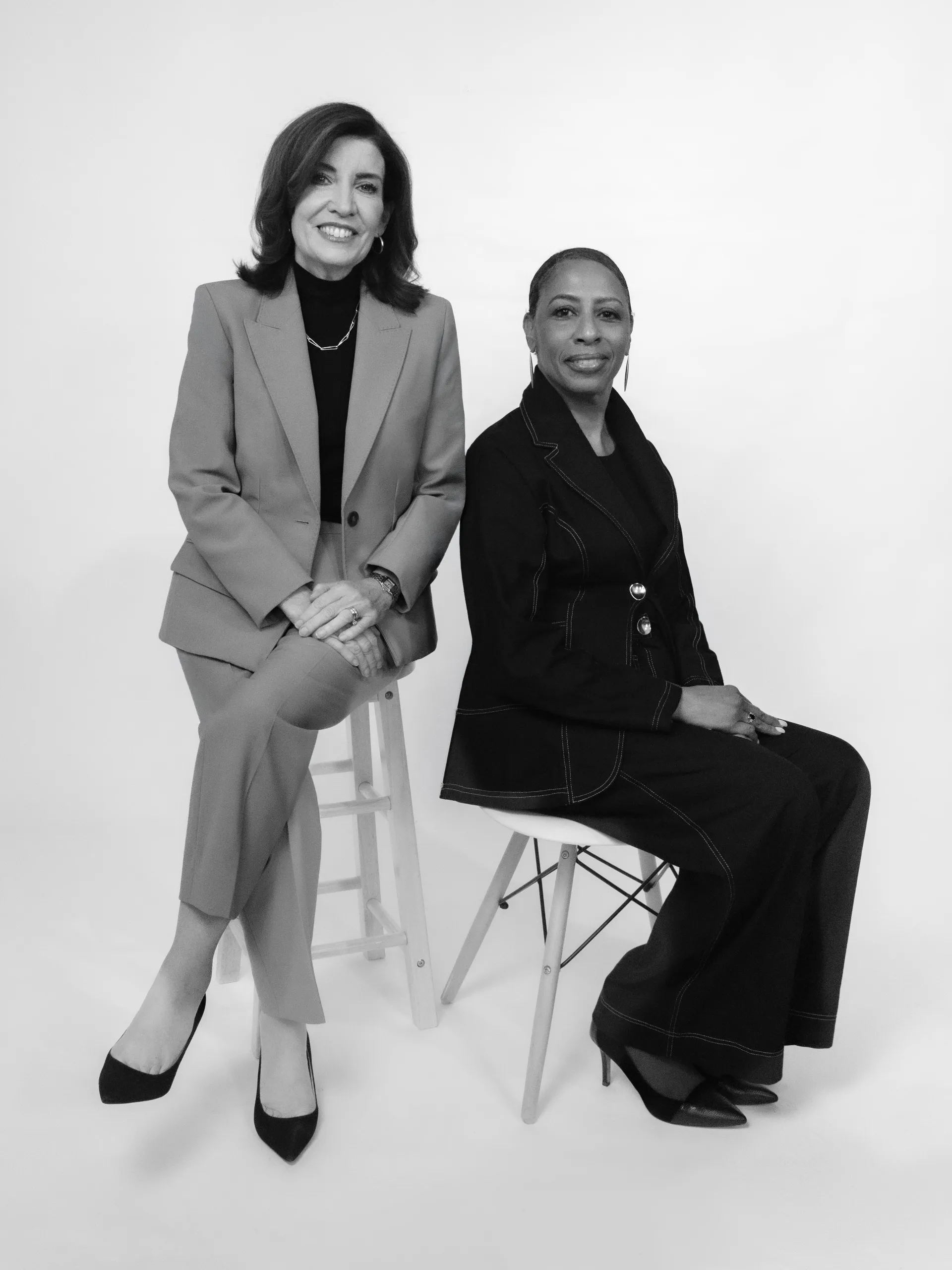
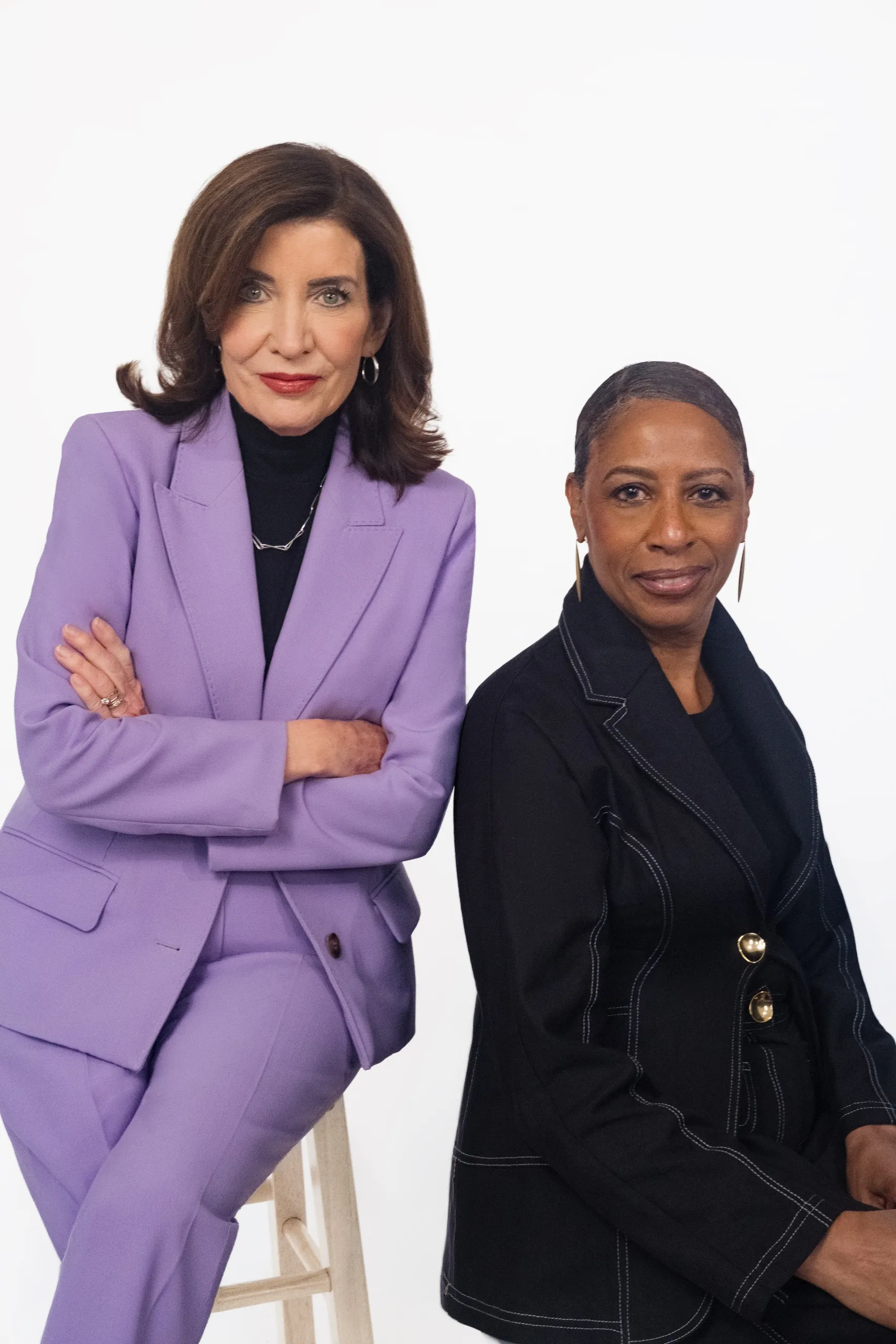
A week before New Yorkers decide whether to send them to Albany together, Gov. Kathy Hochul and Adrienne Adams can’t stop finishing each other’s sentences. Sitting side by side in a Midtown studio on a Monday afternoon, they talk over and around each other like old friends who have long stopped waiting politely for the other to finish. If they win on November 3, they would make up the first all-female gubernatorial ticket in New York history, and Adams, the former City Council speaker, would become the first Black woman elected lieutenant governor of New York. But for all the history riding on this ticket, the first thing you notice is how much fun they seem to be having together.
Adams calls the governor’s sense of humor “the bomb.” Hochul grins like she’s heard it before but doesn’t mind hearing it again. Someone drops something behind the set and neither of them flinches. They have known each other for more than a decade, and throughout the interview, they keep turning toward each other before turning back to me. The chemistry is personal, but it is also political. In a state where governing relationships are often remembered for how they implode—and a national politics that turns everything into a zero-sum blood sport—Hochul is trying to sell collaboration itself as a governing asset.
To hear her tell it, New York politics has spent far too long confusing conflict with strength: governor versus mayor, executive versus legislature, ego versus ego. “Who’s the top dog? Who’s going to get the press conference first? Who’s going to get the credit? Who’s going to win the fight of the day?” Hochul says. Hochul, who is seeking a second full term against Republican Bruce Blakeman, has spent the past four years explicitly rejecting that model. “I wanted to reset people’s perception of government,” she says. “I can be effective. I can be successful. I can win the day when I need to, but it doesn’t have to be a bloodbath.” It’s a simple concept with big implications at a time when the country is watching many of its leaders compete to be the nastiest in the room.
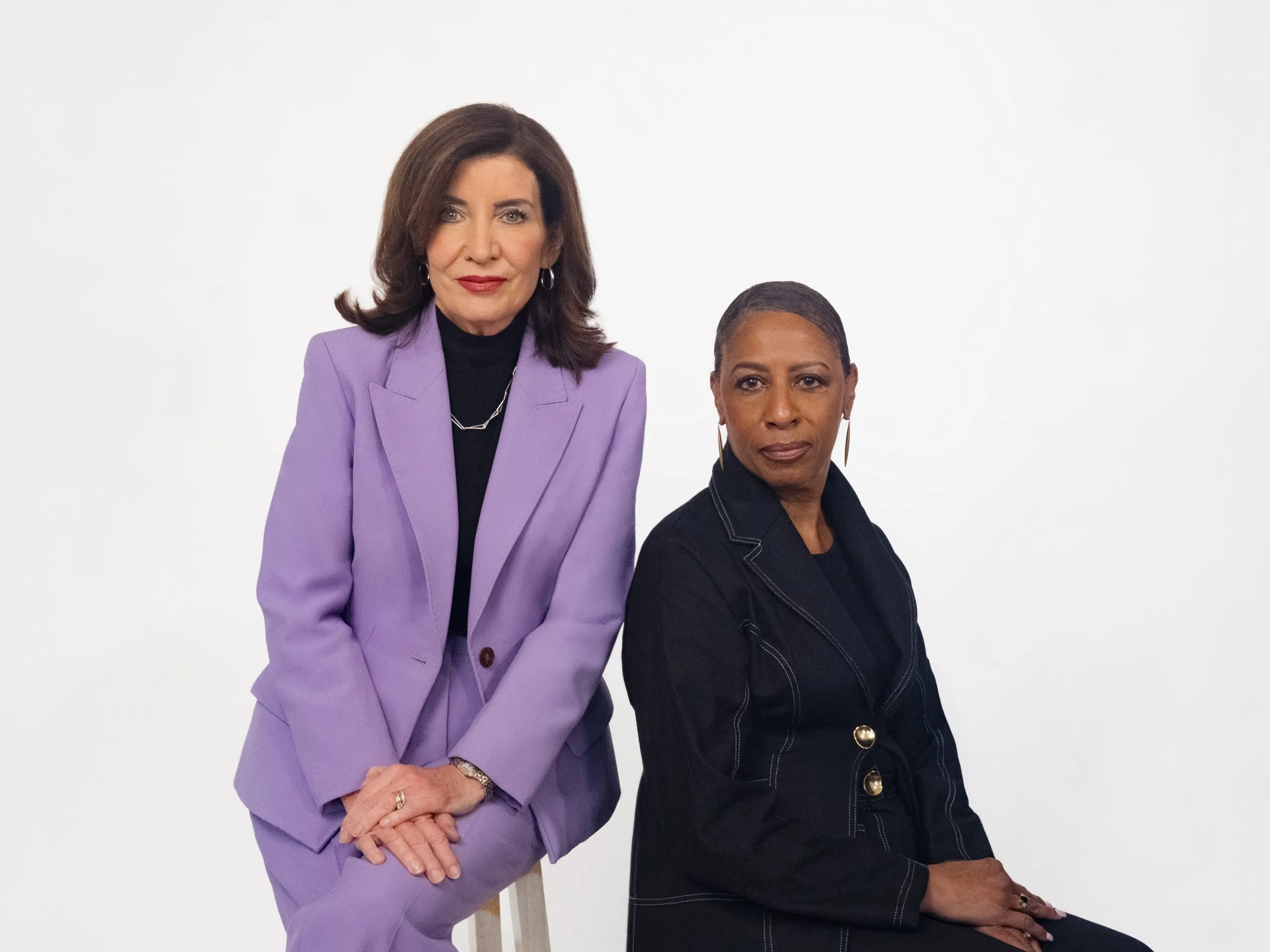
Governor Kathy Hochul and former New York City Council Speaker Adrienne Adams sit for a joint portrait in New York City.
The most visible evidence of that philosophy is Zohran Mamdani, the democratic socialist mayor who, by conventional political logic, should be Hochul’s natural antagonist. Instead, on his eighth day in office, the two announced free childcare for two-year-olds in New York City as part of Hochul’s $1.7 billion statewide increase in childcare and pre-K funding. At the press conference announcing the initiative, Mamdani called out the “dysfunction” that had long defined the governor-mayor relationship, and people on the street have noticed. Hochul says she often hears it from New Yorkers who describe the moment as “a new era.” “There’s this uniqueness about New York where people want a piece of it,” she says. “They want to feel alive again.”
For Hochul and Adams, keeping New York alive means making it possible to build a life here. Their agenda spans across housing, education, and affordability, but childcare may be the clearest test of what their version of government is supposed to accomplish. Both women know firsthand the compromises behind work, family, and care, and they argue that those experiences should inform how they govern. Their ticket is, in part, a test of whether that argument holds.
Long before childcare became part of either woman’s political agenda, it was a problem they were trying to solve at home. For Hochul, it started with the birth of her son while she was working as a staffer for New York Sen. Daniel Patrick Moynihan. It had been her dream job since she was a teenager, and she had achieved it in her twenties. But when the baby came, she and her husband had already taken substantial pay cuts to pursue public-service careers, and the numbers left them with only one real option: Hochul stayed home.
“All of a sudden you go from being in a high-powered position, doing important things, and now I’m worried about making sure the laundry’s folded while the baby’s taking a nap,” she says. Their income plummeted, and she remembers clutching coupons, buying diapers in bulk, trying to find somewhere to store them in a small apartment. A generation later, she realized very little about that calculation had changed.
We have to be tougher. We always have a lot more to prove.
Governor Kathy Hochul
For Adams, the story somehow loops all the way back around. In 1989, she and her husband blended their families, and she became what she calls an “instant mother of four,” with children ages two, two, four, and five. They were lucky enough to have one of her husband’s relatives move in and become the children’s caretaker. Fast-forward nearly four decades: one of those two-year-olds is now grown, married, and raising three little girls of her own. Earlier this year, she and her family moved out of state because they could no longer afford childcare in New York. “We lost them to Delaware,” Adams says. “We’ve come full circle with this childcare situation.” Hochul cuts in beside her: “Until now.” Adams nods. “Until now.”
That family story is now sitting inside a much larger experiment. Hochul has poured billions into childcare statewide and backed New York City’s new free-care program for two-year-olds. Next fall, the program is set to expand from roughly 2,000 seats to more than 12,000 children across all five boroughs, with citywide universality as the eventual goal. If it works at scale, New York could become a test case for a much broader idea: what happens when childcare is treated more like public infrastructure than a private family burden?
At a Hochul-Adams campaign rally in Brooklyn the day before our interview, Mamdani—who has endorsed their ticket and campaigned alongside them—told the crowd about a mother he and Hochul had recently met who had been spending $2,300 a month on childcare. With her son now in 2-K, the family is saving up every dollar: “I’m going to start to save for a home,” the mother told him. “I’m going to finally be able to raise my kid in the city that raised me.” It’s the kind of story that plays out in every expensive city in the country. The line between childcare policy and housing policy, it turns out, gets thin fast.
For now, though, the appetite is already bigger than the program: nearly three families applied for every available seat in its inaugural round. There are workers to hire, providers to keep open, and money that has to keep arriving. Washington adds another uncertainty. “I also worry about what Donald Trump is going to do next to us,” Hochul says. “I mean, what program is he going to cut?”
The question is not hypothetical. In January, the Trump administration froze $10 billion in childcare and social services funding for five Democratic states, including New York, citing unproven fraud allegations. Attorney General Letitia James led a lawsuit and a judge blocked the freeze; the administration later rescinded it in July. But other federal cuts kept coming: billions in healthcare funding, new restrictions on food assistance, and a suspension of federal funding for the state’s Medicaid Fraud Control Unit.
Closer to home, Hochul’s Republican opponent, Nassau County Executive Bruce Blakeman, has called the childcare program “overexpensive” and said he would limit it to working parents who can prove their employment with tax returns. He was more direct with a Buffalo TV station: “Not for some lazy ass who’s going to sit on the couch and send their kids off to daycare so they can watch The View or cartoons. That ain’t happening with me as governor.”
To see those things go backwards, I am hurt. I’m terrified for my grandchildren right now.
Adrienne Adams
Hochul and Adams are betting the answer is the opposite of all of that. Their agenda extends beyond childcare into housing, education, and a broader affordability argument aimed at the families who are doing the math every month on whether they can stay in New York. Hochul has already signed the most significant changes to the state’s environmental-review law since its passage in 1975, aimed at shortening reviews that can add years to some housing projects, and she wants Adams to be the person who travels the state and wins over elected officials still hesitant to build.
Hochul describes the partnership in practical terms: She handles Albany, Adams handles the ground. “I’ll give you free rein in areas where you want a portfolio,” Hochul tells her during our interview. Adams has already been crisscrossing the state, trying to reach all 62 counties and finding that the issues in rural New York and urban New York are not as different as the politics suggest. People just want to know “their elected officials are listening to them, that their elected officials see them,” she tells me.
The story of how Adams ended up on this ticket starts with no plan at all. She had left the City Council speakership on New Year’s Eve after an unsuccessful run for mayor, and she was done. “Politics, bye-bye,” she says. Adams believed the reports that Hochul had already made her pick. Fine by her. Then the governor invited her for tea.
They were sitting together, talking about the new year, when the governor started complaining about press coverage—“The media gets this stuff wrong all the time”—and then, mid-thought, just said it: “Adrienne, will you be my lieutenant governor?” For Adams, “Everything in that room just stood still,” she says.
Adams would be, it’s worth noting, Hochul’s third pick for lieutenant governor in five years. Her first, Brian Benjamin, resigned after being indicted on federal bribery and fraud charges, which were later dropped. Her second, Antonio Delgado, broke with her and eventually challenged her for governor. By the time Hochul chose Adams, she was looking for a lieutenant governor who would operate as a true partner.
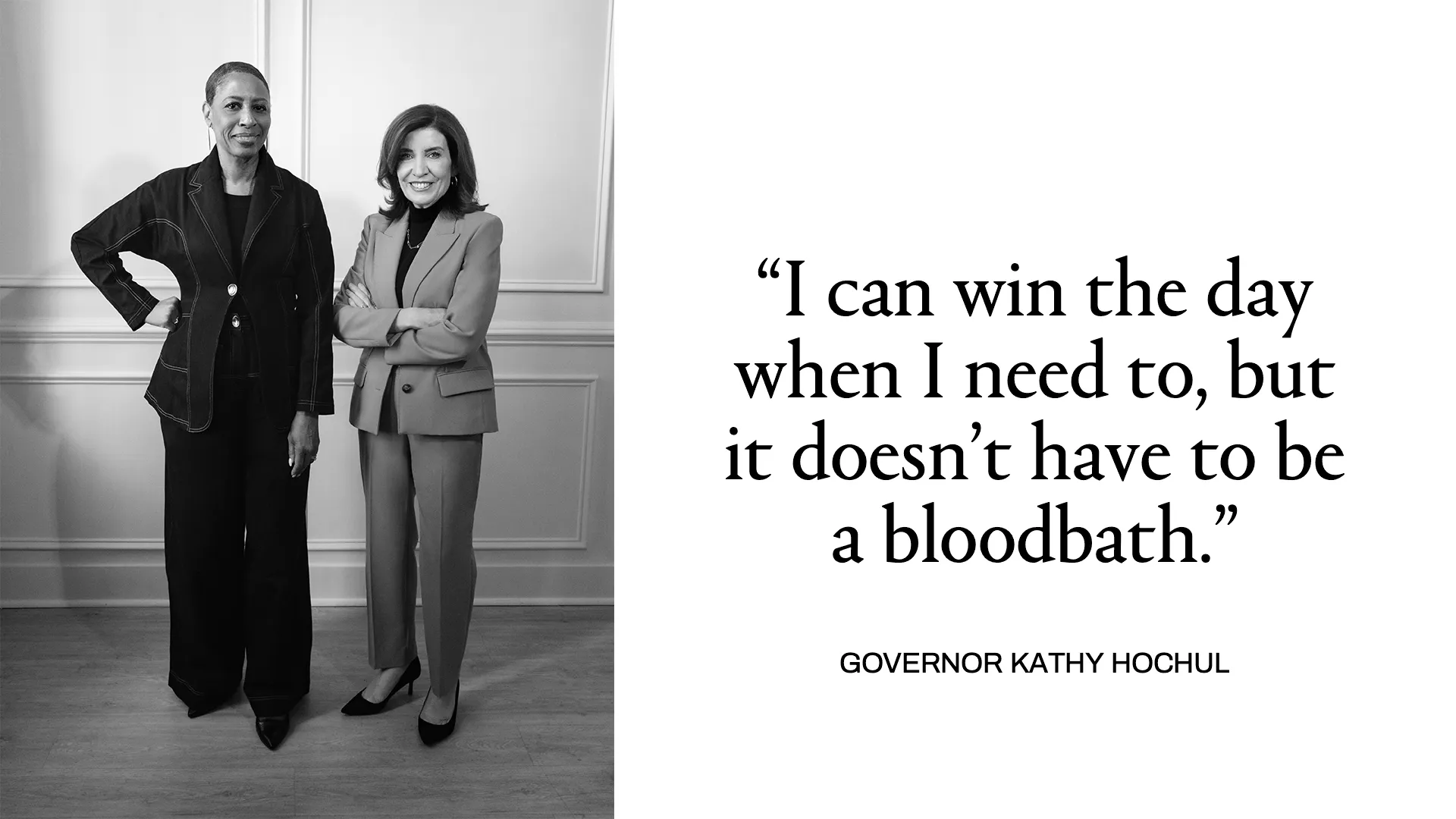
She and Adams had been friends since 2014, and their relationship deepened during the last mayoral administration, when city and state “really pulled together.” Hochul had also watched Adams navigate the City Council speakership and come out of it “battle tested”: someone who already knew what it felt like when allies turned and protests followed you. “Very few people can be in that rarefied space of saying, ‘I’ve been through it,’” Hochul says. Women in politics, she adds, learn that lesson early. “We have to be tougher. We always have a lot more to prove. The expectations are higher and we persevere and we overcome.” And toughness wasn’t the only thing she was looking for: “I gravitate toward people who exude positive energy,” she says. “We had a chemistry, and people could see that immediately, that we create energy between the two of us.”
Adams hadn’t imagined going back to politics at all, but said yes because of who was asking. “Kathy Hochul is the only person that could have pulled me back.” She describes the trust between them as intrinsic. “We’ve always been able to have honest conversation, put it out on the table, really talk about anything,” she says.
When I ask whether they’ve actually had any disagreements—a policy difference, a strategic call, a moment when all that honesty was put to the test—both women pause. Adams says she doesn’t have an example. Hochul smiles:“We’re in campaign mode. We both agree we want to win.”
They are more forthcoming about what drives them, and here they diverge in ways that feel more revealing. Hochul’s worries are tactical: public safety, the energy grid, whatever Trump might do next. She also refuses to call any of it stressful. “Nothing keeps me up at night,” she says. “I get a good night’s sleep, so I recharge the next day.” Asked how she handles the pressure, her answer is essentially that she does.
Adams gets more personal. When I ask what keeps her up at night, she goes back to childhood, her union parents, and an aunt and uncle at the March on Washington. “To see those things that my grandparents fought for, some of the things that they lived through, and then were blessed enough to see those things turn around,” she says. “To see those things go backwards, I am hurt. I’m terrified for my grandchildren right now.”
Hochul, beside her, cuts in. “It’s coming back.” And then, ever the pragmatist: “The next election in a few days, get the firewall, House and Senate, and then we just power through. I say to everybody, we can hold on for two more years.”
Hochul, 68, and Adams, 65, are both mothers and grandmothers, and somewhere along the way they became known as the “two moms” ticket. Hochul embraces the framing, with an asterisk. “When you announce it’s the first mom ticket or the first grandma ticket or the first all-female ticket, it really does energize a crowd,” she says. But she doesn’t want that to become “an understatement of what’s really brought to the table.”
Adams is less conflicted. “I’m a mom, so it felt perfectly fine to me,” she says. But the history of the ticket matters to her for another reason: She wants other women, particularly Black women, to be able to see what it took to get there. “It wasn’t a magic wand,” she says, “it was hard work.” She was bullied as a child, struggled with low self-esteem, and spent years trying to “crack out of that shell.” At 30, she was studying motivational speaking—helping other people find their voice while still searching for hers. “Once I started to believe in myself and actually let these wings expand,” she says, “the confidence comes out.”
Back at the Brooklyn rally, Adams had already whipped the room up before Hochul and Mamdani took the stage: “Brooklyn, where you at?!” three times, to escalating roars. Once they did, the governor and the mayor spent much of their time riffing off each other, with Hochul branding Blakeman “next level crazy” to chants of “four more years,” and Adams watching from the front row like she was enjoying a show she helped produce.
Toward the end of her remarks, Hochul is addressing Trump and Blakeman’s stance on childcare when a small child pipes up from the crowd with a perfectly timed “Boo!” The room breaks into laughter. “And that baby gets the last word,” Hochul says, Adams cracking up across from her. In a political culture built on dominating the room, these two seem perfectly comfortable sharing it.