The Wrong Formula
In the face of a baby food shortage, desperate moms are turning to strangers on Facebook to help—but social media shouldn't be the answer.

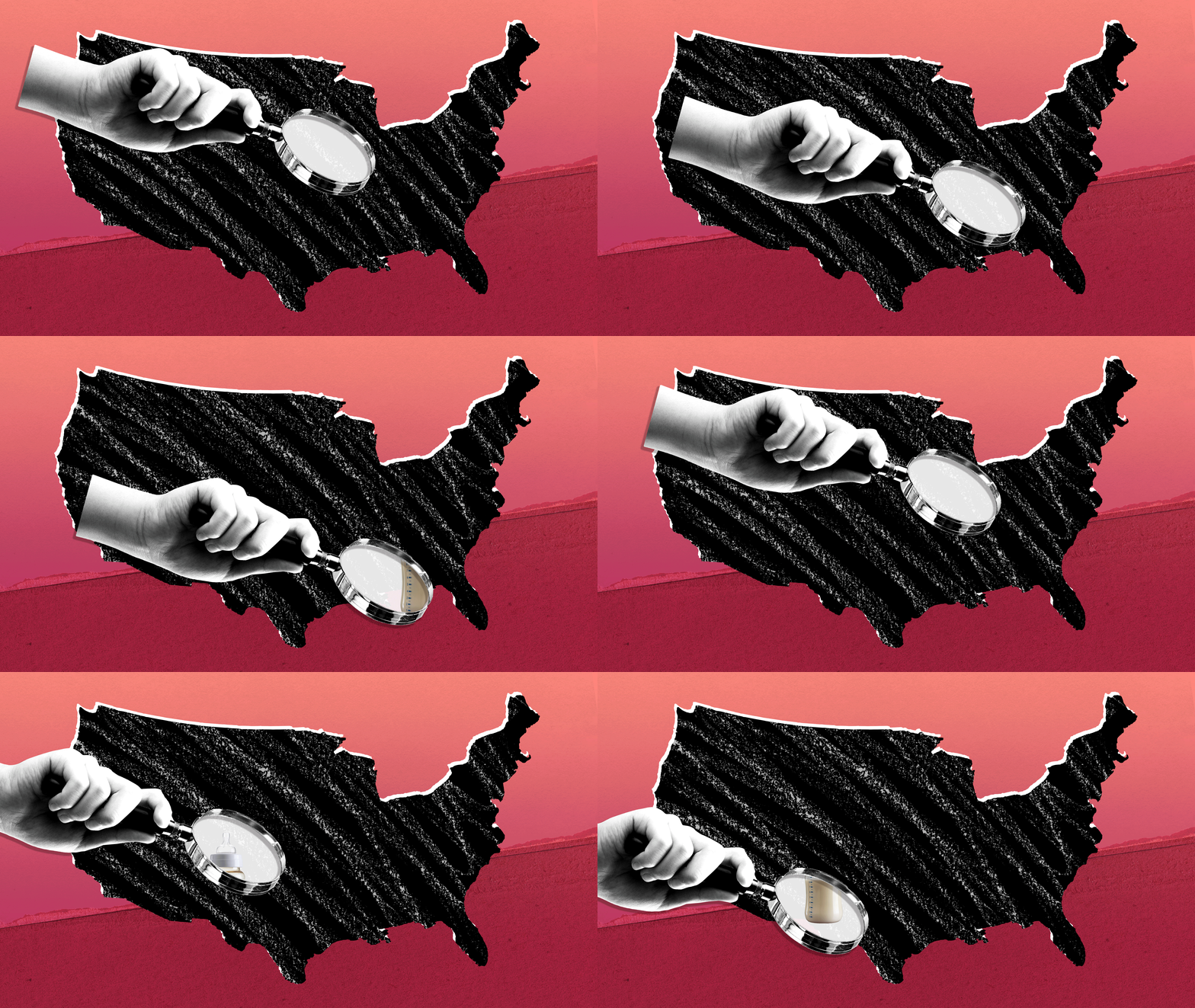
In March, Jae Coleman, mother to a 5-year-old girl and 5-month-old twin boys, went on a routine trip to the store to buy formula. “There was none available,” she recalls. “I had to go to eight, 10 different stores before I finally found one that would work for my son.” She’d recently switched one of her sons to a sensitive formula after she noticed he was having trouble with the regular kind. Now, however, she was struggling to track it down. After weeks of frustration, she posted to Facebook, asking for friends and family to help her find her son’s formula. “I quickly realized, on every mom group I’m part of, and every network, everyone across the U.S. was struggling to find formula for their babies.”
As the baby formula crisis—which has seen, according to estimates from product pricing and data firm Datasembly, a national out of stock rate of 43 percent—enters its second month, Coleman’s story is starting to sound eerily familiar. Dozens of mothers, advocates, and support group leaders I spoke with told me similar tales: Going to the store and seeing empty shelves, having to drive miles and miles to find formula to feed their baby. This was back in April, in March, weeks or months before there were any headlines, any official acknowledgement of a shortage. At first they didn’t think anything of it. Bad luck, strange coincidence, these things happen. But then they happened again. And again. Like a horror story, the stray anecdotes and one-off complaints started to coalesce into what was clearly becoming a nightmare: There wasn’t enough formula to go around to feed their children.
Almost immediately, moms went into action, helping each other. Coleman was one of them. She now runs a Facebook group called “Find my Formula (Greater Seattle Area),” which has helped hundreds of mothers feed their babies. “It’s become a full-time job,” she says, of her work within the group.
For every story about a mother struggling to find the formula she needed, there is another story, of a mother answering her call. There is Melissa, whose baby needs a hypoallergenic formula that is hard to come by; another mom, she says, “knew my situation and knew of another mom with extra of the formula I needed. She reached out to that mom and went out of her way to go and physically pick it up for me.” Or Thalia, whose baby finally came home from the NICU just a few weeks before the shortage began; she’s received donations through a Facebook group. Or Ashley, who was “rescued” when another mom shipped her formula and now wants to “pay it forward” by donating cans of a different brand that’s not well tolerated by her daughter.
If the last two years of the pandemic have taught us anything, it’s that we’re all in this together. Our health, and the health of our loved ones, are not solely private concerns, they are intrinsic to the wellbeing of our communities and should be considered a public good. It’s heartwarming to hear stories like Ashley’s and Thalia’s, to hear about people like Coleman taking time away from their own children to help their community. These stories are inspiring, and they are necessary. But they are also indicative of the stunning lack of infrastructural support for new parents—especially for mothers—in this country.
As Kristin Rowe-Finkbeiner, executive director, CEO, and cofounder of MomsRising, an advocacy group that focuses on issues facing mothers and families, tells me, “One of the things that we’ve seen is that moms in the U.S. are ignored and made invisible time and time again.”
All too often, when there’s a crisis in America, the onus is thrown back onto the individual. Poor? Get a job. Sexually assaulted? You asked for it. Can’t get formula? Just breastfeed!
Celebrity news, beauty, fashion advice, and fascinating features, delivered straight to your inbox!
You’d think that after the pandemic, Americans would have learned how destructive this pull-yourself-up-by-the-bootstraps rhetoric is. Unfortunately, even when it comes to the formula shortage—a national hunger crisis that affects millions of infants and small children—people can’t stop pointing the finger at each other long enough to see the bigger picture: that the lack of support new parents (and by extension, their infants) get is a systemic problem. Arguing about the benefits of breastmilk as if nursing were merely a lifestyle choice is a distraction.
It took weeks of fury and sharp criticism from both sides of the aisle before President Biden finally announced decisive action to boost formula supply: Just last Wednesday, he invoked the Defense Production Act to speed up the formula manufacturing process and authorized flights to import brands from overseas.
People often ignore what’s happening to moms until it is a state of emergency.
Kristin Rowe-Finkbeiner, MomsRising CEO
In the meantime, it was regular moms and dads who came to each other’s rescue—well before the companies that produced the formula, or the stores that bought the formula, or the government, whose federal grant program, The Special Supplemental Nutrition Program for Women Infant Children (WIC), accounts for about half of all infant formula purchased in the US. They had to turn to each other because no one else was listening.
“The tragedy of the infant formula recall and the crisis [it’s caused] is that people often ignore what’s happening to moms until it is a state of emergency,” says Rowe-Finkbeiner. “So it’s not surprising, but it is tragic that moms were the first to raise the alarm to the baby formula shortage.”
Many of the women I spoke with found the formula they needed through a Facebook group founded by Julie Leffell called Mom Friends of Friends. Leffell founded the group in 2019 about a year after the birth of her daughter, hoping to build a small community of new moms; three years later, the group, which is private, has more than 7,300 members across the United States and internationally. Leffell was so inspired by the community she helped build that she quit her job as an attorney to focus on supporting new parents; she now runs support groups that she calls “virtual villages” and has been hired by corporations to coach new parents through their transition back to work. Since the formula shortage has grown increasingly dire, nearly all of Leffell’s time has been devoted to helping moms get the food they need to feed their babies. In the two days before we spoke, she’d made “about 15 or 20” drops of formula to moms in the tri-state area; she estimated that within the same time frame more than 50 swaps, donations, or sales had been facilitated through her Facebook group.
This is not just charity; it is work. While government bodies are still scrambling to try to ease this formula shortage, stories like Leffell’s and Coleman’s prove that making it through the crisis comes down to more unpaid labor for mothers.
“People say all this stuff about wanting to support moms, but then you go on maternity leave and no one even checks in on you. I mean, besides that form you fill out at your six-week checkup—your doctor, your company, no one from HR even asks to see how you are doing,” Leffell says. Other examples abound.
The United States is one of the only countries that does not offer national paid family leave. About a quarter of women return to work within just two weeks of giving birth; nearly half of women without college degrees return before six. This doesn’t just impact women and moms: Paid family leave has been shown to reduce infant mortality by as much as 20 percent. It has also been shown to reduce the amount of children living in poverty, and increase rates of breastfeeding. Women returning to work after two weeks have little chance to establish a breastfeeding routine and, if somehow they did, shift work and limited private space at the office would all but obliterate it.
The problem isn’t just statistical, it’s spiritual.
The United States also has the worst maternal mortality rate in the developed world; American women are three times more likely to die as a result of being pregnant or giving birth than their counterparts in the United Kingdom and Canada, and eight times more likely than women in Sweden, Norway, and the Netherlands. Black women are disproportionately harmed. Even when controlling for education, income, and age, Black women are three times more likely to die from pregnancy-related causes than white women. (The World Health Organization characterizes maternal death as occurring while pregnant or within 42 days of birth, meaning that many women must return to work at a time when the medical community still views them at risk for serious health complications.) If mothers survive pregnancy and childbirth and make it back into the workforce, they then have to contend with the lack of affordable childcare. Even once their children are school-age, mothers grapple with immense worry about their safety; this week's shooting at an elementary school in Uvalde, Texas, showed once again how vulnerable school children are because of this country's lack of gun control policies.
The numbers are depressing enough, but the lack of support that new mothers receive goes beyond what can be quantified. The problem isn’t just statistical, it’s spiritual.
Yes, the wheels are now turning to get food to infants. Brian Dittmeier, senior director of public policy at the National WIC Association, the non-for-profit education and advocacy arm of the WIC program, says that, despite perceptions to the contrary, “from day-one there’s been this inner-agency effort” to address the issues caused by the formula shortage. “One of the frustrating pieces is that we still have to wait to see the formula back on the shelves even though supply has been ramped up. It’s not like we can just flip a switch.” Dittmeier noted that in recent days great strides have been made on both the federal and corporate level: Lawmakers worked to pass a bill that would allow low-income families more flexibility in what brands and sizes of formula they are allowed to buy using WIC benefits. The FDA announced it would increase flexibilities on certain imported formulas in an effort to boost supply.
But those are not long-term solutions. The shortage laid bare the fact that the formula industry in the U.S. is a monopoly, with just four companies producing 90 percent of infant formula, leaving parents and babies disturbingly vulnerable if one brand has an issue. Dittmeier says that the FTC is now investigating consolidation within that industry. “How do we build a more resilient manufacturing sector in the first place so this never happens again? What I’m seeing is both an issue of a highly concentrated sector, but also how highly centralized things are within one company,” he adds, noting that the formula producer Abbott’s manufacturing processes are potentially too reliant on their Sturgis, Michigan factory, which, in February, was shut down due to contamination problems, spurring on the shortage. For many mothers struggling to find food for their babies today, these efforts have come far too late.
On May 13, Republican Congresswoman Elise Stefanik led a press conference with her House Republican colleagues. She said emphatically, “This is not a third-world country. This should never happen in the United States of America.” It’s a sentiment I heard and read a lot while reporting on this crisis.
Stefanik and others speak as if a whole other country must have snuck in beneath our borders and sprung up fully-formed. This bad thing over there, that’s not my country. Americans can’t seem to reconcile that this is their country. The complete lack of support is characteristic of their country.
The pandemic exposed how flimsy our care infrastructure was, how easily childcare could disappear, how little was keeping women—who left the workforce, voluntarily and involuntarily, by the millions—afloat. And now, just as American parents try to get back on their feet after the crushing, destabilizing, flying-without-a-net last two years, another wave has come crashing down on us.
Disasters are going to happen. Hurricanes. Fires. Viruses. We can’t stop them from coming. What we can do is make sure that people have enough resources and support to weather the storm. If, for instance, mothers had access to more affordable child care, or received paid parental leave, this formula shortage might not have been so devastating. People might have more time to track down formulas, and more money to order often pricier supplies from overseas. They might have had somewhere else to turn than a stranger on Facebook.
“We have a crisis in our country and we can’t wait to build the care infrastructure,” says Rowe-Finkbeiner. She noted that much of what MomsRising is strenuously advocating for—affordable childcare by skilled careworkers paid a living wage, paid family leave, paid medical leave, and an expanded child tax credit—were covered in Biden’s Build Back Better Framework, which passed in the House of Representatives in late 2021 but has since stalled in the Senate. “These are not unsolvable problems. Other countries have solved them and we know how to solve them. It just takes getting over the edge of change, particularly in the U.S. Senate.”
“The pandemic and the shortage of infant formula have been a wakeup call for our nation,” she adds. “When we do answer this call to wake up, we need to make sure we don’t do it half-heartedly, [that] we do it in a way that truly moves our nation forward.”
No, this isn’t a third world country. It is very much America. But it doesn’t have to be.

Hayley Phelan is a novelist and journalist. Her work has appeared in Vanity Fair, Marie Claire, Elle, Harper's Bazaar and others. Her book criticism has appeared in the Los Angeles Review of Books, and, as a humorist, her work has been published online at the New Yorker. Her debut novel LIKE ME is now available.