Black at Bravo
In a candid conversation, cast members discuss navigating the world of reality TV as a Black woman, from the politics of speaking up to the double standard they navigate every single episode—and why they keep showing up anyway.


The unspoken contract of being a Black woman on reality TV usually goes something like this: Be yourself but not too much. For a handful of Black women occupying space on the predominantly white shows of Bravo TV, the feeling of having to shrink is commonplace—some might even say it’s their job. While they may carry it with grace, seemingly meshing well with friend groups and doing so with a smile most of the time, those of us who understand the complexities of being Black women know there is always more happening beneath the surface.
For me, that awareness came early. I was 5 years old and one of only two Black girls in my kindergarten class when I first realized what it meant to be seen as different. And while at the time I couldn’t have begun to comprehend what that feeling of incongruousness would mean for the rest of my life, it was palpable.
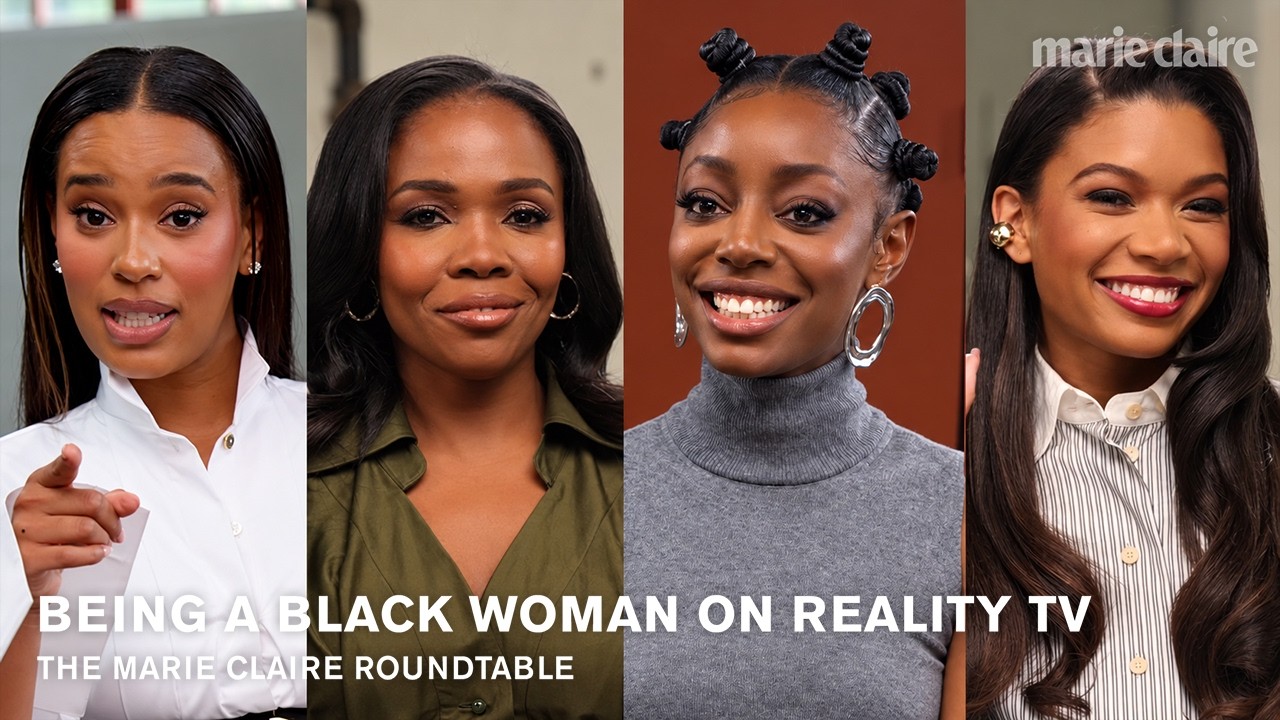
To understand the experience of having that feeling play out for millions of viewers every week, I sat down with four of Bravo’s most prominent Black cast members on a late June afternoon in Brooklyn: Lake Rucker of Southern Hospitality, Jasmine Goode of The Valley, Venita Aspen of Southern Charm, and Mia Calabrese of Summer House. Together, we unpacked what it means to exist so publicly in a universe that rarely includes or uplifts Black women. For the first time ever, they said out loud what they’ve only ever said in private.

(From top clockwise in left image) On Venita Aspen: Hermès dress; Aquazzura shoes; Jennifer Zeuner earrings. On Lake Rucker: 3.1 Phillip Lim jacket; Alexandre Birman shoes; Ettika jewelry. On Jasmine Goode: Nomia dress; Jimmy Choo shoes; Ettika jewelry. On Mia Calabrese: Sergio Hudson suit; Jimmy Choo shoes.
Marie Claire: Do you feel like you’ve been given the space to be messy, angry, vulnerable, all of it, on reality TV?
Mia Calabrese: I mean, we can do it, but we just know the backlash is going to be very different than our white counterparts.
Venita Aspen: At the end of the day, the backlash doesn’t feel worth it. You know, you sit with that for however long the show’s on. So say it’s like three months—every week for the next three months, someone’s going to tell you that you shouldn’t act like that. “You acted like this” or “You’re looking bad for the community” or “Of course the Black girl’s acting like this; of course the Black girl’s angry.”
Jasmine Goode: The other cast members, they’re allowed to act that way. They can act up, get loud, do this and that—everyone will still listen to them. But the moment I show some emotion, it’s looked at like, “Oh, you’re doing too much. You need to calm down.” That’s frustrating.
Lake Rucker: Growing up, especially growing up in the South, my parents always taught me that I have to work 10 times as hard as the white people around me because I went to PWIs [predominantly white institutions]. So it was always hard, having to navigate that. Not being able to fully express my emotions because you’re either deemed as aggressive or overly emotional, and sometimes you just want to be vulnerable and be yourself.
MC: How have you all been received by the Black community as Black women on these predominantly white shows?
JG: I’ve been getting a lot of “Get new friends, you don’t need to be on this show.” And it’s like, But this is literally my life. I’ve been in this friend group. These are my friends; I can’t leave my friends because you think I need to have only Black friends. So I’m getting some support, but then it’s these people always saying, “Why are you in this group? This is your fault, you did it to yourself.”
VA: Or like when you post a picture with them and they’re always like, “Oh my God, do you not have Black friends?”

Venita Aspen
The greatest lesson I’ve learned about myself is that even on my worst days, I’m still showing up better than my counterparts.
Venita Aspen
MC: Lake, your mom’s advice about not involving non-Black people in Black people’s business went viral this season. Do you wish you’d listened sooner?
LR: Oh, 100 percent. I love my mom’s advice, that’s why I speak to her about it. She’s always giving me the best advice with counseling me, being there for me, helping me be the amazing woman that she is raising me to be. I feel like I made so many mistakes this past season, but I’m also growing and learning. I joined this business when I was 21 years old. I’m 23, and I’m allowed to make mistakes and learn from them. Going back to the Black community, responding back to those mistakes, it’s been a struggle because seeing the feedback and the backlash from this past season, it’s been kind of hurtful. But, you know, it’s only making me stronger and want to learn from those mistakes and come out on top.
MC: Do you feel pressure to defend your castmates when they say something that the Black community takes issue with?
VA: They make it very hard not to see it. And when it’s happening, like when the whole Emmy [Sharrett], Leva [Bonaparte], Brad [Carter] situation was happening, the amount of messages I received on Threads being like, “You should speak up, you should say this, you should say that.” And at the end of the day, do I have my thoughts? Yes. But I’m not going to put myself in a crossfire when I’m not the main one in it. Why do I have to do it? Why can’t Madison [LeCroy] speak up about it? Madison and Leva are also friends. Why can’t Austen [Kroll] speak up? Why can’t anyone else do it? Why does it have to be me?
LR: I had several conversations with Emmy, telling her that what she said was wrong. I made it very clear to her my feelings on it, and I made it clear to Brad. I made it clear to Leva as well. Leva is a very strong businesswoman, and she can hold her own. And when it comes to Emmy, it was just very disheartening to see how long it took her to realize what she had done was wrong. As someone who has viewed her as my closest friend on the cast, when your closest friends are Black, it’s kind of like, Well, how do you see me if you saw Brad this way?

Mia Calabrese
Being direct, does it make someone aggressive? That makes me sure of myself. We cannot confuse those two.
Mia Calabrese
MC: Mia, you were called aggressive at the Summer House reunion. What was that like?
MC: Yes, after the reunion, someone called me aggressive. I won’t say his name. But I was asking maybe uncomfortable questions, direct questions. But being direct, does it make someone aggressive? That makes me sure of myself. We cannot confuse those two. It’s okay to ask hard questions, because those questions need to be asked and answered.
JG: The fact that you were even called that is crazy to me, because I feel like other people on your cast have been reckless and no one’s ever calling them aggressive.
MC: Even when we’re looking at the reunion, I typically don’t raise my voice, and there’s not an aggressive bone in my body. I’m not aggressive. It was actually like one of the first times I’ve been called that, and, of course, it’s by a white man. I found that fascinating because I’m watching this and I’m like, Okay, well, let me watch this back. And I’m watching my white friends onstage, who to me were a lot more aggressive than I was, and those words never came out of his mouth about them.
MC: In which ways have you all censored yourself for the show?
VA: I kept myself kind of cookie-cutter, in a box. I had to be the perfect Black girl, if you will. But even Mia knows, I cut up. I think that this is the first year I’m allowing myself to fully be who I am and not care what my castmates have to say about it on the other end of it, when they see it back in a few months. I can’t worry about how they feel because it is true, I haven’t been fully myself. And now I’m just like, you either like it or not, take it or leave it.
JG: I’ve always been tiptoeing and being careful with what I say around the group. Sometimes I’m worried they’re going to perceive me this way if I say something, so it’s like, Okay, don’t act that way, Jasmine, because the world is going to look at you crazy. So it’s been a struggle. Hopefully one day, I’ll get there, where I don’t give a shit. I think I’m starting to get there slowly. Like, this season, I’m starting to have those tough conversations and letting people know, “Look, this is how I’m feeling.” But in the beginning, it was really hard to be my true self. I was always nervous that somebody was going to be judging me.
VA: They’ll judge us regardless.
MC: It’s also kind of like a push and pull constantly, being a Black woman. It’s like, how far can I really go without being called aggressive? It’s like, how far can I push this?
JG: And then you see other cast members doing something, and I’m like, I act that way too, right? Because they’re doing it. But I’m like, No, you can’t do it. It’s not the same for you.

Jasmine Goode
Being a Black woman on TV is hard...So I’m just proud of all of us being proud of ourselves.
Jasmine Goode
MC: What has your experience of dating on TV been like as Black women— and, for Jasmine and Lake, queer women?
LR: You know, I’m Gen Z so it’s a lot more lax when it comes to sexuality, fluidity, and dating outside of your race. But I’ve always just dated who I vibe with.
JG: Me and Melissa, we were dating before the show even was a thing. So it’s like, yeah, this is my relationship. We live in L.A., thank God, in a state that’s accepting. So I think it’s been great that we can show representation.
VA: I think I’m in a place in my life where I truly don’t care about what people think, because who I fall in love with doesn’t have shit to do with you. When I’m dating somebody, that’s who I’m with. My mom never raised me to be like, “Oh, you can only take one type of man.”
MC: My relationship was not typical, right? We were in a long-distance relationship. In the beginning, it worked—until it didn’t. People were like, “You should do this.” And I hear everything you’re saying, but I care about how someone treats me. Are you kind to me? Are you respectful to me? Do you listen to me? It’s not the perfect relationship; whose relationship is perfect? But if the foundation is there, that’s what matters to me. I think that’s not always shown, Summer House is not a show about my romantic life. So that part was not shown. I was getting a lot of blowback about that, and while everyone’s entitled to their opinion, it doesn’t mean I have to listen to it.

Lake Rucker
Going back to the Black community, responding to those mistakes, it’s been a struggle because seeing the backlash from this past season, it’s been kind of hurtful.
Lake Rucker
MC: Do you think reality TV has a problem with not addressing racially charged moments when they happen?
MC: Yes, and I also think we don’t always know how to have those conversations with our white counterparts. Like, we can sit here right now and have this conversation for hours and hours and hours and hours. But if this was a mixed group, I don’t know. Would we be able to have the conversation so comfortably? And also, would they be receptive towards it? When we had our conversation, me, KJ, and Ciara, last summer, what I took from that was, Wow, they sat there and listened to us. Nobody was interrupting. Nobody was saying, “Well, it’s actually not like that.” Which, in my past when I’ve tried to have those conversations with white friends, that’s kind of where the conversation goes.
JG: And like you said, I think especially for me this season, the fact that they’re airing the tough conversations I’m having with my friends is, like, a big deal for me. I’m like, Thank you, because that’s what I want. I feel like a lot of my cast members love everything being out there and open. I think that’s really big. And you know, it’s hard.

MC: Would you say it’s worth it, being a Black woman on Bravo?
JG: I think we talked about that last night—about how, with all the struggles and the things that we deal with, the trolls and comments, it’s still worth it.
MC: It’s also representation. It is so important for little kids or young women or young men, whomever, to look at what we’re doing and say, “That person looks like me, that person has gone through similar life experiences that I’ve gone through.” And that, to me, makes it all worth it. I get a percentage of viewers that don’t like me, but the larger percentage that does, that sees me, that’s what matters.
MC: What have you learned about yourself through this journey?
MC: When I was given this opportunity, I said I wanted to be 100 percent myself, no matter what that looked like. My lesson is that I just have to continue to be me. And if people don’t like you, that’s okay, but at least you’re being true to yourself.
VA: The greatest lesson I’ve learned about myself is that even on my worst days, I’m still showing up better than my counterparts.
LR: I feel like I’m learning a lesson every single day; I feel like I’m growing every single day. I’m so young, and I have so much more life and lessons to live. But what I tell myself every day is, It’s okay.
JG: I’m so proud of all of us. I think being a Black woman on TV is hard. I’ve been on a couple shows. It’s not easy. So I’m just proud of all of us being proud of ourselves.
Stylist Cassy Meier | Goode's hairstylist Anari LaBoard | Goode's makeup artist Billie Gene | Rucker's hairstylist Nika Pearl-Edwards | Rucker's makeup artist Renee Garnes | Calabrese's hairstylist Ester Rojas | Calabrese's makeup artist Renee Sanganoo | Aspen's hairstylist Karen Miller | Aspen's makeup artist Brittany Whitfield
This piece originally appeared in Marie Claire's 2026 Legends issue.
