Aside from the slow-rolling hot dogs at concession stands and the sideline billboards for Hubba Bubba bubble gum, you'd be hard-pressed to find a hint of pink at any of the National Football League's 31 stadiums, where, during most of the six-month season, the decor tends to match the distinctly masculine nature of the game. Not so in October, when pink becomes the de facto color of the sport. Players bound onto the field sporting pink cleats, wristbands, and chin straps, and punt pigskins emblazoned with pink decals under the watchful eyes of refs with pink whistles. It's all part of the league's massive sponsorship of National Breast Cancer Awareness Month, which by October's end will have seen the distribution of 650,000 pink ribbons at stadiums across the country.
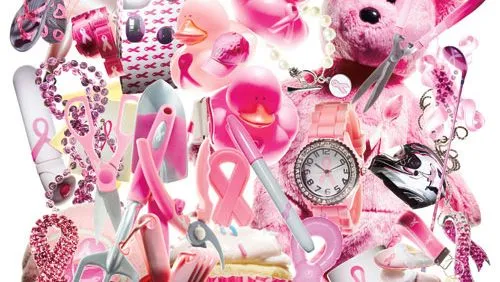
Though the NFL has, shall we say, a complicated history with women, its embrace of breast cancer awareness is perhaps only fitting. After all, in the nearly 20 years since the pink ribbon became the official symbol of the cause — Estée Lauder cosmetics counters handed out 1.5 million of them in 1992 as part of the first-ever nationwide awareness campaign to leverage the pink ribbon — breast cancer has become the NFL of diseases, glutted with corporate sponsorships, merchandise deals, and ad campaigns. This is true year-round, but especially in October, when breast cancer marketing reaches a frothy pink frenzy. This month, an awareness-minded consumer can buy almost any knickknack or household item in pink — from lint brushes and shoelaces to earbuds and Snuggies. If she happens to be in an American Airlines Admirals Club, she can snack on pink cookies while drinking pink champagne. If instead she finds herself at one of the nation's 500 Jersey Mike's Subs franchises, for about $7 she can order the "pink ribbon combo," consisting of a sandwich, chips, and soda served in a limited-edition pink plastic cup (because nothing says "cancer awareness" like chips and soda).
Though breast cancer researchers and advocates perpetually plead for more money, the disease is, in fact, awash in it. Last year, the National Institutes of Health, the nation's top agency for health-related research, allocated $763 million to the study of breast cancer, more than double what it committed to any other cancer. The Department of Defense also funds breast cancer research ($150 million this year), as do several states, most notably Texas and California. All that is in addition to the money raised by the roughly 1,400 IRS-recognized, tax-exempt charities in this country devoted to breast cancer. They operate in every state and in just about every major city. The largest of them, Dallas-based Susan G. Komen for the Cure, grossed $420 million last year alone. All told, an estimated $6 billion is raised every year in the name of breast cancer. And the money keeps pouring in.
Which seems like great news for the fight against breast cancer, and in part it is (though not as great as it sounds, and we'll get back to that). But it's also been a boon for charity scammers — the charlatans who prey on the public's beneficence and its inveterate laziness when it comes to due diligence. The nonprofit world is full of them. (Greg Mortenson, the celebrated author of Three Cups of Tea, is only the latest philanthropist to battle allegations that his organization, the Central Asia Institute, misused funds.) Breast cancer makes a particularly alluring target — not just because there is so much money involved or because women across all income levels tend to give more than men, but because we give to breast cancer forcefully, eagerly, superstitiously. Breast cancer holds a peculiarly powerful sway with us — it's a disease dreaded so profoundly that not supporting the cause feels like tempting fate.
When our minds wander to the unthinkable, breast cancer tops that black list of God-help-me scenarios, conjuring up images of surgery, mutilation, chemotherapy and its attendant nausea, and hair loss (as terrifying as losing a breast for some); of helpless partners convincing us (and themselves) that we're still as desirable as before; of living with a constant, insidious fear that it's never really over. It's about our breasts, for chrissake, the embodiment of femininity, sex appeal, and motherhood. It is a disease of agonizing choices (Christina Applegate's preventive double mastectomy) and unfathomable compromises (Elizabeth Edwards' deathbed denouement with her wayward husband). This is what breast cancer means to many women, and it's why, unlike even ovarian or uterine cancer, it makes us suckers for every pink-ribbon trinket and walkathon solicitation that crosses our paths.
In this environment, it's difficult to ask questions. "You know, breast cancer has been untouchable for a while. If you question anything, well then, you must hate women," says Gayle Sulik, author of Pink Ribbon Blues. "That mentality makes it really hard to say, 'What's working? What's not working?' The goal is eradication. Isn't that what we say we want?" There is no denying that money raised for research has been instrumental in the fight against breast cancer. Sophisticated digital mammography has reduced the risk of false-positive diagnoses; the discovery of genetic markers has allowed women with increased risk for breast cancer to weigh their preventive options early; drugs like Herceptin, which targets the proteins responsible for a cancer cell's growth, have demonstrated remarkable results in the 20 percent of patients afflicted with the particularly aggressive HER2-positive form of breast cancer. Doctors warn that there are never any absolutes when it comes to breast cancer, but for the 60 percent of women diagnosed at the earliest stage, survival is virtually guaranteed.
Yet what many in the breast cancer community are loathe to admit, despite all these lifesaving developments, is that, in fact, we are really no closer to a cure today than we were two decades ago. In 1991, 119 women in the U.S. died of breast cancer every day. Today, that figure is 110 — a victory no one is bragging about. Breast cancer remains the leading cancer killer among women ages 20 to 59; more than 1.4 million new cases are diagnosed annually worldwide. Roughly 5 percent, or 70,000, breast cancer patients are diagnosed at a late stage, after the cancer has metastasized — that rate hasn't budged since 1975, despite all the medical advances and awareness campaigns. For these women, the prognosis remains grim: Only 1 in 5 will survive five years out. Fundamental questions still elude researchers: Why do a third of all women considered cured by their doctors suffer recurrences? Why are breast cancer rates rising in Asia, where they've been historically low? Is it even possible to prevent breast cancer, and if so, how?
A popular gripe among advocates is that too much is spent on awareness campaigns — walks, races, rallies — at the expense of research. (And really, when Snuggies go pink, haven't we hit our awareness saturation point?) There's a case to be made for that, of course, but there's another explanation, one that exposes an ugly, even blasphemous truth of the movement: Breast cancer has made a lot of people very wealthy. The fact is, thousands of people earn a handsome living extending their proverbial pink tin cups, baiting their benefactors with the promise of a cure, as if one were realistically in sight. They divert press, volunteers, and public interest away from other, more legitimate organizations, to say nothing of the money they raise, which, despite the best intentions of donors, doesn't always go where it's supposed to.

In 2001, Hillary Rutter received a call at her Plainview, Long Island, home from an outfit called the Plainview Chapter of the Coalition Against Breast Cancer, asking for a contribution to help subsidize the medical expenses of local breast cancer survivors. Rutter, the director of the Adelphi New York Statewide Breast Cancer Hotline & Support Program, had never heard of the group and didn't know any of its board members. When she asked pointed questions about where donations were going, the caller hung up on her. Three weeks later, she received an invoice from the CABC stating that she'd pledged $25.
Galled that a fly-by-night operation would exploit the issue of breast cancer in Long Island, where women have long suspected they are at an epicenter of the disease, Rutter secured a copy of the group's financial records. (Tax returns of nonprofits are available to the public.) What she saw shocked her: Breast cancer patients saw virtually nothing from the $1 million the group had raised. Instead, those dollars went to telemarketers and salaries. Rutter began keeping a file on the group, which over the years grew thick with complaints about harassing calls and questionable fundraising tactics. "As far as I know, the CABC has done nothing but line their own pockets," says Rutter. "They're just horrible."
Last June, New York Attorney General Eric Schneiderman filed suit against the Coalition Against Breast Cancer, calling it a "sham charity" that for 15 years "served as a personal piggy bank" for the group's insiders. According to the complaint, founder Andrew Smith; his girlfriend, Debra Koppelman; and their associates pilfered almost all of the $9.1 million raised in the past five years alone. Other eye-opening claims: The telemarketing firm hired to solicit donations was owned by CABC cofounder Garrett Morgan, who billed the charity $3.5 million for his services. In total, Smith and Koppelman paid themselves more than $550,000 in salaries between 2005 and 2009, plus another $150,000 in retirement accounts, this though both held down full-time jobs as recruiters. The CABC issued Smith a $105,000 personal loan, which he squandered on bad investments; Koppelman authorized a $50,000 loan to herself toward the purchase of a home. (CABC is contesting these claims.)
"There is a lot of deception that goes on with breast cancer groups," says Daniel Borochoff, president of the American Institute of Philanthropy, a Chicago-based nonprofit watchdog group. One problem, he says, is that breast cancer charities are often run by well-meaning but inexperienced survivors or relatives who duplicate the efforts of established organizations. They use donor dollars to print their own educational brochures, though they certainly exist elsewhere; they organize events to promote awareness — "Skydive to End Breast Cancer!" — then blow too much of their funds getting these events off the ground. There's no requirement of a college degree or business experience to run a charity. You don't even need a clean legal record. (The treasurer for the Coalition Against Breast Cancer was a Long Island housepainter with several warrants for unpaid child support.) Even the names of many charities are designed to fool donors into believing they are bigger and more impressive than they are. Case in point: Though its moniker suggests it presides over a vast network, The Breast Cancer Charities of America is a tiny, three-woman outfit operating just outside Houston that banked $2 million in 2009, mostly through telemarketers. (Founder Erica Harvey says she came up with the name "with a team of marketing consultants.") "Any bozo can set up [a charity] and start soliciting," adds Borochoff.
All charities must file detailed financial reports with the Internal Revenue Service, but they don't have to be audited, or certified by a licensed accountant. In effect, anyone can write them up and turn them in. Some states require that a CPA review the books, but the rules vary widely. In California, only groups grossing $2 million or more per year need a CPA's certification; there's no auditing requirement at all in Texas. Even still, it's alarmingly easy to boost a charity's numbers to make it appear as if it's spending more on its mission — education and support groups, for example — than it actually is, especially for the many nonprofit outfits that rely on telemarketing. Here's how it's done: If a telemarketer charges, say, 70 cents for every dollar it collects — telemarketers are as expensive as they are annoying — a charity can write off some of that expense as part of its educational mandate by stamping "Don't forget to get a mammogram!" at the bottom of its invoices to donors. Another common accounting trick allows charities to accept gifts — say, a used car worth $500 — but then report these contributions at a much higher value. Neither tactic is illegal, by the way. What's the point of all this financial monkey business? Size matters when it comes to charities. The bigger the organization, the more reputable it seems, and the more likely it is to receive your cash.
The Breast Cancer Society, based in Mesa, Arizona, has made an art form of this kind of creative accounting. Founded in 2007 by James T. Reynolds II, now 37, the organization provides critically ill breast cancer patients across the country with cash grants to pay for everything from groceries to medical bills, Reynolds says. In 2009 (the most recent year for which tax records are available), the BCS claims it raised $50 million in contributions, the bulk of which went to supplying medicines to hospitals in Third World countries like Guatemala and Ethiopia, ostensibly for the treatment of breast cancer. (Reynolds says he has visited only three of the eight hospitals that purportedly received these medicines.) Press him on his group's finances and he admits that, in fact, BCS raised just $15 million in cash donations in 2009. The other $35 million represented his estimate of medications that the BCS accepted as gifts or bought at a major discount but then listed on its books as having much higher values. For example, BCS reported that it sent $8.8 million worth of goods to hospitals in East Asia. "I'd have to look it up, but it probably cost us maybe $40,000 to procure and distribute that," Reynolds concedes in a phone interview. Where do these medicines come from? Reynolds says he gets them from other organizations, including the Ontario-based Universal Aide Society, which saw its Canadian charitable status revoked two years ago for malfeasance. (Its employees used funds to finance vacations and other personal expenses.) This so-called "gifts in kind" scheme makes BCS seem a whole lot bigger than it actually is and obscures the fact that the group spent 90 cents of every dollar that it raised on telemarketers, not patients.
Nonprofits don't seem a likely place to make a fortune. But in 2009, Reynolds collected a $223,276 paycheck, nearly double what he made the year before. (Perhaps that's only fair given that over the same period, he doubled his telemarketing efforts, which, in turn, nearly doubled what BCS brought in from solicitations.) He says his salary is comparable to that of executives running similar organizations and commensurate with his 18 years of nonprofit experience. He neglects to mention that his experience has been limited largely to his work with the Cancer Fund of America, a controversial group founded by his father, which has been blasted by both the Better Business Bureau and the nonprofit rating agency Charity Navigator for giving less than a penny of every dollar raised to cancer patients. Charity Navigator once listed the Cancer Fund of America Support Services, an affiliate Reynolds ran between 2003 and 2007, as one of "10 Non-Profits That Make Ebenezer Proud." Reynolds was also one of the Cancer Fund of America's highest-paid employees for several years, serving as its vice president between 2006 and 2008. In 2007, the Georgia Governor's Office of Consumer Affairs accused that group of making false and misleading claims in its mail solicitations, allegations that the Cancer Fund of America ultimately settled for $50,000. Reynolds is nonplussed by critics who say he's taken a page from his father's "one for you, three for me" playbook and applied it to his Breast Cancer Society. "I've offered to have people come and visit our facilities and sit down with them and open our books up," he says calmly. "I don't ever want to run an organization that hides things."

It's good practice, say experts, for charities to make their financial records accessible to the public on their websites. But most, including the Breast Cancer Society, do not. "Nobody wants you poking around their financial drawers, asking why this much is spent on salaries versus this much on research. Who wants to deal with that?" explains charity consultant Gary Snyder, author of Silence: The Impending Threat to the Charitable Sector. Tax returns for all IRS-recognized nonprofits, dubbed "990s," are free for perusal on guidestar.org, but these are usually two or three years old, and realistically, how many of us would even know how to read them? So donors rely on groups like Charity Navigator, which uses tax returns to rate organizations on transparency and how much they spend on actual services versus overhead and salaries. The problem is, these ratings are notoriously unreliable, since tax returns are prepared by the organizations themselves. It would be as if your Equifax credit score were based on credit card statements you devised for them. (Last year, Charity Navigator announced that it would revamp its evaluation process.)
For the past six years, Charity Navigator has conferred its highest four-star rating on the National Breast Cancer Foundation, based in Frisco, Texas, a suburb of Dallas. The NBCF is something of an institution in the area, each year doling out 50 or so grants of upwards of $40,000 apiece to clinics and hospitals across the country to subsidize mammograms for the uninsured. (All told, the NBCF claims to have paid for 130,000 mammograms.) The group was founded two decades ago by breast cancer survivor Janelle Hail, a charismatic Paula Deen look-alike. Despite its size — it garnered $10 million in donations last year — and blue-chip partnerships with the likes of Dannon and Fujifilm, the NBCF could be called a family business. Buried in the footnotes of its latest tax return: A significant wing of the Hail family is employed by the NBCF. In 2009, Janelle Hail took home a $172,000 salary, plus another $57,000 in "other compensation." Her son Kevin Hail, NBCF's chief operations officer, makes $130,000, plus another $55,000 in other compensation. (Both have enjoyed raises of upwards of $10,000 per year since 2005.) NBCF also employs Hail's husband, Neal, as "senior consultant" and son Brent, who is the vice president of operations. But because the IRS requires that charities only disclose the salaries of its board members, key employees, and anyone else earning more than $100,000, Neal and Brent don't qualify, and Hail won't say how much she pays them, despite Marie Claire's repeated requests.
Family-run charities are standard fare in breast cancer circles, and, not surprisingly, family ties raise some discomforting conflicts of interest. Phyllis Wolf and her son Joseph cofounded the Baltimore-based American Breast Cancer Foundation in 1998. Its mission: Provide financial assistance to uninsured breast cancer patients. For most of its history, the American Breast Cancer Foundation relied on telemarketers to solicit donations. But by 2002, Joseph had struck out on his own, opening a marketing firm called Non Profit Promotions, which, despite four other vendors providing similar services, quickly scored the ABCF's biggest telemarketing contracts. "He always [tried] to give us the better deal, having had a relationship with the foundation," says Sherri Walters, development associate at the ABCF. Non Profit Promotions generally pocketed about 40 cents for every dollar it collected, and over the course of nine years, Joseph billed his mother $18 million for his services. ABCF terminated its relationship with Non Profit Promotions in 2008, about a year before Phyllis Wolf took early retirement.
The net result of all this profiteering? Pink has lost its punch. "All these groups that have sprouted up around the country have diffused the attention to breast cancer," contends Fran Visco, president of the National Breast Cancer Coalition and former chair of the Integration Panel of the Department of Defense Peer-Review Breast Cancer Research Program. "They take up dollars and put them into little pots all across the country. They take away from the efforts that can — and do — make a difference. They should all be focused on putting themselves out of business." But who closes up shop when business is booming?
For anyone worried about where their donations are going, here's a useful tip: Skip the pink-ribbon merchandise. Because no one really owns the rights to what has become the universal symbol of breast cancer (though Susan G. Komen for the Cure trademarked its own version), peddling the logo has become a massive racket, overrun by slick profiteers exploiting the public's naive assumption that all pink purchases help the cause. Often they don't. Tchotchke vendor Oriental Trading sells an extensive line of pink-ribbon party favors, including "Find the cure" car magnets and "I wear pink in honor of" buttons. Save for proceeds from its pink rubber duckies, part of a sponsorship deal with Komen, not a penny of Oriental Trading's breast cancer novelties goes to breast cancer. Three years ago, veteran nurse Christina McCall, the daughter of a breast cancer survivor, launched Pink Ribbon Marketplace, an online store based in Germantown, Tennessee, with a vast array of pink-hued goodies. "As a woman and the mother of three daughters, it quickly became apparent that creating a business that gives back to breast cancer victims and their families was important to me," she writes on her store's website. "I personally chose our local American Cancer Society and Reach to Recovery Program to be the receipient [sic] of funds we donate." But when asked about those donations, McCall fesses up that, in fact, no monies have ever gone to the American Cancer Society or its breast-cancer-targeted Reach to Recovery program. "I'm a little leery of [donating money]," McCall told Marie Claire. Instead, she says she gives away free products to charity events and donates to individuals — "depending on my profits." (Shortly after MC contacted her, McCall removed any reference to the American Cancer Society from her website.)
Last year, the Better Business Bureau issued a warning to consumers about misleading or vague claims made on the packaging of pink-ribbon-festooned products. "Simply because a company puts a pink ribbon on its package doesn't always mean a good breast cancer charity is benefiting from your purchase," noted Michelle L. Corey, a BBB exec.
Google "pink ribbon," and the first listing to pop up is pinkribbon.com, the glossy website of Pink Ribbon International, an Amsterdam-based outfit owned by Dutch businessman Walter Scheffrahn. The site serves up an eclectic mix of breast cancer information and merchandise, including a yard sign ($14.99) and barbecue apron ($16.99) embossed with the site's logo. Over the past seven years, Scheffrahn has shelled out 200,000 euro ($288,000) to buy the rights to the enviable pinkribbon.com domain name in roughly 40 countries. "There's not a real global awareness of the pink ribbon," says Scheffrahn. "We want to take it to the next stage." But despite its official-looking packaging, his site is riddled with misleading information, including a statement that Scheffrahn's company donates "10 percent of its company capacity and funds" to charity. Exactly how much is that? Scheffrahn says it refers to manpower, not actual dollars. Scheffrahn also claims that 90 percent of donations made to breast cancer through his websites go to charity. (Ten percent is reserved for overhead, he says.) But this, as it turns out, is also a bit fuzzy. Scheffrahn says his entire Web network generated "something like $20,000" by the end of last year. (That's hard to confirm given that, at press time, pinkribbon.com's tax returns were not yet available to the public.) So where did the $20,000 go? Scheffrahn confesses that not only hasn't he donated the money yet, he's unsure which organization to give it to. "It will go to a fund we think is appropriate," is all he can come up with, as though it were the first time he'd ever been asked the question.

WHERE SHOULD YOU GIVE?
These well-regarded breast cancer organizations spend most of their funds on research and treatment:
INVESTIGATE BEFORE YOU DONATE
Crucial questions to ask before donating to a breast cancer charity, courtesy of the American Institute of Philanthropy:
1. How forthcoming is this charity?
Never give to a charity you don't know anything about. If you can't find an annual report or tax return on the charity's website, ask to see one before donating. Think twice about giving to a charity that drags its feet on such a basic request. You have a right to know how much the organization is raising and spending — and how it does that.
2. Where is the money going, exactly?
Find out how much of your donation goes to overhead — administrative and fundraising costs — versus actual programs and services. The American Institute of Philanthropy recommends that at least 60 percent of charitable donations go to actual services. (That means that the bulk of your dollars go to, say, research or underwriting mammographies versus, say, paying salaries and marketing costs for an event.) "Most highly efficient charities are able to spend 75 percent or more on programs," according to the AIP. Note: Be especially wary of charities that list "public education" as a service — the oblique term is often used to disguise telemarketing expenses. If the charity rep says it sponsors educational programs, pin him on specifics.
3. How clear is the charity about its long and short term goals?
Be skeptical of breast cancer charities whose mission statement includes "awareness". What exactly does that mean? How does it plan to make people more aware? At what point will it have satisfied its mission?
4. Am I being pressured to donate?
Do not give a dime to charities that use guilt, harassment or other aggressive tactics to solicit a donation. And you're under no obligation to donate, even if the charity has sent you stamps, cards or other 'gifts' designed to sway you. It's also OK to ask for more information about the charity in writing. If the charity balks, don't give, period.
5. Don't be fooled by impressive or familiar names of charities.
It's astonishingly easy to set up a charity and name it whatever you'd like. Some dubious charities specifically use names that sound like larger, more reputable organizations to confuse donors. Check out whether the charity has ever received complaints with your local Better Business Bureau (www.bbb.org) and review the latest financial reports the charity has available at Guidestar.org.
6. Is the person soliciting a donation from you a volunteer or a professional fundraiser (ie. a telemarketer)?
You have a right to ask and a right to know. Keep in mind that telemarketers, while perfectly legal, are rather expensive. Which means less of your donation goes to the cause.
THINK BEFORE YOU PINK
Not all pink ribbons benefit breast cancer. Before you buy a product anything to support "the fight against breast cancer", ask these key questions:
How much money from the purchase actually goes toward breast cancer programs and services?
Can you tell? If the company selling the merchandise says "a portion of proceeds", find out how much exactly. (The packaging or label ought to make this explicit.) Also, is there a cap on how much the company will donate to charity in total? Some companies will give a set donation, regardless of your purchase.
Where is the money going?
What organization will get the money? If you can't tell or you don't know what the organization does, reconsider your purchase.
What types of programs are being supported?
If research, what kind? If services, are they reading the people who need them most? Be wary of programs supporting "breast cancer awareness" — what exactly does that mean? How are they making consumers aware?
Is the product itself not contributing to the breast cancer epidemic?
In 2010, Susan G. Komen for the Cure controversially partnered with KFC on a "Buckets for the Cure" campaign, which promptly inspired howls from breast cancer advocates who argued that fatty foods like fried chicken actually raise your risk for breast cancer.
Questions courtesy of Breast Cancer Action.