Can Your Sunscreen Cause Skin Cancer?
A new study claims your SPF might be doing more harm than good.
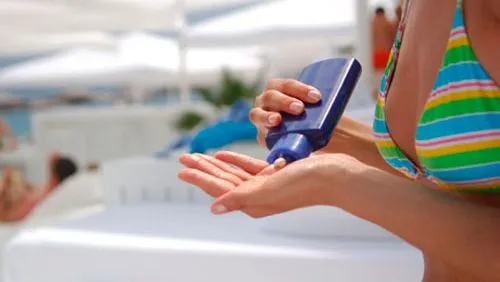
A new study has found that an overwhelming amount of sunscreens on the market contain an ingredient that speeds cancerous cell growth. That's right: sunscreen might cause cancer, the very thing people lather it on to protect themselves from.
But don't go throwing out your white creams, sprays, oils, and lotions just yet. Many doctors and dermatologists aren't convinced that sunscreen should go the way of canola oil and old-school Coppertone.
Dr. Marta Rendon, a board-certified dermatologist and global spokesperson for Procter & Gamble's Head and Shoulders division, tries to assure worried consumers that the results — released last week by the Environmental Working Group, a nonprofit public health organization — come from animal testing only and are the findings of "just one study."
According to that study, nearly half of the 500 most popular sunscreens may actually increase the speed at which malignant cells develop and spread skin cancer such as melanoma.
Why? Because they contain Vitamin A, an ingredient that was added to sunscreen formulations because it's an antioxidant that slows skin aging.
This isn't necessarily new information to Rendon, who acknowledges that some studies suggest "that vitamin A might have some phototoxicity." Still, she says that "it does not necessarily correlate that it'll increase your risk of skin cancer."
To be safe, however, Rendon recommends using sunscreen that blocks both UVA rays — the ones that penetrate the skin more deeply to cause aging issues such as fine lines and wrinkles — and UVB rays, which are the ones that can give you a sunburn and are more responsible for cancer.
Celebrity news, beauty, fashion advice, and fascinating features, delivered straight to your inbox!
"Both forms of ultraviolet light are carcinogenic and increase the risks of skin cancer, but some sunscreens don't target both — most of the new ones are UVA blockers," Rendon says. "You need to block both."
Although in its annual report, the EWG only recommended 39 of the 500 products they examined as safe to use, Rendon says that all FDA-approved sunscreens have undergone rigorous trials to prove their efficacy and hold up against safety standards. (Some brands she recommends? Any with Helioplex, such as Neutrogena's line, or with Mexoryl like La Roche-Posay.)
But regardless of where you stand, she says that by following a few simple rules, you'll be safe in the sun: