A massive billboard looms over my San Francisco neighborhood, towering above taquerias, bars, and churches. It features a giant photo of a woman and her baby—at night, they're illuminated against the dark sky. The text next to them reads, "Change your mind? I did," and offers the number for a hotline that's staffed 24/7.
Emily Duerr is the woman in that photo. She was a 19-year-old college student living in her parents' crowded duplex when she discovered she was pregnant. The baby's father told her he wouldn't help—she should get an abortion, he said.
"I thought I had no other option," Duerr tells me. She visited a Planned Parenthood clinic for the procedure, but after she took the pill that would start the process, she felt like she'd made the wrong choice. Duerr wanted out, but feared it was too late. That's when she says God told her to search "abortion reversal" online, which led her to a women's center in San Jose. Eight months later she gave birth to a baby boy.
The man on the other end of Duerr's Google search was George Delgado, M.D., an outspoken Catholic who has called abortion "a grave evil" that "spiritually scars" women. A general physician trained at the University of California, Davis, Delgado declared in 2012 that he had found a way to reverse medical abortions (the nonsurgical abortions achieved with prescription pills up until 10 weeks into pregnancy). He explained that if a woman changed her mind after taking the first dose of medication, he could counteract the abortion process with high amounts of progesterone. He could prove it, he said.

His case series, published in The Annals of Pharmacotherapy, included just six women. They had all begun medical abortions, changed their minds, found Delgado, and received his treatment. Four of the six delivered healthy babies. According to Delgado, those four successful pregnancies verified his claims.
Many members of the medical community disagree. They assert that the case series doesn't constitute credible, medically accepted evidence—for one, it skipped the standard protocol of a control group. It also "used inappropriate comparison groups, was too small to support scientific conclusions, and used data collection that was unverified, inappropriate, inaccurate, results-oriented, and without appropriate ethical safeguards necessary for human research," says Diane J. Horvath-Cosper, M.D., a reproductive health advocacy fellow at Physicians for Reproductive Health. "So-called abortion reversal has not been tested for safety, effectiveness, or the likelihood of side effects." Although progesterone is generally well tolerated, it can cause "significant cardiovascular, nervous system, and endocrine adverse reactions as well as other side effects," according to the American Congress of Obstetricians and Gynecologists (ACOG).
David Grimes, M.D., former chief of the abortion surveillance branch at the Centers for Disease Control and Prevention, called the article little more than a "collection of anecdotes from Catholic physicians" and accused Delgado of making "numerous scientific errors" and "violating the essence of the scientific method."
It's possible the women in Delgado's case series would have experienced the same results if they'd simply had no reversal treatment at all. That's because research shows that Mifepristone—the first of two medications, which these women took before changing their minds—isn't effective at inducing abortions unless it's followed up with a second drug called Misoprostol. Taken alone, Mifepristone does not lead to abortion up to 46 percent of the time; when followed by Misoprostol, the procedure completion rate shoots up to 97 percent.
Even still, conservative lawmakers have begun using Delgado's research to shape regulation across the country. The Washington, D.C.-based group Americans United for Life has crafted "model" legislation requiring doctors to tell women seeking an abortion that reversal is an option, despite the lack of evidence that it is. At least nine states have introduced bills.
Now the medical director of the pro-life Culture of Life Family Services, Delgado tells me that he's been working with other doctors on two new studies that are ready for publication. The first, he says, will show that when taken alone, Mifepristone is more effective at causing abortions than currently thought. The second will include data from more than 200 women who gave birth after going through his Abortion Pill Reversal (APR) treatment. Delgado claims they will prove, once and for all, that the treatment is real.
Forty-five minutes outside San Diego is Escondido, California, home to one of Delgado's family practices. It sits in a strip mall near the freeway, surrounded by fast food restaurants and tattoo parlors—here and at the 350 APR network facilities around the world, OBGYNs, family practitioners, nurses, midwives, and other certified medical professionals administer his signature APR treatment to women hoping for a miracle. According to Culture of Life executive director Sara Littlefield, all are volunteers.
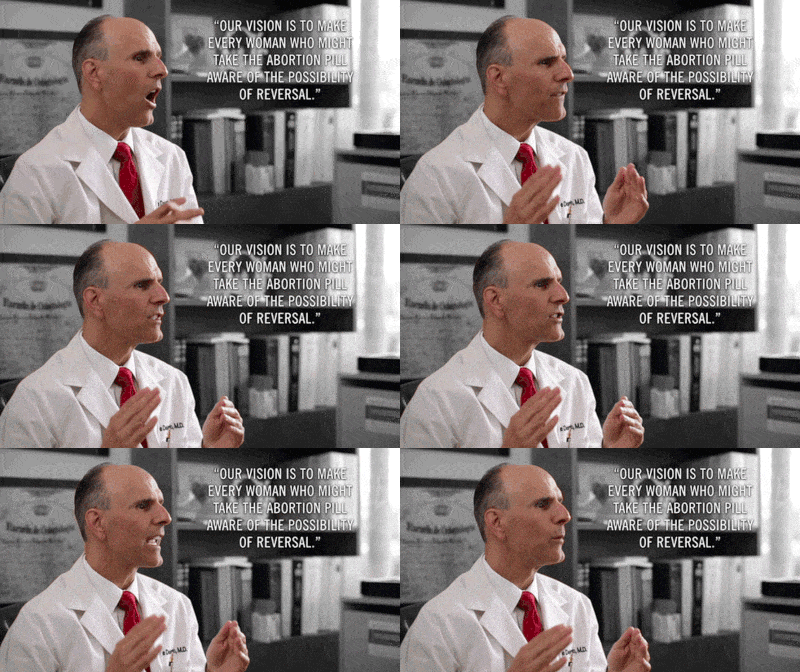
George Delgado, M.D., discusses his hopes for the APR network.
Inside the waiting room, a young woman sits on a chair while her three young sons—the oldest perhaps 6, the youngest a toddler—grapple with one another, laughing. They play beneath a towering statue of Mother Teresa with a child on her arm while their mother speaks in Spanish to the receptionist. An early-20s couple emerges from the back of the office and crosses the lobby with a waddling girl and a boy in a baby carrier. The receptionist coos at them. The father drove two hours from work in Burbank to get to this appointment, he tells me, but it's worth it because he and his wife really like Dr. Delgado and he's become their family doctor. They found him, he says, when they were "a little shaky" about having their first child.
Eventually Dr. Delgado appears. He's polite and welcoming, warmer in person than in the APR promotional videos I'd seen, in which he talks about abortion reversal's "redemptive value" for women.
That value is in fierce dispute. Last year, the state of Louisiana passed a resolution asking the Department of Health to study abortion reversal. According to their report, there wasn't proof that the treatment worked: "In reaching this conclusion, the panel [of medical experts] expressed great concerns about the experimental nature of using progesterone treatment after taking mifepristone, as highlighted in the Delgado study, and the failure of the study to meet the established standards of safety, efficacy, and ethics," they wrote.
Delgado maintains that many of the criticisms of his original article are unwarranted, countering that it was "an observational case series" not a controlled trial, that he "made no errors in simply reporting on the experience of women who received progesterone," and that his work has nothing to do with any myth or opinion. Despite the criticism of APR, there doesn't appear to be any evidence that the treatment harms fetuses or causes them to develop abnormally—Delgado reports that babies whose mothers have undergone the treatment have the same rates of illness and abnormalities as babies whose mothers have normal pregnancies. I never heard contradictions to that in my reporting, even among staunch critics. But without medically robust, peer-reviewed research, Delgado's claims are anecdotal at best.
Horvath-Cosper, the health advocacy fellow, told me she thinks that the problem with Delgado's science is that it was done backwards, with a desired result in mind—one that would support an ideological agenda. "It's not unusual to have strong views," she says. But, she argues, "high-quality science starts with a testable hypothesis; Delgado starts with his personal opposition to abortion."
Delgado has called abortions "a scourge and a plague on our society." He's also opposed to basic and common forms of contraception like condoms; he refers to contraception itself as "evil." In a 2013 appearance on Catholic Answers Radio, where he has been a guest dozens of times, a caller asked Delgado if it was morally permissible for a man with AIDS to wear a condom to protect his wife from becoming infected during sex. Delgado replied that it wasn't acceptable to use condoms ever. "Contraception [puts] a barrier between he and his wife," Delgado said. "The conjugal embrace is no longer a total gift of one to the other."

Catholic iconography, like this statue of the saint Mother Teresa, fills the waiting room of Dr. Delgado\'s Culture of Life clinic in Escondido, CA.
It's one of many such beliefs Delgado has expressed during his radio appearances that go against the advice of the medical community. He is also opposed to a woman having her tubes tied ("tying tubes is only for the expressed purpose of stopping fertility"), disagrees with in-vitro fertilization ("the whole sexuality of the husband and wife is torn asunder"..."instead of a husband impregnating his wife, it is a technician"), and believes that birth control and euthanasia are intrinsically linked.
But in person, Delgado doesn't come off as an extremist. He has the measured calm of a man who believes he's doing the right thing.
Like the APR clinic in Escondido, the St. Juan Diego Women's Center in San Jose—where Duerr went back when she was 19—is filled with Catholic iconography. Statues of saints stand more than a foot tall and there's an altar set up in the staff break room.
On the way in, I notice that it's situated strategically: across from a high school and next to a Planned Parenthood. Volunteers tell me they regularly stand in the parking lot and pray for the women walking in there, hoping to keep them from making "the wrong decision." No one can prevent them from doing this, they point out—the parking lot is public property.
"Our motto is, 'Anything to save a baby,'" says Willie Lapus, St. Juan Diego's director. In his native Philippines, he tells me cheerily, there's an absolute ban on abortions, regardless of the circumstances.
Delgado's ideal America might look a bit more like that: "Just as we have laws protecting babies who have already been born from being killed, we should have laws protecting unborn people from being killed," he writes in an email. Delgado tells me he hasn't, or couldn't remember, communicating with lawmakers interested in using his treatment as a basis for enacting regulation, but a bill based on his work was passed by Indiana's House of Representatives at the end of February (it has since hit a roadblock in the judiciary committee). Among other things, the bill would require women undergoing a medical abortion to receive written information about APR—with a disclaimer that it's not scientifically proven.
"We're just saying you have the right to try [to reverse abortion]. We're not saying it's going to work," Republican Representative Ben Smaltz said in February.
Georgia, Utah, Idaho, North Carolina, and Colorado (where Delgado gave expert testimony) have considered or are considering similar abortion reversal bills. Arkansas, South Dakota, and Arizona enacted such laws, but the Arizona legislation was repealed in 2016 after Planned Parenthood sued; the organization called it "a reckless law [that's] a prescription for bad medicine and government interference."

"Essentially, he's experimenting on women," Dr. Daniel Grossman, professor in the department of obstetrics, gynecology, and reproductive sciences at the University of California, San Francisco, says of Delgado, adding that he's concerned the women who got APR couldn't really know what they were agreeing to because the treatment's promises aren't proven. Grossman says he's willing to look at Delgado's forthcoming studies, but questions whether they'll be unbiased: The journal where Delgado plans to publish at least one study on which he is a co-author is partially funded by an organization that focuses on anti-choice issues. In response, Delgado insists that "all new medical breakthroughs occur through experiments," and that his protocol is safe.
Other opponents have said that even if Delgado's upcoming studies show proof that his treatment works, Abortion Pill Reversal is still fraught. "They're making up a problem that doesn't exist," says Amy Everitt, the state director of NARAL Pro-Choice California, explaining that statistically, women rarely regret their abortions. At least 95 percent of women who get an abortion say they made the right decision, according to a survey of 670 women by the Center for Global Reproductive Health at UCSF School of Medicine.
But Delgado says it's a woman's regret that made him develop an abortion-reversal technique in the first place. Five years ago, an acquaintance contacted him because a woman who had taken the first medical abortion pill now wanted to keep the baby. Her desire to change her decision, he tells me, is what led to the creation of APR.
In that way, Delgado seems to believe he is his own kind of "pro-choice:" He tells me his work gives women more options—specifically the option to take back a medical abortion. "If [pro-choice proponents] really consider themselves pro-choice, then they should have no problem giving women a second choice," Delgado argues.
Like the woman who inspired him to start it all. "I still have her picture there on my wall," he says, pointing to a three-by-five photo pasted to a colorful piece of paper. I ask what her name is. Delgado says he can't remember.
I think Delgado is motivated by things other than women's health," Everitt says. "What folks like him are doing is taking their own agenda and trying to push it on others, but portraying it as spiritual support."
Delgado openly admits that his Catholic faith shapes many of his views, but insists that his motivation is simply helping women. When I press him about his religion-based stance on condoms and contraception, he stands by it: "I would not say I'm anti-contraception—I would say I'm pro-natural law and pro-supporting the meaning of the sexual embrace," he clarifies. "The natural design of sex is that it's a man and a woman coming together in an exclusive relationship, which is marriage, and it has two components: a unitive aspect and procreation. These two are inextricably linked."

Everitt argues that it's antithetical to be opposed to abortion and contraception when contraception can prevent so many unwanted pregnancies. After all, contraception is directly linked to lower abortion rates. "These men are actually anti-women," she says. "They have a worldview where women should not have sex for pleasure. And when women do, they believe there's a price to pay for it—and that price is unwanted pregnancies that women should continue no matter what."
Delgado vehemently rejects that implication."How can I be anti-woman when I am helping women who ask for my assistance?" he asks. "I give those women who request it a second chance at choice."
But women often agonize over the decision to get an abortion, Everitt points out, and having laws in place that mandate women be told that APR is an option—even and especially when there's a disclaimer about the treatment's efficacy—makes an already distressing situation that much harder. Among women in that UCSF study, 53 percent said that making the decision to have an abortion was "difficult" or "very difficult."
And then there's the challenge of seeing it through. The obstacles—finding a doctor who performs abortions, traveling potentially hundreds of miles or across state lines to get to their clinic, walking into an office that may be surrounded by protesters, telling complete strangers about something intensely personal, and having a procedure that could make you feel ill—may partly explain why APR has received more than 1,800 calls to its hotline since 2012, including 600 in 2016, according to a rep for Culture of Life Family Services.
These women pay between $200 and $1,500 for the treatment, if the expenses are out of pocket. Insurance will often cover the therapy, considering it miscarriage prevention, says the clinic's Nurse Manager Debbie Bradel, R.N. If no one else will pay, sometimes Culture of Life will—or a doctor will treat the woman for free.
"That's why we do what we do, to give these women the opportunity to be moms, to have that motherhood, to own that motherhood," says Littlefield in an APR promotional video.
But in the midst of all this focus on the women—to make the "right" choice in the first place, to undo the "wrong" choice if you didn't—there's a part of the equation that's left out. It takes two to conceive a child, but women who seek abortions are often alone, isolated from family and friends by shame or fear of judgement. Many women end up raising their children by themselves—out of 12 million single-parent families in the U.S. in 2016, more than 80 percent were headed by single mothers.
American women's bodies and what they do with them will be fought over—by people like Delgado and organizations like Planned Parenthood—until that full picture is front and center. Until we're realistic about the scope of motherhood and what it truly means for the woman at its heart.
In so many cases, the burden of child rearing falls disproportionately on her shoulders. It would be nice if there were a way to reverse that, too.
