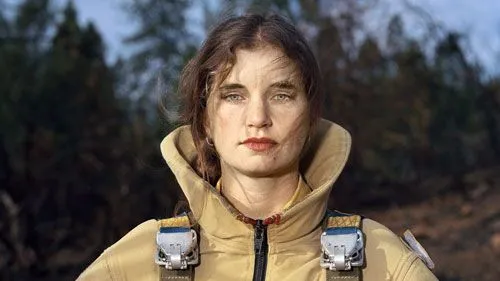
KATIE "K.T." SCHEER, 33: The Smokejumper
Redding, California
Time on the job: Ten years
Why she loves it: "I don't do desk jobs"
Perk: Four to six months off in the winter and early spring
"I've always loved being outdoors. So I trained to become a smokejumper—we parachute into wilderness areas that can't be reached by regular firefighters and put out fires before they can spread.
I'm the only woman in my crew—only 5 to 10 percent of smokejumpers are female—but I don't mind. Wearing heavy Kevlar suits, we jump from planes as close as possible to a fire. Then the plane throws our cargo—food and water, plus tools like chain saws. As soon as we hit the ground, we cut a line around the perimeter of the fire to contain it. That means we cut the brush and trees out of the way, then dig a trench down to mineral soil. When the fire hits bare earth, there's nothing for it to burn. Depending on the size, jobs can last from half a day to a week.
My parents worry, but I tell them that the odds of getting hit by a car while driving to a fire are probably greater than the odds of getting injured on a jump. Still, I once 'burned out,' which means I landed in the trees but my parachute didn't catch and hold—it collapsed and I fell. Luckily, I just got the wind knocked out of me.
This job is for people who want to push themselves. But there are great rewards. Every time I jump out of a plane, it's a rush." —As told to Melissa Walker

STEFANIE ALCOCER, 38: The Bomb Squad Technician
Los Angeles
Time on the job: Four years
Her motivation: Protecting the city
Dress code: Her bomb suit weighs 80 pounds
"After 13 years with the Los Angeles Police Department on the gang unit and the anti-terrorism and organized crime unit, I beat out 39 other officers for the bomb squad. It's an elite post that requires an intensive year of training. We have a saying: 'In order to beat the bomber, you have to make the bomb.' I built a pipe bomb first; after that, I moved on to an improvised explosive device, or IED, by creating a circuit that led to the explosive, then attaching a timer. Blowing things up gives me an adrenaline bump and always has.
Our squad investigates terrorist threats and meth labs; we dismantle old military weapons; we use explosives to breach doors during hostage situations. Every call is a potential life-threatening event.
Recently, a shipping container with the word bomb spray-painted on the side arrived at the Los Angeles port from China. We called in reinforcements and shut down the port. Wearing our flak jackets and ballistic helmets, the same kind of gear used in The Hurt Locker, my partner and I drilled a hole through the top of the container and directed our bomb-sniffing dog to investigate. When he didn't alert us to anything, we opened the container from a distance with a system of ropes, clamps, and carabiners. We eventually declared it safe. But you never know. One of my first calls was for a copper pipe bomb at UCLA—I rendered that inoperable using a bomb-deactivation robot. If I hadn't, the explosion would have caused serious injury or death.
The majority of calls turn out to be hoaxes, but you can't get complacent. That's how people get hurt." —As told to Whitney Joiner

ILANA SCHAFER, 30: The Disease Detective
Atlanta
Time on the job: Ten months
Risky moments: Visiting outbreak areas
Early education: She trained as a veterinarian
"As an epidemic intelligence service officer at the Centers for Disease Control and Prevention, I work with rare, contagious, and deadly viruses like Ebola and Marburg. Patients usually develop symptoms such as high fever and severe hemorrhages within a week and can die within days.
When an Ebola or Marburg outbreak occurs, I immediately jump on a plane to the site. We need to find out how many people are sick, where and how they might have contracted the virus, and if they have passed it on. The faster we're on the ground, the faster we can contain further cases.
Once I'm at the site, I interview anyone with symptoms: Did they have any contact with wildlife or anyone else who is sick? Managing this data is how we keep track of the outbreak. For every case, I try to find everyone they've been around, even before they exhibit symptoms. Patients are placed in isolation; on the rare occasions when I visit them, I wear full-body covering, a respirator and face shield, and multiple pairs of gloves. It's heartbreaking to see people suffering, and some patients I've interviewed didn't make it.
Usually, Ebola or Marburg outbreaks happen every few years. But just in recent months, in Uganda and the Democratic Republic of Congo, we've had four. We don't know if that's because more outbreaks are occurring or if we're just getting better at detecting them. I don't worry about infection—if you protect yourself, there's very little risk of contracting either virus—but my family was definitely worried the first time I traveled to an outbreak site. Now they're getting used to it." —As told to W.J.

CRISTINA ZENATO, 41: The Shark Handler
Freeport, Bahamas
Time on the job: 17 years
Why she loves it: "Sharks aren't mean"
Work requirement: Obsessive preparation and control
"Swimming with sharks was a childhood dream, and I finally did it when I went to the Bahamas on vacation in 1994. I remember those early dives as being full of wonder—there were sharks all around me. I was counting them, breathing with them, almost like a member of their school. I was never afraid, just fascinated. I loved it so much I decided to stay, and by 1995, I was training to be a diving instructor and a shark diver. A year later, I was feeding sharks and have been ever since.
As diver operation manager at the Underwater Explorers Society, I oversee a crew of 12 people and six boats. Certified tourist divers come from all over the world to watch me feed and handle the animals. We go about 45 feet below the surface, and sharks swim around us. No one is in a cage. We usually see Caribbean reef sharks, which grow to about 8 feet.
When I tell people what I do for a living, they almost always mention Jaws. But it's just a movie. Sharks aren't as dangerous as people think, and 99 percent of the time it's perfectly safe to be in the water with them. But sharks trigger the primordial fear of being eaten. I'm not a fool: When I'm feeding great whites, which is rare, I know that those sharks eat animals my size, so I'm always in a cage. With other sharks, which have a different diet of dead or injured fish, I wear allover body chain mail when I feed them. They can bite you accidentally—your hand is in the way! I have received minor bites, but only during feeding. The biggest risk with the chain mail is that a shark will clamp down and get its teeth stuck—if it can't get free, it will twist and arch, which could make your arm turn with the animal and cause a dislocated shoulder or elbow. That's never happened to me, but I've seen it with other professionals.
When we do dives with tourists, we use food to get the Caribbean reef sharks close enough to touch. I teach people to pet them gently on the nose so the sharks enter a state called tonic immobility, a natural hypnosis that makes them sleep. It's a specialized maneuver that I have to get in very close for—a shark would never come that close in a casual encounter with a diver. People say, 'Oh! I never knew sharks could do that!' They question what they thought they knew about sharks. When a shark is in tonic immobility, she sinks down to the bottom naturally. Then she's in my lap, this 8-foot animal under the sea. It's magical." —As told to M.W.

SAMANTHA MACIVOR, 37: The Stuntwoman
New York City
Time on the job: Nine years
Why she loves it: "The set feels like home"
Philosophy: "If you don't feel fear, you're not alive"
"I usually work as a body double for actresses who have physical roles or who require dangerous action on-screen. My skills include stunt and precision driving; stair falls; squibs—mini explosives to make it look like you're getting shot; fighting; and ground pounding, meaning I'm willing to hit the ground hard!
According to my parents, I always had natural athleticism. And I was the kid who fell down and got right back up. I took dance lessons my whole life, and in 2003 I was cast as an extra in a rave scene on Third Watch. I was mesmerized by the stunt people. I started trying out their equipment, like an air ratchet, a contraption that lifts you off the ground. But I soon learned that many stunts don't use equipment. Jumping off cliffs is just that—jumping off cliffs!
It took a few months to get my first stunt job—a riot scene for HBO's The Wire where cops were dragging, punching, and kicking people. Now I work regularly. I've doubled for Mariska Hargitay on Law & Order: SVU, Edie Falco on both The Sopranos and Nurse Jackie, and for movie stars like Emma Watson and Scarlett Johansson. In the movie Zombieland, I was yanked out of a car and dragged on my stomach with a high-powered winch system. When I'm not on a job, I train, which means yoga, combat and dance classes, plus gymnastics. I work enough to have a solid salary, but each job has a different budget. Usually I'll get extra if I have to do the stunt more than a few times.
I've never been seriously injured—just some cuts and scrapes and whiplash. But I've been on set where people have been severely burned in fire stunts, and one woman nearly died after a car-crash stunt. In this line of work, there's always a risk.
My scariest stunt was probably one I did for a TV pilot that never aired. The shot was a woman grabbing a child from an apartment that was on fire and then falling from a 10th-floor window. I was in a harness, dangling from a crane with a 4-foot-tall dummy in my lap, and had to plunge 75 feet while attached to a rope. I was free-falling for about 40 feet before the rope began to slow my descent. It was intense.
There have been times when I've thought, Is this safe? But the only time I say no is when I'm already booked. I trust the teams I work with, so I just do it." —As told to M.W.