11 Gripping Books About Tech for When You Need to Log Off
Escape the algorithm by reading these incendiary novels and memoirs about Silicon Valley.

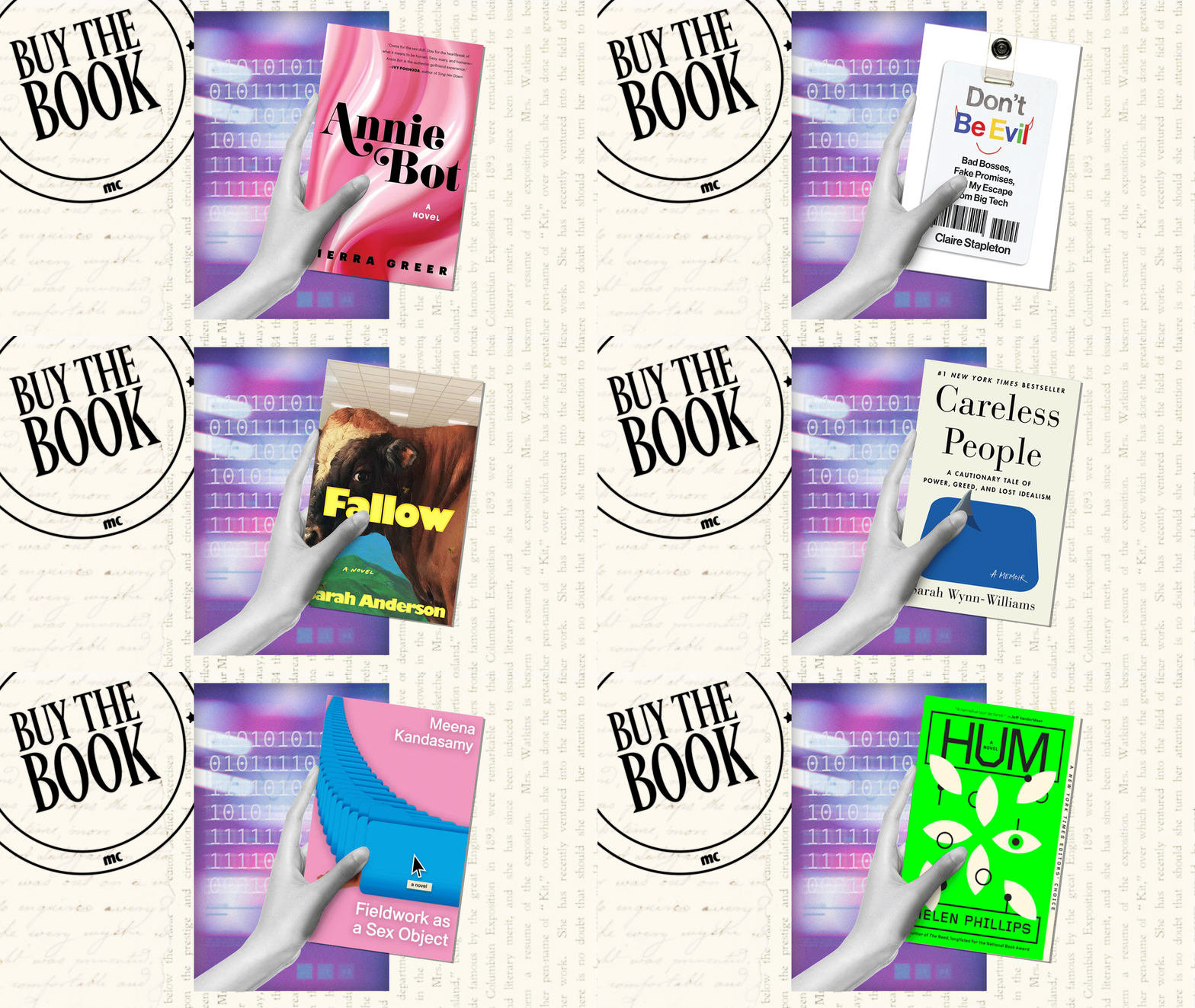
When you're looking to get lost in a book, sometimes you need your reading material to match your mood. With Marie Claire's series "Buy the Book," we do the heavy lifting for you. We're offering curated, highly specific recommendations for whatever you're looking for—whether you're in your feels or hooked on a subgenre trending on #BookTok.
From climate change to data centers, the last thing we needed was another) existential threat. But then, sigh, came the A.I. of it all, gunning for our jobs, entertainment, and, in some cases, logic. In turn, a tidal wave of revolt has risen, interrogating the safety and morality of such technology. And yet, A.I. is everywhere. It’s taken over banking apps. Job searches. And especially culture. Despite its potential risk to, you know, humanity, we can’t seem to stop consuming all there is to read, hear, and talk about Big Tech and A.I.-adjacent fodder.
Our appetite for it is only growing. Just look at the box office numbers for Nathan Fielder and Lance Oppenheim's documentary, You Can See Everything, the incisive look at the days leading up to disgraced former health tech startup Theranos founder Elizabeth Holmes’s prison sentence. It opened at $15 million, which is staggering for a documentary. And it's just one of many incisive looks at technology coming out of Hollywood this year, from dramas like The Social Reckoning and Artificial to the Netflix series The Altruists.
But when doomscrolling or even watching entertainment about our algorithms gets to be too much, you can always log off and read a good book—even ones about this very subject matter. From sci-fi novels about mysterious start-ups and robots to nonfiction about Silicon Valley oligarchs, we rounded up the best books about living in, leaving, and surviving the world of Big Tech.

Not to be a downer, but today’s level of surveillance is like a sci-fi book rather than, say, your morning commute. But here we are. Shoshana Zuboff’s exposé covers how Big Tech has ushered in a new economy in which human data (often without consent) is utilized to sharpen consumer targeting and increase revenue. Revealing how these companies managed this with little federal oversight, she proposes how consumers could take ownership of their data and curtail surveillance capitalism.
Though this may sound more like something you’d read for school rather than entertainment, Zuboff’s arguments are fascinating and passionate. What’s more, you can dip into various sections of the book to satisfy your curiosity.

At the beginning of the novel, Annie Bot’s sole purpose is to utilize her A.I. to be the best possible partner to Doug. And for a while, she is. She provides all the necessary support (and sex) that Doug could wish for. A programmed “cuddle bunny,” Annie is attuned to his needs—even her libido has been programmed to align with his desires. But as her A.I. becomes more refined, she teaches herself to read and even code. But as she advances toward becoming more human (and therefore imperfect), Doug is increasingly harsh and abusive. Becoming cruel and unrelentingly dominant over Annie.
A sharp investigation into what it means to be human (and humane) today, Annie Bot packages moral dilemmas in a galloping novel. An updated take on The Stepford Wives, Annie Bot sings with social commentary, while remaining wildly entertaining.

Well, here it is: The book that started it all. John Carreyrou’s investigative piece, Bad Blood, helped elevate Theranos from a Silicon Valley scandal to an international phenomenon explored in podcasts, docuseries, and a TV show, culminating in the barnburner documentary, You Can See Everything. Carreyrou, then a reporter for The Wall Street Journal, received a tip about the shady science behind then-startup darling Theranos and its founder, Elizabeth Holmes.
What came next were years of cultivating sources, digging into the flimsy science the company claimed was legitimate, and taking a hard look at Holmes herself. This book will appeal to those hooked by the enigma of Elizabeth Holmes as well as aspiring (or current) journalists seeking one of the top pieces of investigative reporting from the past decade.

When a memoir is under wraps until its publication date to avoid litigation or silencing, you know you’re in for a good read. Such is the case with Careless People, Sarah Wynn-Williams’s tell-all about working at Facebook as its Director of Global Public Policy during the 2010s.
A scathing review of Mark Zuckerberg's leadership and aim toward world domination (I wish I were embellishing here), the memoir remains grounded, sharing Wynn-Williams’s struggles with juggling her professional life with motherhood, making the book more relatable than some may initially think. Bringing you inside conference rooms and team meetings, this book isn’t one to miss if you’re curious about how Zuckerberg has crafted his companies in his image, and the corporate culture that festers because of it.

You know things must have been bad when even the woman responsible for the company narrative is penning a tell-all about her bosses. Though (potentially) bad for (Google's) business, Claire Stapleton’s book makes for a fabulous read.
Joining Google in 2007, Stapleton rose the ranks in marketing departments at Google and YouTube. She worked closely with executives to shape talking points for company meetings and helped massage difficult updates before sharing with shareholders and employees. But her experience soured after learning about Google’s government contracts and its mishandling of sexual harassment allegations. Once a corporate cheerleader, Stapleton took a stand against Google’s evolution: She helped stage the 20,000-employee walk-out.
Stapleton’s recounting of how she lost faith in Google during Big Tech's early days is as infuriating as it is dazzling. Got a road trip planned? This audiobook will help the hours and miles fly by.

Sara Hussein, a busy mom of twins, is exhausted. So, on a flight back home to California from a work trip, she relies on her Dreamsaver, a sleep-optimizing device—which also deploys A.I. to predict how likely its user is to commit a future crime. Back on solid ground, she’s overwhelmed with the idea of returning to her life after a long day of travel. But her family (and bed) will have to wait. She’s pulled aside by security—and not just any security, the Risk Assessment Administration.
Angered by being unfairly profiled, Sara is brash with the officers who tell her that she’s scored highly on the risk chart. And, after flubbing the interrogation, she’s sent to a privatized “rehabilitation center,” where all her moves are tracked. Her release hinges on her risk score lowering to average. But she can’t seem to get there. As time passes and she sees her family slipping away, Sara becomes determined to do whatever it takes to break out of the center and burn it all down in the process.

Stuck in a dead-end job at a call center, Natalie has resigned herself to working a gig she hates until she dies (okay, dramatic!). But when she comes across a vague job ad for The Company (resembling something like Meta or X), she throws her hat in. To her utter shock, she breezes through the interview process, agreeing to personality tests and prying questions about her personal life. Soon, she’s offered the role as The Company’s first on-staff surrogate. Designed to provide a baby to interested executives, the program aims to reduce their parental leave and "streamline" career growth.
To Natalie, it’s the perfect gig: Every want and need is accounted for. She’s provided a beautiful apartment, nourishing meals, and premium healthcare to ensure she’s in peak shape before every conception appointment. Once she becomes pregnant, the perks only get better. Her colleagues treat her like a mix of a saint and a promising new hire. But when one of her last pregnancies goes off the rails, she must decide what’s most important for her future. And what she’ll do to preserve it.

Amrita (or Amy, as her British friends call her) was living like any other university student in London. She hung out and partied with her best friend, Nimmi, and kept her family in India updated through group chats. But when she wakes one morning to discover that a deepfake porn has been released starring none other than her body, she is thrust into an online world she never wanted to know existed.
What comes next is a tour through the internet's underbelly as she works to uncover who is behind the video. As views mount by the second, Amy finds that the assailant may not be a stranger, but someone much more familiar. A cutting look at consent, sexuality, and bodily autonomy in the digital age, Field Work as a Sex Object is unflinching in its social commentary and a damn fun read to boot.

In the near future, people are tracked not only by surveillance but also by their wearable devices. They relax in their “wooms,” or pods, where they seal themselves into a world of their choosing. This is where May, the family breadwinner, would like to lick her wounds after losing her job to A.I. But with her family’s well-being on the line, she signs up for an experimental new procedure.
The operation alters her face to make her unrecognizable to surveillance and any device that requires a Face ID to register her identity. At first, she relishes the freedom, but when her children go missing at a retreat in Brooklyn’s Botanical Gardens (now a coveted five-star experience), May finds that her procedure could stand in the way of being reunited with her kids.
A home run of a book, Helen Phillips balances producing a highly readable novel that never sacrifices style or substance. Sure to launch you (or anyone in your orbit) out of a reading slump, Hum will appeal to a range of tastes and interests, whether someone prefers sci-fi, cli-fi, or stories about motherhood.

With its recent film adaptation starring Jenna Ortega and Amy Adams, Kazuo Ishiguro’s novel is back in the chat (did it ever leave?). Though the movie seems cheerful, the book is much less so. In the novel, it’s the near future, and technology has invaded nearly every aspect of a person's life, pulling them away from others and decimating communities. The class divide has only deepened, with wealthy families often genetically manipulating, or lifting, their kids. And with that, they're often homeschooled. It’s an optimized, lonely life. But affluent kids may receive an Artificial Friend (A.F.), an A.I.-driven companion.
Klara, an A.F., is purchased for Josie, a young, lifted girl who’s showing signs of a sickness that can plague kids who have been genetically modified. The two bond, often watching the sunset together. Mostly solar-powered, Josie is transfixed by the sun, even when she needs to be recharged on the energy port. As she learns more about Josie, her family and humans in general, Klara begins to distrust her charging portal and wonders what life might be like without needing to be charged at all.
Holding a mirror to our times, Ishiguro once again applies his uncanny ability to emphasize humanity by peering into the mechanics of technology. Captivating and propulsive, Klara and the Sun may appeal to fans of Tomorrow, and Tomorrow, and Tomorrow and Ishiguro’s other banger, Never Let Me Go.

Who remembers the mid-2010s tech founders thumping their chests and chanting, “Move fast, break things?" Anna Wiener certainly does. A burned-out publishing assistant in New York City, Anna gambled and resigned for a role at a tech start-up in Silicon Valley. Once in the Bay Area, she bounced between jobs until landing at GitHub, a developer platform. There, she faced ongoing predicaments, like whether she should blow the whistle on how the company collects and shares customer data. As if that wasn’t stressful enough, she endured offhand misogyny from her colleagues.
Uncanny Valley reads as if your bestie is FaceTiming you from her work’s bathroom, hiding from a tyrant boss and/or horrible coworkers. Perhaps required reading before making the leap into tech (especially for those in creative industries), Uncanny Valley confirms that all those tech founder biopics aren’t as far off from the real thing as you might have hoped.