
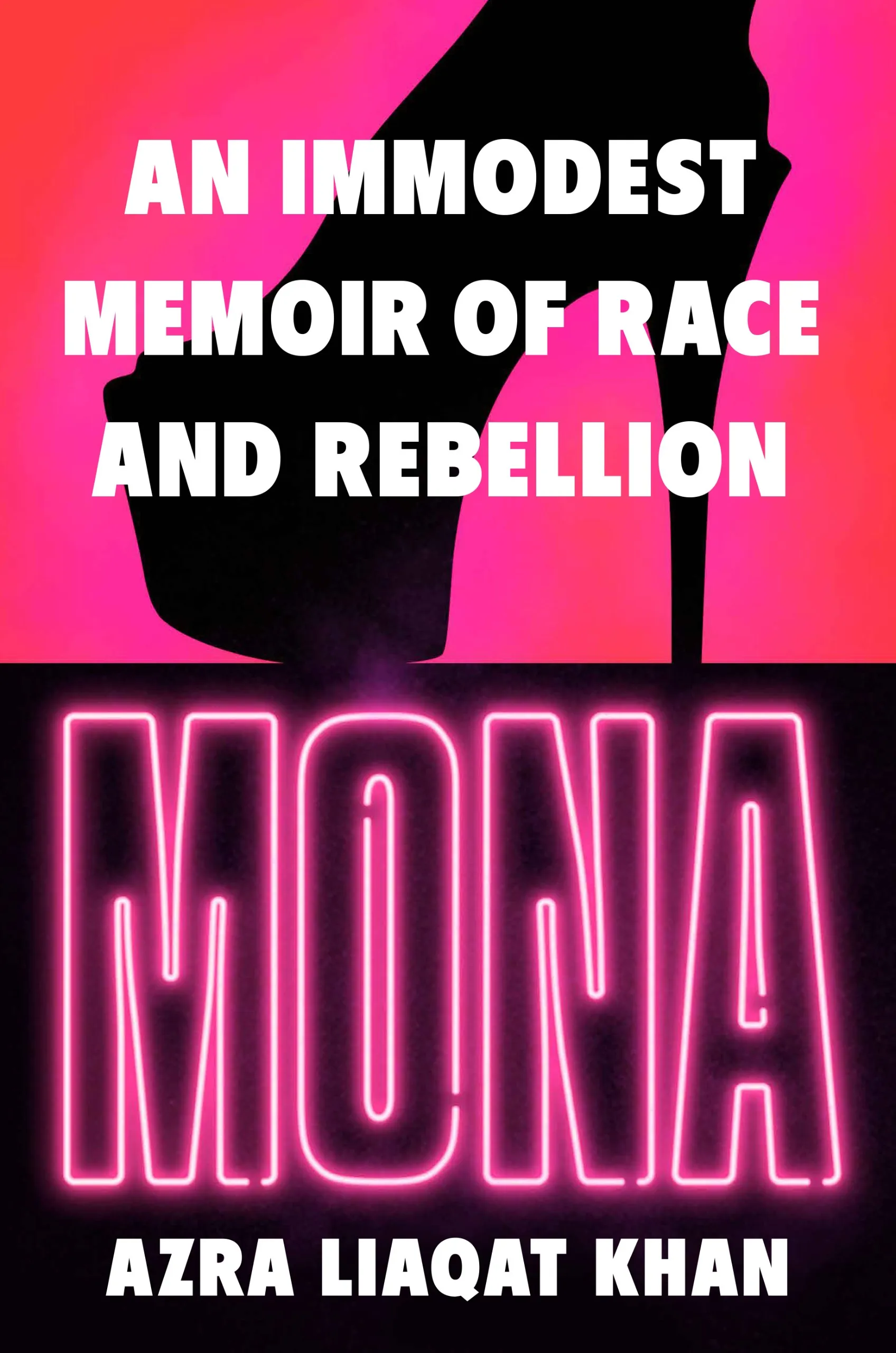
Pop culture has embraced nuanced stories about sex work in recent years, but few hold a candle to the dynamism, humor, and insight of Azra Liaqat Khan's memoir Mona. In the book, the professor and labor organizer (who writes under a pseudonym) explores her experience as a Muslim American working as a stripper to pay off graduate school in a post 9/11 N.Y.C. Navigating the Islamophobia she faced in her day-to-day and at the club, as well as her immersion into class politics, it's among the sharpest memoirs you'll read this fall.
As Mona hits shelves on November 17, Liaqat Khan has shared an exclusive excerpt with Marie Claire. Below, you can read the introduction to the highly anticipated new release, about a moment when her race felt like "currency" as she met a fateful client.
It was slow at the club when I met Liam. There were no big spenders, so most of the dancers were chain-smoking in the dressing room. I slipped into the alleyway for a quick but excruciating conversation with my mother.
She’d read my email, which said:
Salaams Ammi & Abbu—I looked over Sadiq’s biodata and photograph.
I don’t think he’s right for me.—Azra
Ammi was pissed.
Over the past year, my parents’s anxiety about arranging my marriage had boiled over into all-out panic. I was approaching my late 20s, Ammi said. I was living hundreds of miles away from our home in North Carolina, my PhD well underway, she reminded me. For the darker-skinned of her two daughters, prospects were not good. (This last bit, she didn’t need to say.)
Here at the club, my prospects were also not good. With no hourly pay and house fees totaling over $100 per shift, it was starting to look like I might walk out poorer than I’d walked in. I ended the call with my mother and returned to the strip club floor, surveilling the empty seats.
A man I’d never seen before arrived and sat down. Since he was new, he was fair game for any of us, but I had to time my approach carefully. Too early, and I’d seem like one of those door vultures who pounce on new customers. Too late, and another dancer would swoop in.
I waited until he received his Heineken, then approached him.
“Hi!”
He ignored me, wholly uninterested. This normally would have been my cue to leave him alone, but I looked at the flimsy set of bills rubber-banded to my ankle.
I had to persevere.
“How’s it going?” I chirped.
I was as annoyed with myself as he seemed to be. The hard sell was never my MO. I made my money playing coy and waiting for a customer to wave me over. This strategy spared me the sting of rejection, and it guaranteed that whoever I sidled up to was already interested and likely to spend. I admired the iron will of dancers who bounced from customer to customer, throwing arms around their necks, asking, “Dance?” If the answer was no, they moved on to the next without a trace of injury.
“I’m all right,” he said. He looked at me, looked away, and then did a double take, staring. “Are you Indian?” he asked.
I’m not especially dark-skinned, but I was still the darkest girl at Private Eyes. Like most Manhattan clubs, Private Eyes had its requisite light-skinned Black dancer and several Latinas, but no one who wouldn’t burn after a couple hours in the sun without a strong SPF.
Private Eyes and my childhood home: the two settings I inhabited where skin color was currency. I’d gone from my relatives’s constant reminders that I was the darker daughter to the strip club, where anyone over my Fitzpatrick IV had a helluva time getting hired—particularly at one of these swanky Manhattan joints.
Even in a city like New York, where you can’t swing a tray of samosa chaat without hitting someone from the diaspora, I seemed to be the only desi (South Asian) stripper. A Sri Lankan girl had worked a single shift but quit after choosing a name that sounded more like the head of HR than an exotic dancer: Sharon. There was also Tiana, a Tibetan who grew up in India and spoke fluent Hindi, but she found she made “way more if I tell customers I’m Chinese.”
Race, you see, wasn’t just assigned at the club; it was performed.
And we milked it.
Race, you see, wasn’t just assigned at the club; it was performed.
All of us—dancers of color, Russian women with accented English, all-American “girls-next-door”—knew we could turn our ancestry into some guy’s fantasy. Being Muslim, for instance, earned me thousands of extra dollars over the years, especially in this era right after 9/11, when Muslims were under a microscope, and Americans assumed that women like me were in dire need of rescue.
Very well, then. If America insisted on portraying us as hapless victims in need of protection (only to bomb our homelands into oblivion), I may as well profit off it.
“Yeah, I’m Indian,” I told Liam.
Ever since my very first audition at a Queens club called CityScapes, Guess-My-Race had been an initiation rite with customers. At my audition, as I found myself naked (on stage! in stilettos!) for the first time, a South Asian ogler asked me Liam’s question–are you Indian–and was ecstatic when my answer was, “Yes.”
Thus, even before being hired, my identity had sold a dance.
Being desi ended up paying more of my bills than being snatched at the waist or appearing 10 years younger than my age. Just as all my desi friends listened to M.I.A.’s Arular on repeat when it was released and the way we lined up at opening night for Harold & Kumar Go to White Castle, so too an assortment of desi men came to the club to see the Indian stripper who spoke Hindi and watched Bollywood movies. I’d acquired such a level of fame in N.Y.C.’s South Asian pervert circles that, as I’d later discover, a clerk at a local porn shop was promoting me to his desi customers. (I ought to have found him and paid him a commission.)
Liam was happy that I was Indian, too. With my answer, he transformed from standoffish to outright giddy.
“So you’re vegetarian?” he asked.
“I’m not, no,” I said.
Not the answer he wanted. He slumped and looked away.
But I wasn’t ready to give up. I couldn’t go home broke because the guy didn’t want a lap dance from a carnivore.
“My family’s Muslim, not Hindu,” I said. “And Indian Muslims do eat meat.”
On the stage, Majestic helicoptered her long, silky locks before twirling herself around one of the poles on the small platform in the middle of the club floor. Lucky bitch; I was stuck delivering a lecture on cultural literacy.
“Ever read any Peter Singer?” he asked.
“You mean Animal Liberation? Yeah . . .” I said. “I read it. Have you?”
“Well, of course, yes. Yes, I read it. I—really? You have?” he asked.
“I have.” I’d skimmed the book years before, but with the largely useless skill of a PhD student, I had the ability to recall and recite key arguments of a book on demand. “I guess I liked parts of it. But it felt so utilitarian. Didn’t Singer argue that a disabled child’s life is less valuable than an intelligent pig’s?”
“Well—no, that’s not exactly what he was saying,” said Liam, part defensive, part turned on. “Singer’s book was the bible of the animal rights movement. You can’t take today’s critiques about disability and just apply them to something from the seventies.”
But people in the '70s were making these critiques, I thought. And don’t mansplain the nuances of animal rights discourse to me. There are marauding right-wing Hindu mobs in India lynching Muslims for the “crime” of beef-eating. Is that your notion of animal rights? How about this: you shut up and give me some fucking money? If you wanted a humanities seminar, you should have gone to the New School, not Private Eyes.
On slow days like this one, when every lap dance felt like a tiny miracle, my internal monologue became especially vicious.
Not that Liam could tell.
“You know a lot about animal rights. That’s cool, very cool. I’ve always wanted to learn about the subject,” I said, lying. “I’m Mona.”
“Liam,” he said, lingering on the handshake. His voice was now soft, open. I had gone from invisible to the only girl in the room, and all it took was scant knowledge of his favorite book. This would happen at the club, where infatuation materialized out of thin air. You never knew what might get the guy going: that you speak another language, that you have a big butt, that you suck on a lime after a tequila shot.
That was the thing about this job. Platform stilettos and pole dancing may have been its emblems, but really, the work was in the emotional labor. Men wanted affection and conversation as much as they wanted to see tits and ass. My job was to finely tune myself to the mercurial needs of the male ego. As a stripper, you were the salve for a sexless marriage, the entertainment for a rowdy bachelor party, or the ego massage for a bloviating philosophy professor with a lot of thoughts to share on Foucault and Marcuse.
“Please, Mona. Have a seat.”
I already had Liam pegged: a sapiosexual. If he became my regular, he’d be curious about my politics and reading list and indifferent to the sequined bodice that pulled my tits together for some overexposed cleavage. A guy like Liam would never beg me for a blow job.
In short, he was my typical customer.
“I wish I could sit with you, but”—I glanced around the club—“I guess I better go make some money.”
Platform stilettos and pole dancing may have been its emblems, but really, the work was in the emotional labor.
This was laughable. The club was dead. There was nowhere to make money. But I couldn’t just ask him for money, not after our meaningful rapport. My strategy was to make a customer absolutely sure he was different from all those frumpy losers at the bar I saw only as a paycheck, then let him know that if he didn’t open his wallet, which definitely wasn’t the reason I was talking to him, I would have to leave, which I really didn’t want to do.
“Wait, no, don’t go. Let me take you for a dance,” Liam said.
Worked like a charm.
In the lap dance section (booths that lined the perimeter of the club), I gave him my standard dance: grinding, straddling, and undressing to a thong. As each song neared its end, I pulled my face close to his and waited for him to say, “One more, please.” Through five songs, he neither broke eye contact nor lost his erection.
“I never thought I’d meet anyone like you here, Mona,” said Liam before leaving.
“Today has been a treat,” I said, pulling him in for a hug and a kiss on the cheek.
A $400 treat.
“You’ll be here Tuesday, right, Mona? You’re sure?”
The look in his eyes made it clear he’d be back. I knew it. But never would I have guessed that I would see Liam every week for the next five years, all while I juggled my parents’s woes, their carousel of potential husbands, and my increasingly untenable double life.
From MONA: An Immodest Memoir of Race and Rebellion by Azra Liaqat Khan, published by Tiny Reparations Books, an imprint of Penguin Publishing Group, a division of Penguin Random House, LLC. Copyright (c) 2026 by Azra Liaqat Khan