The Congresswomen’s Pact
For the first time, twelve congresswomen reveal how they’re banding together after the Trump administration came for one of their own: Rep. LaMonica McIver.


The first call came just before eight o’clock. Then the second, then the third. It was a Monday in May last year, and LaMonica McIver, a 39-year-old first-term congresswoman from New Jersey, stood in the lobby of her hotel in Washington, D.C., frozen mid-step on her way out to dinner. Her attorney, her chief of staff, her colleagues—everyone who kept her life running, flooding her phone like a five-alarm fire. She was being charged with federal crimes—including assault on an officer—over a confrontation with ICE agents during a congressional oversight visit to a detention facility in her district just a few days prior. The charges came courtesy of Alina Habba, Donald Trump’s former personal attorney, who was then serving as the top federal prosecutor in McIver’s home state. If convicted, the congresswoman faces up to 17 years in prison.
These people are nuts, McIver thought. They can’t charge me—I didn’t do anything wrong. Seventeen years, her daughter—assault on a federal officer!—for what, doing her job? Habba’s office had floated some threats in the past few days, sure, but threats are the weather in Trump’s Washington, and no sitting member of Congress has ever been charged for conducting oversight. That McIver, who had been on the job for all of eight months, would be the one to change that was laughable. Certainly not at eight o’clock on a Monday; the clerk’s office closes at five. No matter—Habba, resourceful as ever, had simply posted the charges on Twitter and let the courts catch up in the morning.
The shock bought McIver just enough time to do the next normal thing: catch an Uber to Circa, a bistro in D.C.’s Foggy Bottom neighborhood, where a handful of congresswomen were expecting her for dinner. She told herself the charges were a joke, that the whole thing would collapse under its own absurdity, that someone would catch it, fix it, and she’d get on with her life. Instead, the year ahead would bring legal fees approaching a million dollars, racist bile and threats online, confrontations with Republican colleagues in the building where she still shows up to do the job that got her charged in the first place—and a fight that, as of this writing, is still ongoing. The hardest moments orbit a single thought: her nine-year-old daughter, Zaya, who would be 26 by the time her mother came home if the worst played out in the courtroom. It is a conversation she still cannot bring herself to have with her husband. “I sometimes drive myself crazy thinking about the end result of this all.”
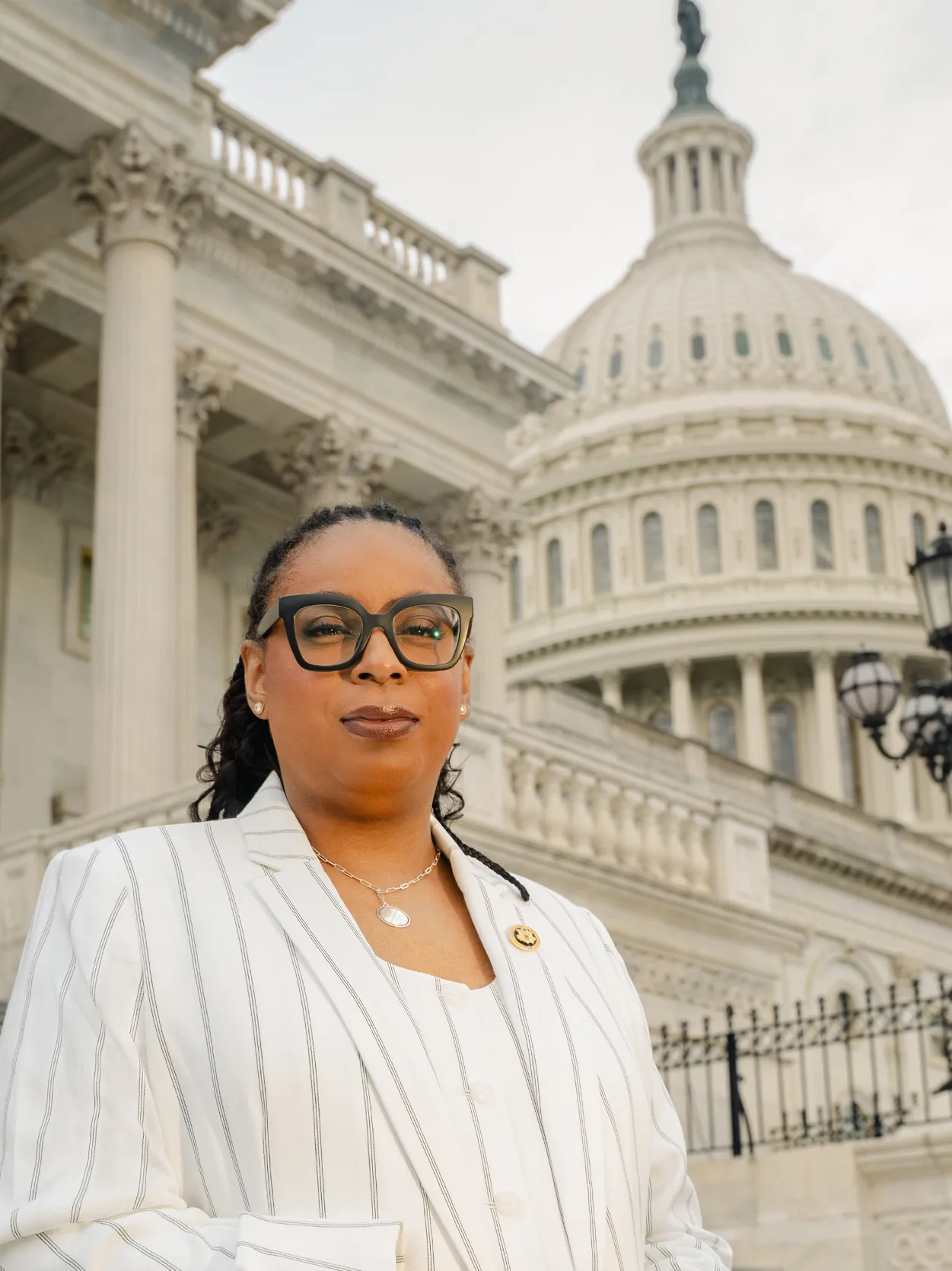
McIver outside the U.S. Capitol.
McIver didn’t know it yet, standing in that lobby with her phone still buzzing, but the lifeline she’d need would not come from any institutional safety net. It was already at that table she was heading to. In the months that followed, the circle would widen into a network of congresswomen spanning four decades and every level of power in the Democratic Caucus, from Nancy Pelosi and Bonnie Watson Coleman to Alexandria Ocasio-Cortez and Ilhan Omar. They brought money, legal expertise, their platforms—and once, a bucket of slime for a nine-year-old’s birthday party. Their support stretched from the House floor on Capitol Hill to a federal courtroom in Newark to group chats that never went dark. It needed to, because the Democratic establishment—as McIver would learn the hard way—had no playbook for a fight like this. So the women built one themselves, with the understanding that any one of them could be next.
Marie Claire interviewed 13 congresswomen for this story. What emerged is a portrait of an administration that has shattered every precedent for how it treats its opponents—and a frontline of women who answered with a precedent of their own.
I just don’t want to live in that world anymore—so we started by building it with each other.
Alexandria Ocasio-Cortez
That fall, McIver is sitting in a federal courtroom in Newark, facing two felony counts of assaulting a federal officer and one misdemeanor count of the same, watching her lawyers make the argument that prosecuting a congresswoman for conducting oversight violates the Constitution. The case has reached open court after she pleaded not guilty and her lawyers filed motions to dismiss over the summer. Her life is now a revolving door of legal briefs and caucus meetings, the congresswoman and the defendant living in the same skin. “I don’t get days I can just be in my bed and be depressed,” McIver tells me. “But every day I have to pick myself up.” At school, a classmate recently told her daughter that her mom was going to jail. McIver responded with the simplest version of the story she could muster: “I’m in a battle against Donald Trump right now.”
But she is not alone, not in this courtroom. In the rows behind her are congresswomen who have no district-level reason to be in Newark on a Tuesday morning: Ilhan Omar, Jasmine Crockett, Sara Jacobs, and Yvette Clarke. Before the hearing, they had told McIver’s chief of staff they were going to speak to the crowd outside before going in, “and then we’re going in and we’re going to sit there.” The congresswomen understood that silence from colleagues could read, to the public, as its own kind of verdict. Letting McIver appear to stand alone was “a non-starter,” Crockett would later tell me, and Jacobs wanted “LaMonica to know she wasn’t alone in that room.” It worked: McIver sat facing forward the whole time, but she could still feel them behind her. “That helped me feel at least a little sigh of relief,” she says. “I’ll never forget that.”
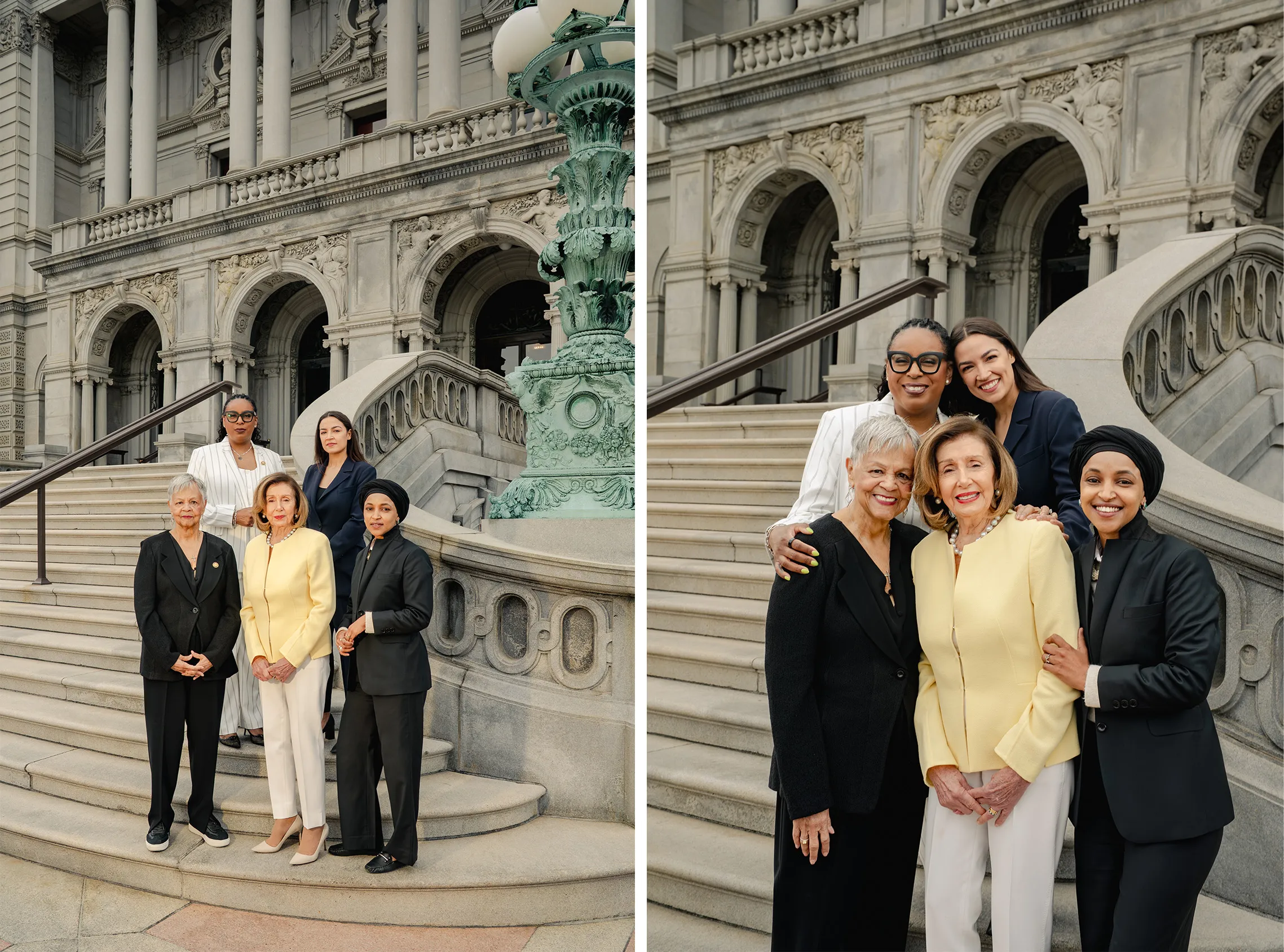
McIver, Ocasio-Cortez, Watson Coleman, Pelosi, and Omar at the Library of Congress.
In the months leading up to that court date and since, a network of congresswomen has made McIver their business. Emilia Sykes sends her Reels all night long. Lateefah Simon walks to her seat on the House floor every day just to be near her—“an energy transfer,” she tells me, “just to get some of that goodness.” Pramila Jayapal’s support always starts with a hug—“a physical, ‘I’m here for you’”—followed by the same question: “What do you need from me?” Jahana Hayes checks in before every recess and after every return. But what McIver has also come to learn is that beyond this circle, the support largely ends. The party’s national organizations—the DCCC, the DNC—have no system in place for a situation like this. What hurts “bigger than the charges,” McIver tells me, “is the support that I just have not gotten.”
McIver hadn’t always had a network to fall back on. In September 2024, she walked onto the House floor for her swearing-in, sporting a teal suit, round tortoise glasses, and a healthy dose of holy shit. Until recently, she had been a city councilwoman in Newark, fighting for federal housing dollars from the other end of the phone. Now she was here, having won a special election to fill the seat left by the late Donald Payne Jr., making her the first Black woman to represent the district and the youngest woman New Jersey had ever sent to Congress. She stood at the podium, one hand on the Bible, and took the oath. Her husband and their then-eight-year-old daughter watched from the gallery.
“I have to remind myself like, ‘Girl, you’re The Congresswoman!’” McIver tells me, smiling and shaking her head. We are at a café tucked inside a historic banking hall in Lower Manhattan, all vaulted ceilings and marble pillars, the city muted behind tall glass windows. “I was taking it in, but it was hard to believe that it was happening.” Pelosi came up to welcome her: “And I’m like, welcome to me?” Then Maxine Waters said hello and she short-circuited again. “Are you talking to me?!”

Crockett, Jacobs, Ocasio-Cortez, Sykes, Jayapal, and McIver between takes.
Sweet. Now figure it out. Since she’d won a special election, there was no freshman orientation or transition period. She was voting within the hour, and by the next morning, she was sitting in a Homeland Security committee hearing with no idea what was on the agenda. She lost count of the number of people who assumed she was someone’s new staffer. “You get thrown into the fire,” she says. “They’re like: ‘swim your way through on your own.’ You don’t even know how to swim.” Congress is also, she discovered quickly, a building full of cliques. “People have their favorites, they have their regulars. If you haven’t been here for a long time and you’re a newbie, that’s hard to navigate.”
McIver was not the first woman to come to Congress without the usual pedigree and find herself alone in it. Just ask Ocasio-Cortez and Omar, who arrived in Washington to enormous public fanfare but almost no institutional guidance. “When you don’t come in with a conventional political background, no one’s grooming you, no one’s mentoring you, no one’s showing you what to do,” Ocasio-Cortez tells me. “You’re kind of left on your own.” When I ask Omar about those early days, she smiles like she can still see herself trying to figure it out. “This town is strange,” she tells me. “I cannot overstate just how incredibly challenging it is to come here without connections to the institution.”
For Black women in particular, the challenge compounds, in part because there are still so few of them. Crockett is only the 56th Black woman ever elected to the House. “We are still very, very, very new to this body,” she tells me. “When I was [McIver’s] age, I never could have imagined doing the things that she has done already.” But McIver was there, figuring it out—young, new, Black and without the kind of safety net that would matter most when everything went sideways.
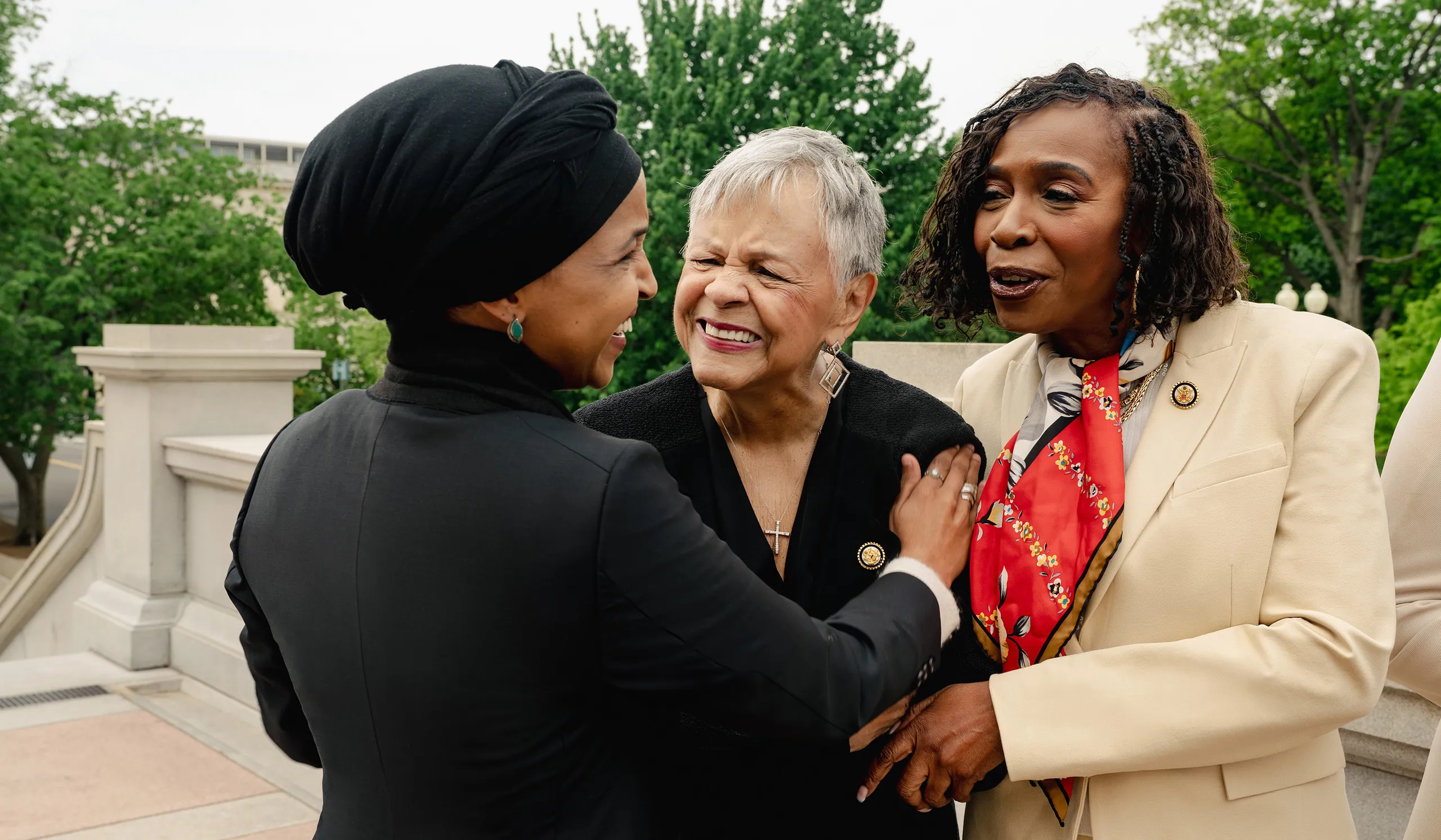
Omar, Watson Coleman, and Clarke between takes.
Enter Watson Coleman. Eighty-one years old, a stalwart of the Congressional Black Caucus, and the only other Black woman in the New Jersey delegation, she had been close with McIver’s predecessor and spotted his successor on sight. “I just kind of took ownership of her,” she tells me. “Come sit here, come sit with us.” Watson Coleman had played a similar role for Ayanna Pressley years earlier, and when she told Pressley about the young woman coming to fill Payne’s seat, Pressley reached out immediately. She pulled McIver aside and asked if she knew where to get her hair done in Washington: “Would seem a strange question for the woman with alopecia who has no hair, but that wasn’t always my reality.”
The Congressional Black Caucus brought others into her orbit—and a second home base emerged through the under-40 dinners, where, as Jacobs tells me, the youngest members of Congress get together to “commiserate” about the particular indignity of their place on the generational totem pole. At her first dinner, McIver had the whole table in stitches: “Those relationships just grew over time,” she tells me.

From left: Crockett, McIver, Clarke, Omar, and Jayapal at the Library of Congress.
McIver was finding her footing, but she had come to Washington to work on what she calls her “love languages”—housing and affordability, issues she’d been reckoning with long before she was legislating them. The oldest of four and the first in her family to go to college, McIver was raised by a mother who struggled with substance abuse, and had watched what happens to a neighborhood when the federal investment doesn’t come. Her entry into politics came at ten, passing out campaign literature for her fifth-grade teacher, Ras Baraka, the future mayor of Newark, who would help shepherd her career from city council to council president to Congress. By November, she was holding town halls, planning legislation around childcare and federal housing funding, and feeling like the work was finally beginning.
Oh, and Kamala Harris was definitely going to win the election. “We’re going to have this first Black woman president,” she remembers thinking. “It’s going to be wonderful and things are going to be great.”
I’m just a Black girl from Newark. It honestly means nothing to this DOJ, this president to throw me in jail, let alone find me guilty.
LaMonica McIver
Within weeks of Trump’s second inauguration, the administration’s immigration crackdown landed in McIver’s district. Executive orders were “flowing out of the sky, like Skittles,” she tells me—ICE raids in Newark, parents afraid to send their kids to school. When a private detention center called Delaney Hall opened without proper clearance from the city, and lawyers couldn’t reach clients detained inside, McIver, Watson Coleman, and Congressman Rob Menendez decided to visit on May 9th.
In the accounts McIver and Watson Coleman gave me of what happened next, the details come fast and out of order, the way memories do when the body takes over. What they agree on is this: they arrived around 1 p.m. and waited over an hour to get inside while ICE agents filled the waiting room. Mayor Baraka, who had been trying for weeks to inspect the facility himself, arrived for a press conference the members had planned for after the tour. A guard let him onto the premises—and then government agents confronted him and accused him of trespassing. Baraka agreed to leave and walked out through the gate, but agents moved to arrest him anyway, on orders from the deputy attorney general. The three members rushed toward the mayor, urging them not to, and a scuffle ensued. McIver grabbed the back of Watson Coleman’s trench coat to keep her from falling and reached toward Baraka with her other hand. Agents in tactical gear were pulling and pushing, one with a gun drawn. “Please do not touch us. We are federal officials,” McIver kept saying. Baraka was arrested and taken away.
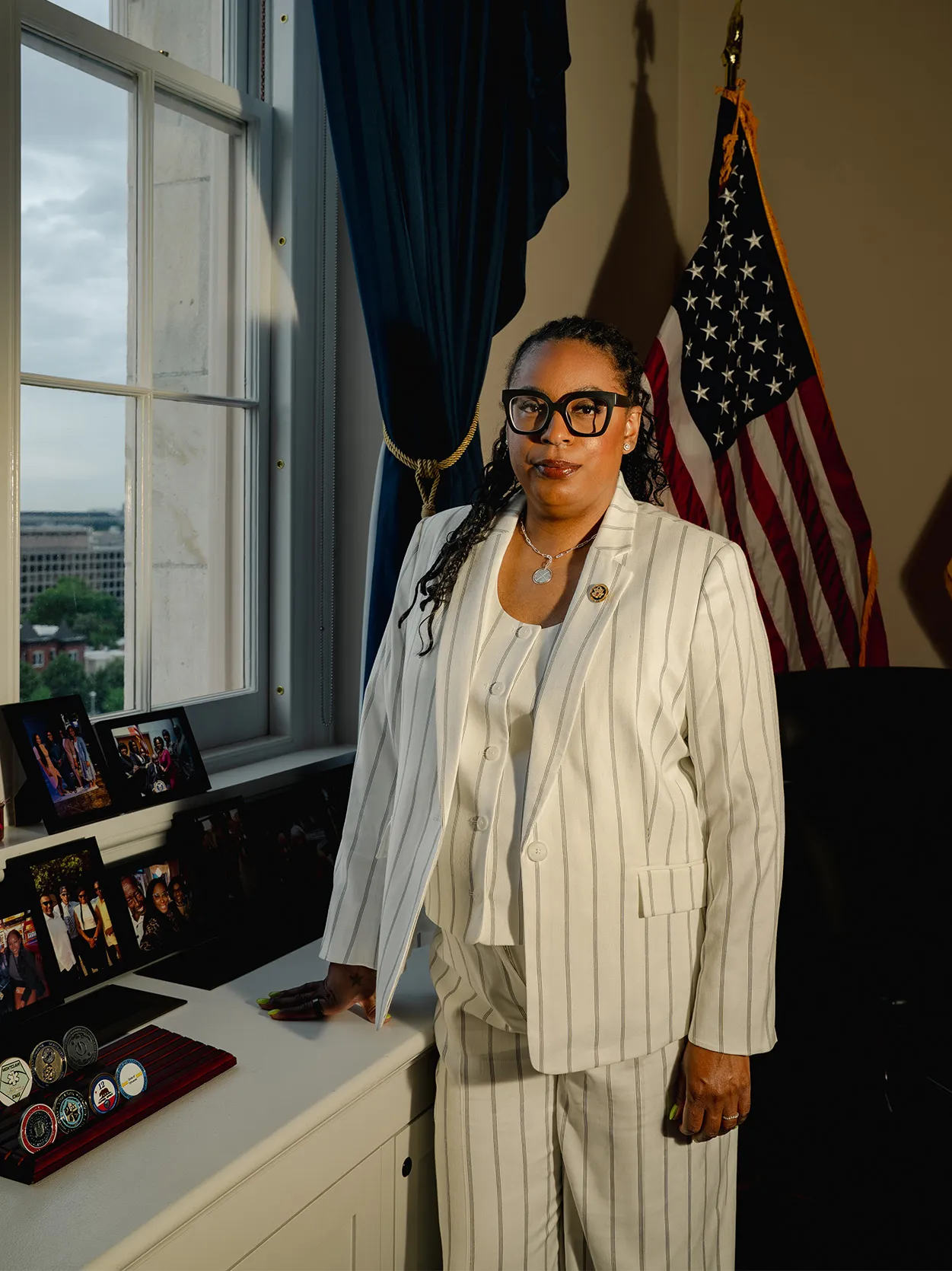
McIver in her congressional office in Washington, D.C.
The members were shaken by the incident, and McIver’s side was sore from all the shoving, but none of them thought it would go further than that. In fact, they completed the tour—were allowed to, even after all of it—escorted by ICE agents through a facility where the elevator was malfunctioning, the phones didn’t work, there was no smell of food, and women detained inside told them they couldn’t connect with their lawyers or get medical care. Of the two and a half hours they spent at Delaney Hall that day, the government’s case against McIver would come to rest on 68 seconds of body-camera footage. The images are murky, but federal prosecutors say they show her slamming her forearm into an agent trying to handcuff the mayor. Watson Coleman, who was inches away through all of it, is unequivocal about what she saw: “I didn’t see her go after anybody. I didn’t see her assault anybody. I just saw her protecting us and using her body and her arms to keep people away from us.”
The U.S. Attorney’s Office for the District of New Jersey declined to comment for this story.
I have trust issues and I look at her as my own family. That’s how serious this is for me.
Jasmine Crockett
Two networks activated the night the charges dropped: one physical, one virtual. At Circa, a handful of congresswomen were already working the problem before McIver walked through the door—Crockett, a criminal defense attorney, was running through statutes in her head, Sykes thinking through logistics for McIver’s daughter and her schedule, Hayes ready to tell her she wouldn’t be facing this alone. McIver walked in and saw their faces. “They done heard the news too by now,” she says, laughing. Meanwhile, the Democratic Women’s Caucus group chat—“probably the fastest place to tap into a network that gets galvanized super quick,” according to Omar—was lighting up. What do you need? How can we help?
Ocasio-Cortez was on the phone with McIver shortly after seeing what she described as “bat signals” on the group chat, and her call came with a directive: “You’re going to need money.” She was right. Members of Congress cannot accept pro bono legal defense for cases like this, and no institutional fund exists to cover one. “LaMonica was one of the first members of Congress to take on ICE and put literally herself and her body on the line,” she tells me. “A pat on the back and congratulations and praise is not enough. If a woman is going to take risks, she needs money, resources, and solidarity, period.” She helped McIver raise over $15,000.
Pelosi moved to the mechanics. She had known McIver’s district long before McIver held it—Donald Payne Sr. was a dear friend, and she had campaigned for him there; when his son inherited the seat and then passed, she felt a responsibility to whoever came next. She donated immediately, then urged McIver to set up a legal defense fund so supporters could give beyond what campaign contribution limits allowed. “That’s how they want you to feel your pain,” she told her. “Not only do we love you and care about you, but let us tangibilize that.”
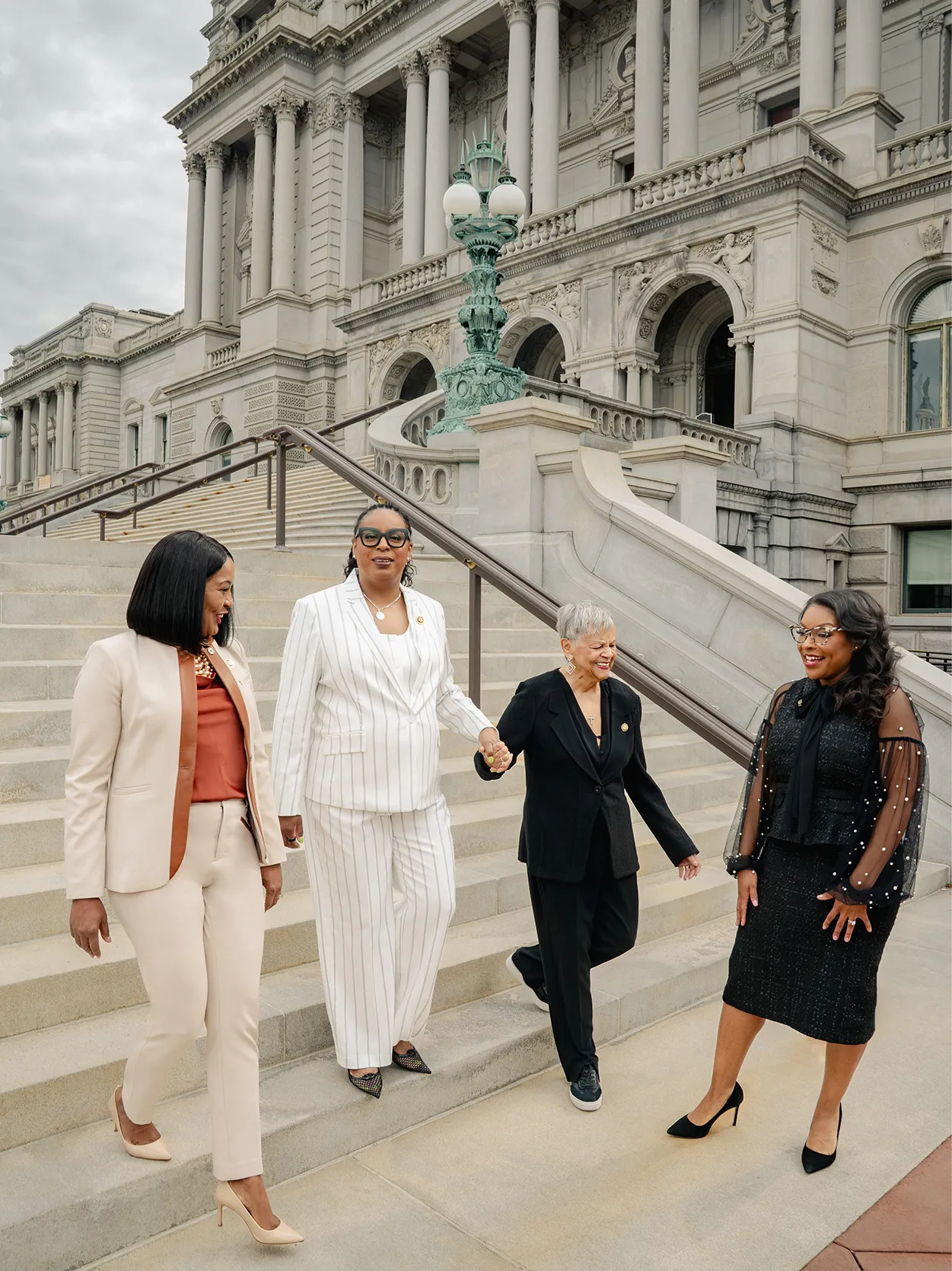
From left: Hayes, McIver, Watson Coleman, and Sykes descend the Library of Congress steps.
The funding and the strategy have been critical to McIver as a defendant. What’s held her together as a person, though, is the daily rhythm the women fell into afterward. “It’s really been a strong base of women who have really been amazing,” McIver says, “and I feel like I can count on.” Prayer Zooms, baby pictures exchanged on the House floor, hugs in the hallways, heads-ups on legislation before her own staff sees it. On the group chat, when McIver mentioned needing slime for her daughter’s birthday goody bags, an alarming number of congresswomen immediately reported for goop duty.
“I think that they thought they could move in ways that are cruel, targeted, and unprecedented, and that maybe no one would care,” Pressley tells me. They were wrong. It endures, she says, “in the pull-asides on the House floor that are just a check-in. It endures with early morning and late night phone calls. It’s essential to our sanity.” Crockett, who has told McIver she plans to make herself available to her legal team after she leaves Congress in January, is blunt about why: “I have trust issues and I look at her as my own family. That’s how serious this is for me.” Pelosi, for her part, sums up the entire pact in three words: “With you, babe.”
Through all of it, McIver has kept showing up—voting, legislating, flying home to her family on weekends. The pace, she tells me, is its own kind of mercy. “I’m busy working, but also I’m momming and trying to do everything else. You kind of don’t really have a lot of space to self-pity party every day.” Watson Coleman, who sits near her on the House floor, watches her do it week after week. “It doesn’t stop her from speaking up, and she’s there to do her job every day,” she says, pausing. “But I know that in her quietest hours, the possibility of the absurdity of all this has got to weigh on her.”
This place does destroy people.
Ilhan Omar
McIver is on a train home from Washington in December, texting a senior staffer about going to prison. The motions to dismiss that her lawyer had filed over the summer had been denied, and the road ahead had gotten longer. “I don’t have a ton of faith,” she writes in messages shared with Marie Claire. “I’m just a Black girl from Newark. It honestly means nothing to this DOJ, this president to throw me in jail, let alone find me guilty. It’s a scary thought, but I’m preparing myself for the worst.” Her staffer sends her a heartbreak emoji and McIver shoots back with heart hands.
The charges are no longer breaking news, yet the case still follows her everywhere. Hateful messages pour in from strangers online; her husband makes the mistake of reading the comments and can’t unsee them. “Our families don’t deserve to be drowned in what we do,” McIver tells me. During a House Homeland Security hearing earlier this year, Republican congressman Eli Crane of Arizona noted, without naming her, that a member of the panel had assaulted an ICE agent. McIver fired back: “Mr. Crane, I don’t know what your obsession is with me, but I am so tired of you mentioning me, and you should take that obsession and need to put it to the people of Arizona.” And while not a single sitting Republican has publicly spoken out in her defense, one Republican congresswoman recently pulled McIver aside and asked if the charges were still happening. When McIver said yes, the woman told her: “That’s some BS.” McIver was stunned. “I wanted to say, ‘Why don’t you say that out loud?’” she tells me.
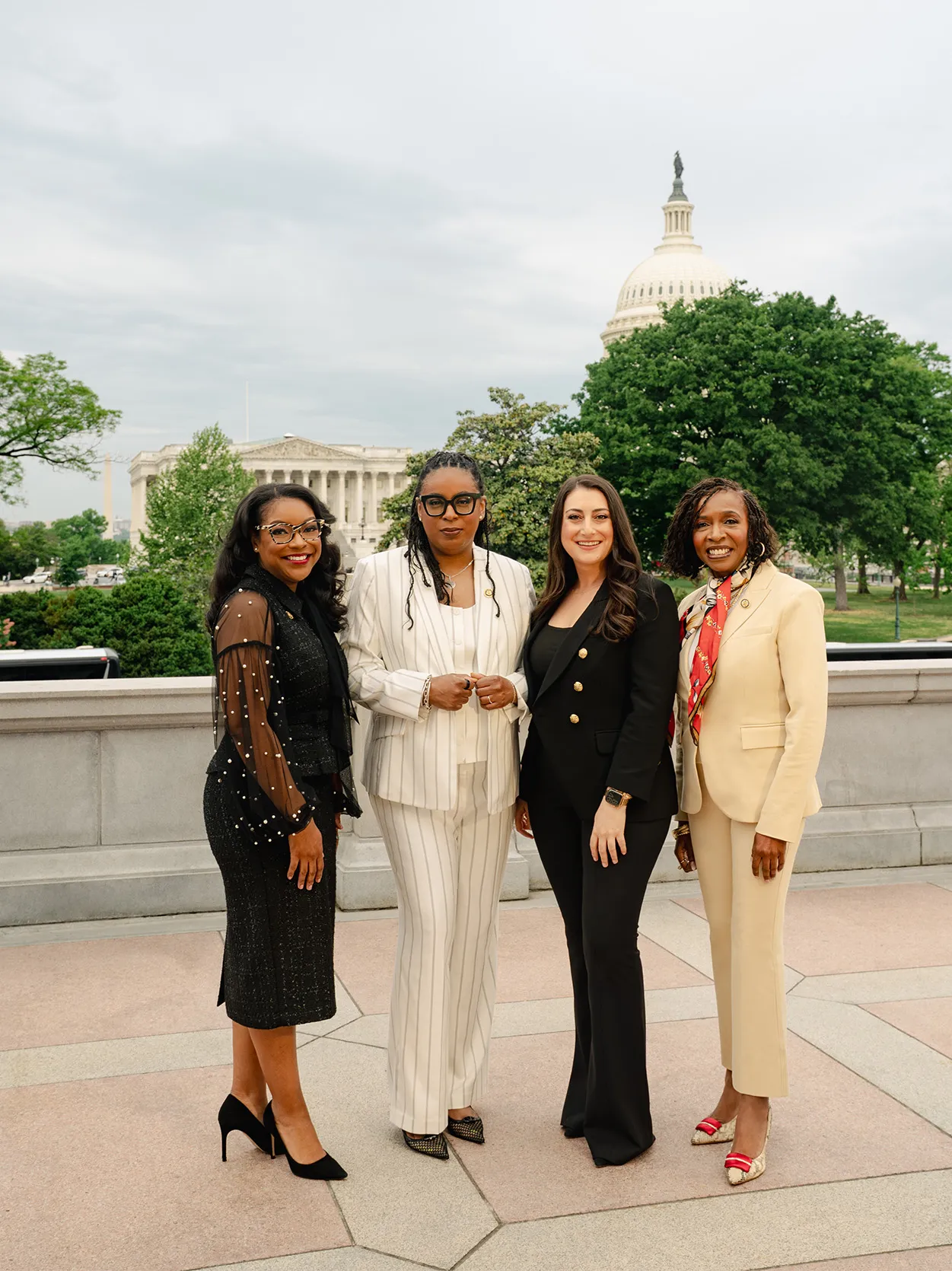
From left: Sykes, McIver, Jacobs, and Clarke on the Capitol grounds.
The women she works with can hold the edges together, but they can’t make the charges disappear. And while the love is real, so is the fury. Every congresswoman I spoke to has taken McIver’s case as a warning. “Today is LaMonica,” Clarke says, “tomorrow it’s me.” Omar calls the precedent “very scary.” Crockett calls it “bullshit.” “Their goal is intimidation and the financial strain, the mental strain,” she says.
None of the them think it’s a coincidence that the charges landed on McIver. “They knew she was going to be effective,” Pelosi tells me. “She came in, she was young, she was [in the] minority. They’re going to take her down.” She has been on the other end of it for decades. “I knew what I was getting into, and I knew that all the things that they did to paint me as a devil—with cloven feet and fangs and flaming hair—and the rest of that, which led to the assault on my husband,” she says, pausing. “I wish they had gotten me instead of him.”
Who’s the next person we’re going to sacrifice so that we can say you all fought appropriately?
Emilia Sykes
Clarke names another layer: “This administration has made it a point to go after Black women in authority. There’s no ifs, ands, or buts about that.” Simon pulls the lens further back, past the incident and the administration, to the building itself: “I don’t know if the founders ever imagined Black women being in the dome with these jobs that we have. Enslaved Americans helped to build the Capitol, but I think we still feel that at a cellular level.”
The administration created the crisis. But the party, it turned out, had no system in place to meet it. When another member was threatened months after McIver was charged and came to her asking how she’d found a lawyer—“Is it the DCCC?”—McIver had to tell her the truth: “No one helped me. We did this on our own. And there was no system set in place.” Sykes has tried to sound the alarm. On a call with Democratic leadership, when the chair started urging members to fight harder, she cut in: LaMonica did that, and now she’s looking at 17 years. “Now what’s the next thing we’re going to cheer on,” she says, “and who’s the next person we’re going to sacrifice so that we can say you all fought appropriately?”
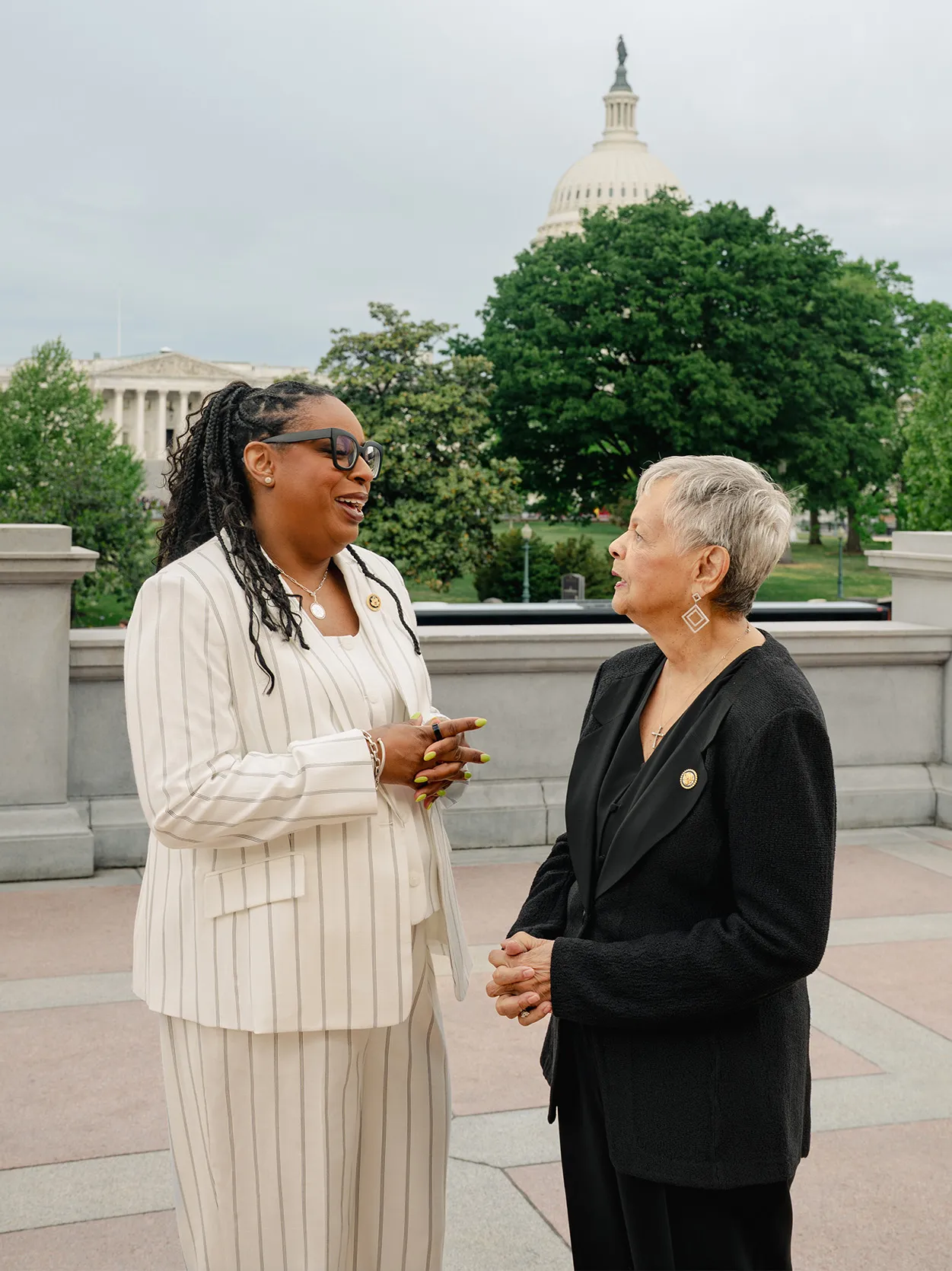
McIver and Watson Coleman on the Capitol grounds.
Ocasio-Cortez puts it in terms anyone with a job would understand: “It is a total failure and an indictment of our systems that this member has to fundraise for the legal defense of conducting her own constitutional responsibilities. Imagine showing up to your job and someone sues you personally for doing your job. That’s supposed to be the company.” McIver, she says, was asked to take a risk and then left to carry the cost alone: “Once you’ve stuck your neck out and done a courageous thing, you are largely left to fend for yourself.” But she’s done accepting that. “I just don’t want to live in that world anymore—so we started by building it with each other.”
There is a theory, shared by more than one of the women I spoke to, about what the building they work in does to the people inside it. “If you are already a kind and genuine and decent person, you will be more kind and more genuine and more decent because the environment calls for it,” Hayes tells me. “If you are not, just walking on these hollow grounds is not going to make you that person. Congress reveals who you are.” Omar has watched McIver prove it. “She is still so soft and so graceful,” she tells me, “because this place does destroy people.”
McIver’s case is now before the Third Circuit Court of Appeals. Oral arguments are set for June 24—the last chance to get the charges dismissed before a trial, barring an appeal to the Supreme Court. She is still raising money for her defense, still working, fighting, and planning her life around the possibility that she could lose it. Despite everything, she has brought back over $10 million to her district for community projects. “When you have an administration who’s working so hard to stop you from doing the work on behalf of the people that you represent, I take that personally,” she tells me. “‘Nothing has faded.”
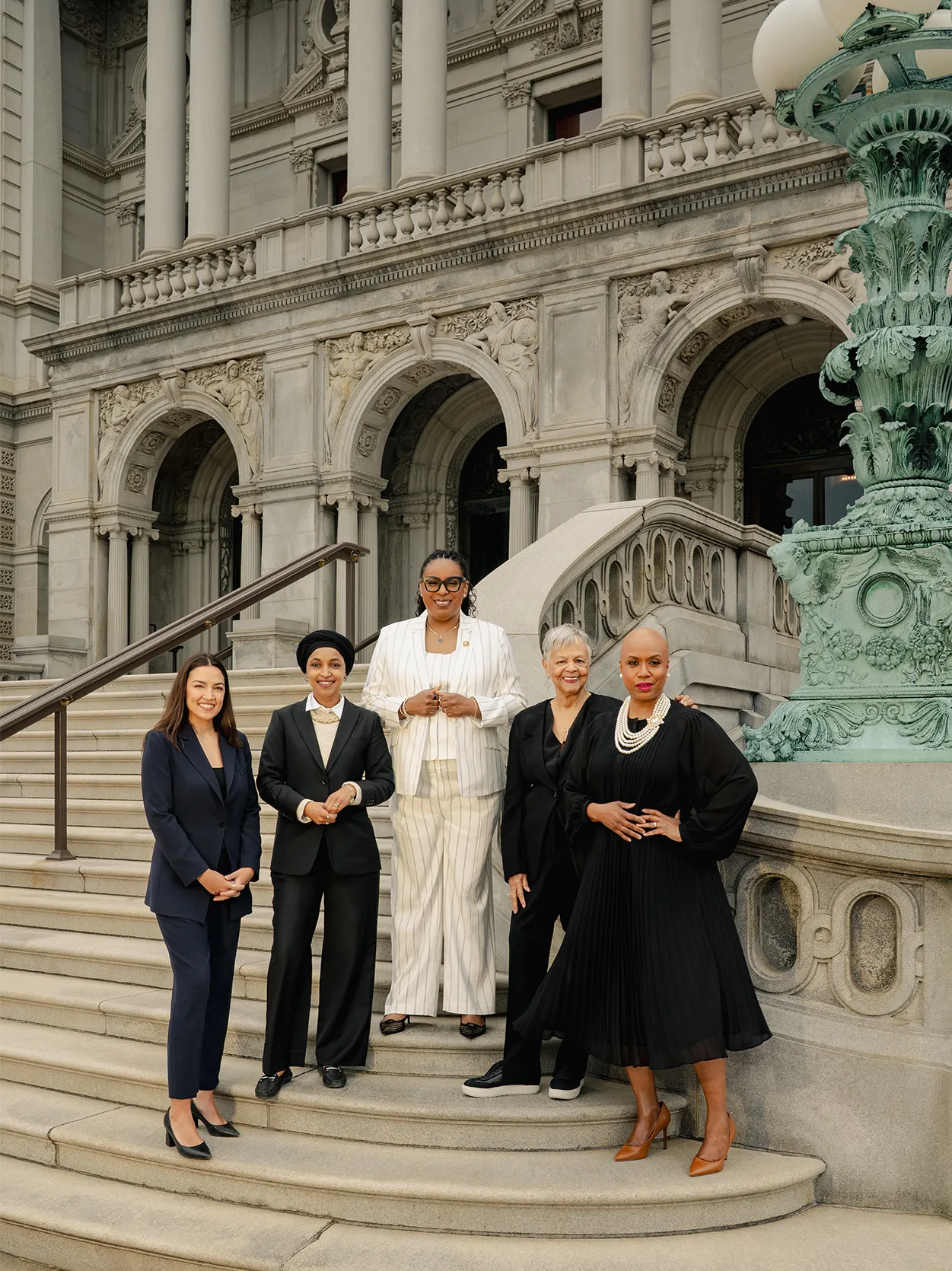
From left: Ocasio-Cortez, Omar, McIver, Watson Coleman, and Pressley at the Library of Congress.
None of the women are ready to entertain the worst-case scenario for McIver. “If that were possible, that means that our whole system is completely broken,” Watson Coleman tells me. But if it ever did come to that, she adds, McIver’s daughter Zaya “would grow up to be the next generation of it, because she would be so fortified by community and family.”
Simon told me about a picture McIver carries of her daughter—“the cutest little girl in the world, with these little cute glasses.” Zaya has since seen the Delaney Hall footage on the news, McIver says. She looked at her mother and said: “Mom, if I would’ve been there, I would’ve had your back.” McIver told her that wasn’t necessary. “Girl, I had it by myself.” But her daughter held her ground.
She sounds, McIver might notice, a lot like some women she works with.