Nood’s Flasher Pro Is Such an Effective At-Home Removal Device, I Canceled My Professional Appointment
I barely need to shave my legs anymore.


I’ve spent a disgusting amount of money on professional laser hair removal. I’ll level set with you: it cost me $3,600 (plus tip) for 16 sessions. Still, it’s the best money I ever spent and has effectively changed my shower routine and my life. I’ve been itching to get my legs and arms done too—who wouldn’t want to never have to shave again?—but I don’t want to shell out a small fortune. That’s where Nood’s Flasher Pro comes in. It’s an at-home IPL device that delivers clinical-level results.
To be completely honest: I originally thought at-home laser hair removal was complete BS. I’ve always preferred professional treatments and am generally wary of heavy-duty at-home devices. But after five friends texted me this month alone asking about the best at-home laser hair removal device, I did a deep dive into the devices on the market, reviewed before-and-after photos, looked at clinical studies, and decided to try the most appealing one (aka: Nood) myself. The TLDR: I’ve been using it for a month and am pretty shocked by the results.
For my full, very honest review, keep reading.
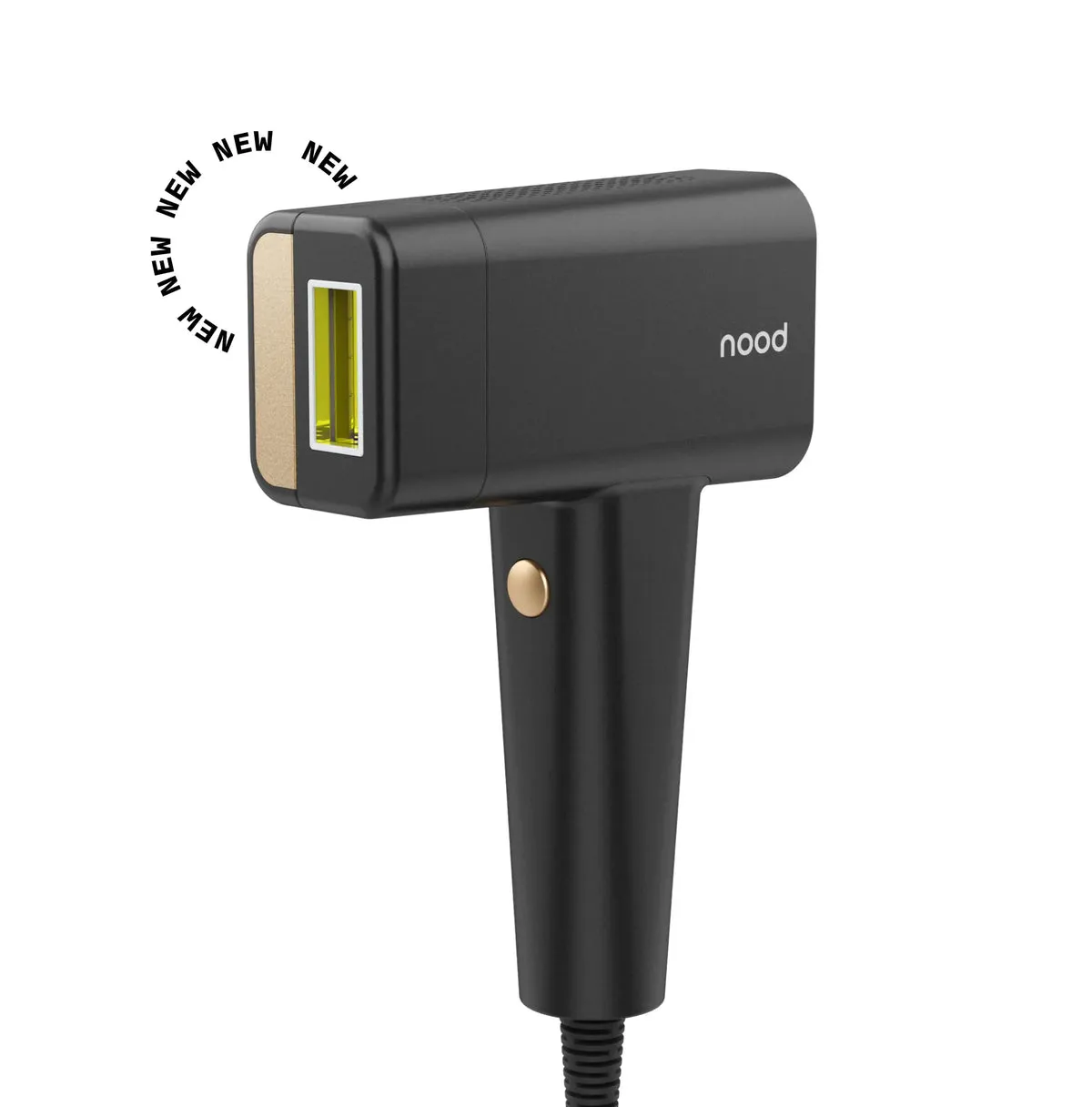
How Does Nood’s Flasher Pro Work?
Like most at-home laser hair removal devices, Nood uses IPL (intense pulsed light) technology. As board-certified dermatologist Joshua Zeichner, MD, previously explained to Marie Claire, IPL devices emit pulses of broad-spectrum light into the skin, generating heat and destroying the hair follicle. They essentially scan your skin for melanin differences and zap accordingly. (Because of this, laser hair removal works best when skin tone and hair are in high contrast—such as pale skin and dark hair. Laser hair removal is less effective on blonde or red hair and can be risky on darker skin tones).
Nood’s Flasher Pro is pretty damn powerful for an at-home device. It uses 7 J/cm2 and can reach the full depth of the dermis (the middle layer of the skin where hair follicles reside), a first for at-home devices. For a little context, Bruan’s Silk Expert Pro 5, which is a best-seller on Amazon, uses 3-6 J/cm2. An in-office device runs laps around both of them, at about 20-25 J/cm2.
The lower power level is intentional, though—these devices can be dangerous to use at home, and keeping the power output lower reduces the risk of injury, burning, or unwanted pigmentation. The only way I felt comfortable using such a high energy level in the comfort of my own home is because it’s equipped with a cooling tip that works to cool the surface of the skin to 60 degrees, which reduces the surface-level heat exposure (remember, IPL works by heating up the follicle) and the risk of burns.
How Do I Use Nood’s Flasher Pro?
Before you actually start treating anything, I’d do a test spot. I personally tested a small section on my upper thigh and waited 48 hours before properly treating my entire leg. After confirming I had no reaction, I prepped for my first session by exfoliating and thoroughly shaving my legs. (PSA: Shave before treating so the light targets the follicle, not the surrounding hair, which could hurt your skin.)
Once you turn on the device, you’ll be prompted to select from one of five intensity levels. If your goal is laser hair removal, level three is the lowest option. Now, the higher you go, the spicier it may feel and the more effective it will likely be. But (there’s always a but), you also risk burning or causing pigmentation around your hair follicle. I personally didn’t want to exceed level three—my skin is sensitive, and I’m generally overly cautious with at-home devices. You’ll also be prompted to select single flash or continuous modes. The former requires you to position the tip over an area, wait for a green light, treat, and move on. The continuous option uses a slow guide; just be careful not to treat the same spot twice.
The goal is to use the Nood device every three days for eight weeks, then scale back to once a week for the following four weeks, and then do monthly maintenance treatments.
Is Nood’s Flasher Pro Worth It?
Given my skepticism, my hopes were pretty low—and I was incredibly cautious. I must have read the instructions 20 times, which, for the record, I think everyone using an at-home device should read. Even with FDA clearance, these machines still carry a risk of injury and pigmentation and should be avoided if you have blonde, red, or gray hair, or a deep/dark skin tone.
Now, onto the actual treatment. To my surprise, the machine was shockingly intuitive to use. I felt a little warmth and a subtle rubber-band snap with each flash, though it was much less intense than the IPL laser I had in my dermatologist’s office. I also felt the cooling tip working its magic; overall, it was very comfortable, and I wasn’t worried about burning my skin. I chose continuous mode and was very mindful of my speed. Treating both my legs took roughly 15 minutes.
I’m a so-so candidate for laser hair removal—it’s why I had to do so many treatments for my underarms. My skin is pale, and my hair is light brown. It’s not quite blonde, so IPL can still treat it, but it’s less effective on me than it would be for someone with super dark hair. I didn’t notice a difference right away, but after a handful of treatments, my hair started to feel finer and grow back more slowly. "It really should be called laser hair reduction," notes Dr. Zeichner. "In some cases, it may be difficult to eradicate hair. That said, you will notice slower growth, thinner hair strands, and a less stubbly feel.”
Now that I’m roughly a month into using the device, I’ve noticed I can go a week without shaving and still have barely any stubble. Hair still grows out of the follicle, but it feels softer—no rough grit or prickly sensation like I normally get 24 hours after shaving. From a tactile perspective, my legs feel soft pretty much all the time. I haven’t had any burning, and I don’t mind the 15-minute sessions; I just plug it in while I watch TV before bed.
It’s not the same as a professional treatment, but frankly, not having to travel to a medspa, get covered in conductive gel, and deal with the spicy zaps makes the Nood even more appealing. I’m not expecting it to turn me into a hairless mole rat, but it’s definitely making a major difference in my hair growth. So much so, that I’ve officially told my friends it’s worth the investment.
Why Trust Marie Claire
For more than 30 years, Marie Claire has been an internationally recognized destination for news, fashion and beauty trends, investigative packages, and more. When it comes to the products Marie Claire recommends, we take your faith in us seriously. Every product that we feature comes personally recommended by a Marie Claire writer or editor, or by an expert we’ve spoken to firsthand.