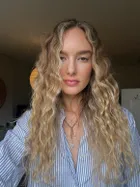
I Got a "Ballerina Boob Job" at 36
A year on, most people can’t even tell I’ve had a breast augmentation.


Cosmetic procedures are more available, and more popular, than ever. For Marie Claire's Plastic Surgery Week, we're going deep—even getting tweaked and augmented ourselves—to find out what really goes on behind closed doors.
The big boobs gene skipped me entirely. This became abundantly clear by the time I hit puberty, when my chest remained resolutely flat, especially if I dared to stand next to my sister (who remains a G cup to this day). But as an active kid who played soccer, rode horses, and went snowboarding with friends, I didn't really mind the lack of cleavage, or the uncomfortable bouncing that came with it. I just lived my life in an AA bra that was mostly for show anyway. No big deal.
But bodies change with age, along with your mindset, and by the time I moved to New York in my early twenties—where I spent my days in an office full of fashionable women and my nights bartending in the East Village—the idea of a breast augmentation became more intriguing. It wasn’t that I wanted to look like the other women in my family, or the celebrities that dominated pop culture at the time (this was the heyday of The Kardashians, mind you). I just started thinking more about balance. To put it plainly, I felt bottom heavy; like my form was asymmetrical in a way that made my clothes always feel either too big or too tight. Still, the idea of augmenting my chest felt a bit scary. What if I looked fake, or too done? I'd never want my boobs to enter the room before I did, so to speak.
"A lot of women don't want to be defined by their breast implants," says Melissa Doft, MD, a double board-certified plastic surgeon in New York City. "That voluptuous look is not as popular, at least in New York City. But I think even across the country...a much more streamlined, athletic look has become the goal instead."
By my mid-thirties, after years spent covering plastic surgery trends and research, the so-called "ballerina boob job" had taken up permanent residence in my mind. Trendy term aside, the concept is more about a smaller, more natural-looking approach to augmentation, to the point that a casual observer might never know that you got plastic surgery. My approach to hair and makeup has always been done-but-undone, so this fell perfectly in my wheelhouse.
Luckily, I'd known Dr. Doft for a decade, and her approach to plastic surgery has always been artful, natural, and understated. That kind of trust matters when you're considering permanently changing your body. So last fall, I decided to venture to her Upper East Side practice for a "ballerina boobs" consult.

Before my breast augmentation, when a towel would barely stay up for my lack of chest.
My Breast Augmentation Consultation
One perk of being a longtime beauty editor is having a plastic surgeon on speed dial. As breast augmentation became more appealing, I spent weeks texting Dr. Doft with questions: Am I a good candidate? What advancements in the space are exciting for you? How long would I need to be on bed rest?
Finally, I called her office to set up an appointment, and within two weeks I was sitting in one of her treatment rooms in Manhattan where I brought up one of my biggest concerns: Would I end up looking like the '00s idea of a woman with obvious fake boobs?
"Knowing you for so many years, we couldn't put in a large implant on you," Dr. Doft assured me. "Your whole look is this very waif, chic look, and you like to dress that way." She explained that because of my size (I'm a US 4) I wouldn't require a large implant in order to achieve more volume. "You're also very narrow," she added, "so a wide implant would be hitting you in your arm."
Once I felt comfortable with the approach, Dr. Doft confirmed that I was a good candidate for a breast augmentation (I'm healthy, I have a support system) we moved onto the implants themselves. I had heard from friends who had undergone the surgery a few months earlier, and my various industry connections, that Motiva implants had become the new gold standard, especially for anyone looking to achieve a smaller, more natural look.
During our consultation, Dr. Doft explained to me that the rupture rate is much lower with Motiva implants—0.6 percent at ten years, versus 10 percent at 10 years, which means that the longevity of the implant is much longer.
We have this new implant and the safety ratings are so much better, it's quite enticing.
Dr. Melissa Doft
Second, they have a textured surface that is more like your body's tissue, which helps lower the chances of developing capsular contracture, a common post-op issue wherein your body forms scar tissue around the implant after surgery. "The capsule contracture rate is 0.5 percent instead of five to 20 percent at 10 years," Dr. Doft shared. "[Now that] we have this new implant and the safety ratings are so much better, it's quite enticing."
Since 2020, "the FDA recommends screening your breast implants with MRI or ultrasound beginning five to six years after silicone implant placement and every two to three years thereafter," per the American Society of Plastic Surgeons,to monitor the implant, and identify complications like implant rupture or silicone leakage
Choosing My Breast Implant Size
I felt confident with the Motiva silicone implants (as opposed to a saline option), but then it was time to move onto the size itself. Dr. Doft brought out four different sizes of implants for me to touch and feel; I even threw one at the wall to test just how durable they are (because the risk of the silicone leaking into my body had crossed my mind). Then I popped a few options into my bra, and together we looked in the mirror and talked about what I liked about each size and what I didn't. I also hadn’t realized that there were so many different options for the implant's projection—not just the CCs, or overall volume.

Trying on various Motiva implant sizes at Dr. Doft's office.
Dr Doft explained, "The mini versus the demi versus the full implant is really about how much projection you want," (a.k.a. how far it extends outward from your body). "Wanting something that's very understated, a mini, is perfect. And particularly for somebody who hasn't really ever had boobs before, sometimes they want their body, but just a little more." Ultimately, I chose a 160 cc mini implant, the lowest projection available, placed partially beneath the muscle using a technique called dual-plane augmentation. (For context, Kylie Jenner has 445 cc implants, so I was definitely on the smaller end of the spectrum.) The goal was a smoother, more natural-looking transition between the implants and my chest.
With the most important decisions for my augmentation finally made (surgeon, size, brand), I scheduled the surgery for three weeks later.
My Breast Augmentation Prep
Preparing for surgery meant getting standard pre-op blood tests at a third-party facility and stopping medications containing ibuprofen, which can increase bleeding risk. I started taking Arnica supplements one week prior to the surgery to help minimize bruising, and I made sure to buy a spare surgical bra that opened in the front to switch between the one that Dr. Doft's team would provide.
The night before the surgery, I made sure that my apartment was clean and tidy, I had fresh sheets on my bed, and that there were plenty of snacks on hand since I would be groggy and sore, and wouldn't want to leave to go grocery shopping. I also tapped a friend to pick me up from the Upper East Side and take me home after the procedure. She was briefed on all the meds I would need to take after the surgery (Tylenol and a prescription painkiller if I felt like I needed it, which I honestly didn't) plus MiraLax—because going under general anesthesia really messes with your guts. Then it was time to take a few final photos of my body pre-implants, for posterity, and try to get a good night's sleep.
My Breast Augmentation Surgery
The most stressful part of my morning before surgery was not being able to chug my typical liter of water after I woke up or consume even the tiniest bit of coffee. I took a shower, making sure to wash and condition my hair since raising my arms post-augmentation would be tough for a few days. I kept my skincare simple, threw on cozy sweats with slip-on Vans (less bending over required), removed all my jewelry, and headed to the train.
Once I arrived at Dr. Doft's surgical site, which is right around the corner from her Manhattan office, her team greeted me and took me back to a private room to get changed and meet with her before going to the OR. I swept my hair up into a bun and hair net (hot) and taped down my gold belly button ring (the only body jewelry that couldn't be removed). Then Dr. Doft came in to confirm my implant size and mark my chest while I was standing, since gravity does different things to your boobs, no matter how small, when you're lying on a surgical table. I slipped on my grippy socks, texted my sister and a friend that it was game time, and headed into the OR.

(L to R): Right before going into the surgical suite; my lovely surgical bra, and noticing that I have breast projection for the first time in my life; Lounging in bed, watching old episodes of House.
The surgery room was small and filled with an all-female team, from nurses to the anesthesiologist, which made me feel especially well cared for. I laid down on the table as they inserted my IV. Then Dr. Doft held my hand as my anesthesia kicked in, and before I knew it, I was reclining in the recovery chair, sipping a box of apple juice.
My Breast Augmentation Recovery
After I relaxed in the recovery wing for a half hour or so (apparently Dr. Doft came to say hello and tell me everything went smoothly, but the memory is a little fuzzy) the nurses walked me to the waiting room to greet my friend. They then escorted us outside to an Uber, and we drove back to Brooklyn.
The stairs in my old building took a little longer than usual, but once I was propped up in bed with pillows and a giant glass of water, I felt surprisingly good. My chest felt heavy, like I had a weight resting on it, but not as painful as I expected. The only time I felt restricted was when I was lying down and needed to push my body upwards. My chest muscles were sore, and I had to get a little creative with how I got up from bed for a few days.
By day two, I was dying to see my new girls. I was also a bit nervous to take a peek. The pink surgical bra was packed with gauze, and I didn't want to disturb anything. But by the morning of day three, I decided it was finally time to shower and check out my new boobs.
The term 'drop and fluff' is tossed around quite a bit and that's exactly what I kept in mind when I saw myself topless for the first time.
Dr. Doft had warned me that the implants would be "riding high" right after surgery, and not to worry—they would eventually settle and have a more natural-looking slope. The term "drop and fluff" is tossed around on social media quite a bit and that's exactly what I kept in mind when I saw myself topless for the first time. After a lifetime with barely any chest to speak of, the sight was admittedly jarring. But as the days passed and I tried on different tops, I began to recognize my new silhouette. The surgical bra wasn't exactly doing me any favors. After three days, I was back out in the world in a loose sweatshirt, meeting my friends for brunch. By day five, I went to a fancy work dinner, my blazer open to a black surgical bra by Skims, and no one was the wiser.
By the two-week mark, when I went back to see Dr. Doft for my follow-up appointment, things already felt much more settled and not so obviously augmented. I could finally raise my arms, wash my hair, and more or less exercise as normal. At the month mark, I was back to sleeping on my stomach (a bad habit I'm still trying to break for the sake of my skin), and I wasn't so worried about knocking my boobs against someone's shoulder on the train.
The incisions were still fresh, and the skin around them was numb since the nerves are severed during the insertion of the implant—all normal, Dr. Doft assured me. She gave me a supply of silicone gel to apply daily to minimize scarring as I healed. I also made sure that once I was able to switch out my surgical bra for something a little more flattering that I had plenty of support—in other words, the barely-there triangles of lace I used to rock needed a touch more oomph to keep my girls in place.

One year after my breast augmentation surgery.
My Breast Augmentation Results
It's hard to believe it's been a year since my breast augmentation surgery. Once everything settled, and I was back to wearing regular clothes rather than sweats to hide the surgical bra, I felt fabulous. In fact, the first time I picked up a lower-cut top, I couldn't stop checking myself out in the mirror before I left home. I had the slightest hint of cleavage, and my butt-to-waist-to-boobs ratio felt balanced and natural. Most days, I forget that I even had the surgery to begin with—unless I'm getting really up close and personal with a mirror to check my scars, which are so faint and so hidden beneath the curve of each breast, you can hardly even see them. But overall, my body feels like mine, just enhanced in a way I'd only imagined for years. That, in and of itself, allows me a new, and very welcome, level of comfort and confidence

Before and after my breast augmentation surgery.
I also don't think that most people can even tell that I had my boobs done. I went from a 32A to a 32B cup, negligible unless you see me in a tight top or a bikini, but for me, it feels like it’s perfect: just a whisper of cleavage, a smidgen more chest definition. All in all, I feel sexy and womanly, like I finally filled out where nature left me a little bit lacking. The biggest difference is that when I hit the gym in my sports bra, I actually do need the support. What a novel concept!
Looking back, my fears of ending up with an obvious (and obviously bad) boob job feel almost foreign. Even with the immense access I have to the best providers in the world, I wish I had floated my questions to an expert or two sooner, just to feel more informed and quell my fears. More than anything, I'm glad I let myself want something different, explore my options, and make the decision on my own terms. I think I look hot, and yes, I enjoy wearing a bikini more than ever. But the unexpected benefit was the confidence that came from making an informed choice about my body at 36.
Why Trust Marie Claire
For more than 30 years, Marie Claire has been an internationally recognized destination for news, fashion, and beauty trends, investigative packages, and more. When it comes to the products Marie Claire recommends, we take your faith in us seriously. Every product that we feature comes personally recommended by a Marie Claire writer or editor, or by an expert we’ve spoken to firsthand.
Meet the Expert

Double board-certified and Clinical Assistant Professor of Surgery at Weill Cornell Medical College, Melissa Doft, MD specializes in a broad range of cosmetic and reconstructive treatments. She seamlessly combines traditional surgical methods with the most state-of-the-art, data-proven new technology. Known for her warm demeanor, genuine kindness, and meticulous attention to detail, Dr. Doft understands the beauty concerns we face and offers conservative, natural-looking solutions.