11 Must-Read Books About Women and Mother Nature Going Head-to-Head
From novels by real survivalists like Blair Braverman to dystopian, climate fiction bestsellers and literary classics.

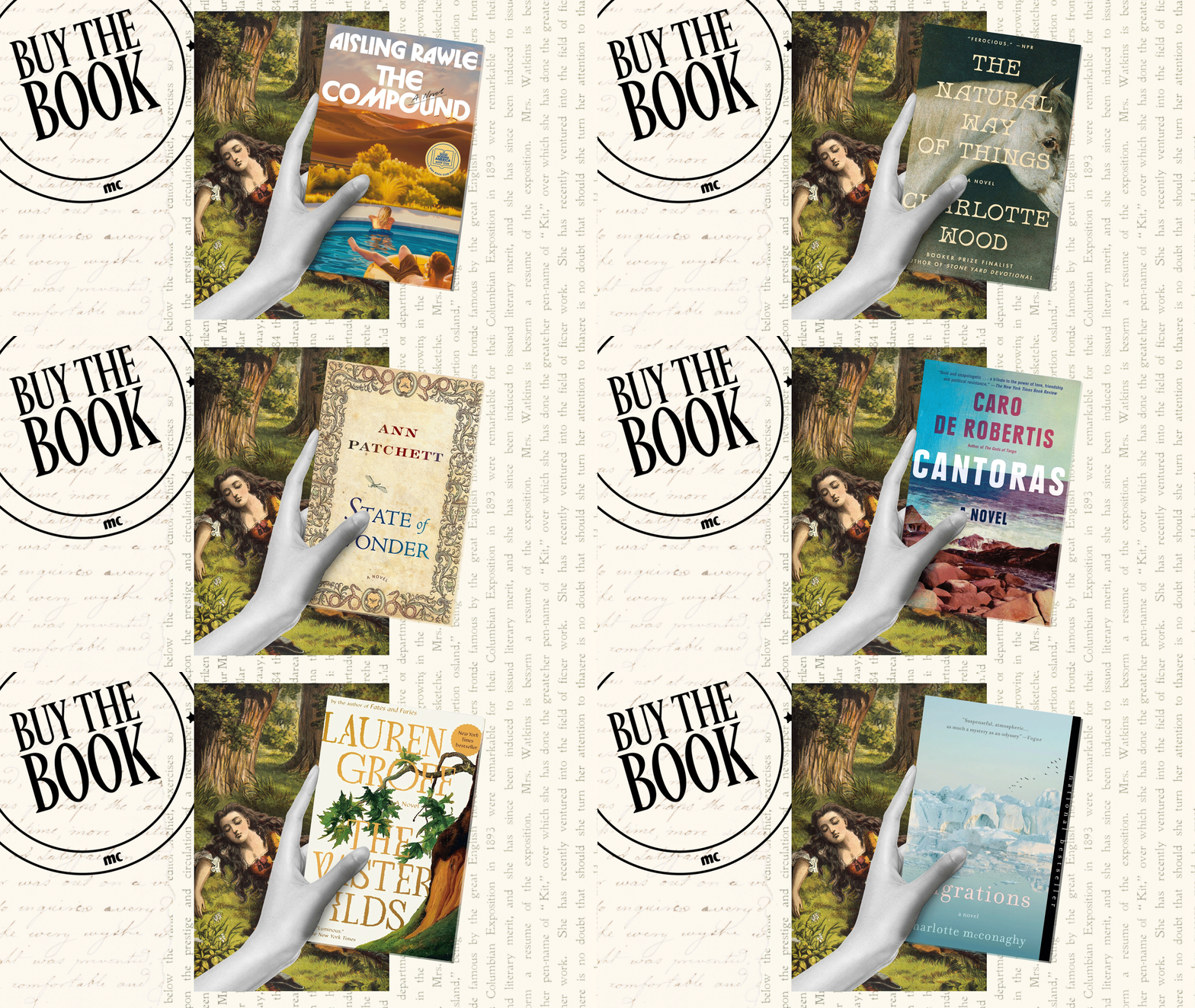
When you're looking to get lost in a book, sometimes you need your reading material to match your mood. With Marie Claire's series "Buy the Book," we do the heavy lifting for you. We're offering curated, highly specific recommendations for whatever you're looking for—whether you're in your feels or hooked on a subgenre trending on #BookTok.
If you were stranded on a deserted island, who would you want along for the ride? For us, many names come to mind—strong, empowering women like Michelle Obama, Greta Thunberg, Padma Lakshmi—but that’s in a glorious hypothetical world where we have them on speed dial. We can’t get enough of imagining who’d we’d want by our side for the ultimate hang/survival challenge—and neither can some authors.
In a slate of woman vs. nature novels, writers have plunked their heroines in harrowing settings and circumstances. Whether abandoned in the Australian Outback or the historic Deep South, a handful of recent bestsellers and certified classics have explored women's resilience against Mother Nature herself and manmade obstacles.
Article continues belowWhile tigers, snakes, epic winds, extreme temperatures, and a post-apocalyptic world may not be a daily threat for most of us, the patriarchy is. If battling bigotry, injustice, violence, and the mansplaining epidemic all the time, while managing families, friends, jobs, and general life, doesn’t prepare a woman to survive in the wild, what does?
So, in honor of women’s resilience, intelligence, creativity, and ability to get shit done even when the world is on fire, we pulled together some of the most captivating novels about women confronting harsh elements in a range of situations. Below, check out the best books about women communing with nature.

Based on the 1621 Vardø witch trials in Norway, this eerily prescient novel follows Maren, a young woman besieged by grief. Standing on the coast of her remote Nordic town, she can only watch as a storm throttles the sea—and the fishing boat with the village’s men on board, resulting in their watery deaths. As she and the other women on shore confront the unforgiving climate and rebuild in the absence of their partners, fathers, brothers, and sons, they strike a unique harmony, completing chores and tasks formerly prohibited. But their independence is short-lived when a government official comes to oversee the women’s work, act as a missionary, and ensure nothing gets out of hand. Obviously, everything gets out of hand.
Maren is caught in the center of this domestic storm: She befriended Ursa, the official’s wife, whom he married during his travels to the village. And, as their bond strengthens, more of their friendship is threatened, especially as the official begins to suspect some of the village women are conducting witchcraft.

Verla wakes dry-mouthed and woozy. After taking stock, she ascertains that she’s been drugged and transported to a dingy cell…somewhere. Soon, another prisoner, Yolanda, whirls into the room. The two then confront their reality: While they were unconscious, they were abducted to an unknown location. Then they meet the others. Composed of 10 women formerly ensnared in sex scandals, none of the women can recall how they arrived at the defunct sheep station that’s (possibly) in the Australian Outback. What they do know is that they are at the mercy of two male prison guards who have no issue putting the women to work in the grueling heat while also fixing meals and generally ensuring that no one dies at the hands of this nightmare. Time passes, and the prison's foundation begins to crumble.
On its 10th anniversary, The Natural Way of Things remains as relevant as when it first came out. Inspired by a real, troubling institution that existed in 1960s Australia, this dystopic novel is an incisive examination of gender, sexuality, and power dynamics. Charlotte Wood inserts the reader straight into the jaws of her story, never relenting until the devastating end. If you raced through I Who Have Never Known Men or The Handmaid’s Tale and are looking for something with the same bite, this book belongs on your TBR.

Jesmyn Ward, one of the best living writers in the U.S., crafted this historical fiction tale about redemption, escape, and survival. Annis descends from warriors and is plied with her stories about her ancestors and combat traditions from her mother, Sasha. Enslaved in the Carolinas by a horrible abuser, Annis is the daughter of the man who terrorizes her mother and eventually separates them. He sells her mother as punishment for arguing against his criminal desires, and soon enough, he sends Annis on the same deplorable Louisiana enslaved persons trade. The only way to get there: on foot.
As Annis and other enslaved people embark on the horrific trek, she meditates on the stories her mother told her about her grandmother, Mama Aza, and encounters several spirits along the way. But there is one entity, Aza, who is at once the most disturbing and severe. Though distrustful, Aza claims she previously guided Annis’s mother and grandmother. After Annis journeys south, where she's sold to the heartless owners of a sugar plantation, an opportunity presents itself—and Annis enters the unknown, using every skill she has to begin anew and possibly, free.
Unspooled in Ward’s unfaltering and lyrical prose, Let Us Descend teems with Annis’s drive for survival, tapping into her ancestral strength, the otherworldly intervention of Aza. Blending Ward’s command of magical realism to draw a sharp portrait of reality, this is a novel that demands to be sat with. A wonderful option to be read with a friend or book club—interpretations and impressions are sure to abound.

Uniquely qualified to write a book about survivalist reality TV gone awry, Blair Braverman taps into her experience as a long-distance dog sledder and one-time contestant on Naked and Afraid. Her novel, Small Game, features Mara, a teacher at a wilderness school, where she mostly teaches rich people how not to die during a night camping. But when she's offered a chance to compete on the competition series Civilization, the reward money is enough to convince her to move forward.
Soon enough, she finds herself with four other contestants dropped in the middle of an unknown forest with no food, each armed with a single tool. As filming progresses, the competitors are shocked to discover that their producers, camera operators—the whole team—have seemingly abandoned her and the rest of the cast in the forest. Unsure whether this is a component of the show or if something larger is awry, Mara must tap into her strengths (finding edible plants, etc.) and weaknesses (trusting anyone) to live long enough to find out the answer.
With her extensive background, Braverman renders a searing portrait of human connection, resilience, and endurance.

Marguerite de la Rocque is born into French nobility in the 16th century. Though steeped in privilege, the young aristocrat encounters hardship early in life when she becomes an orphan and is placed under the guardianship of her cousin, Jean-Francois, who squanders her fortune. As Marguerite matures, she becomes profoundly aware of the dissonance pervading her life. For one, she brims with thoughts and ideas but has no one to share them with—especially considering her role is to be seen, not heard. She carries the weight of a noble title yet is destitute. And then her cousin forces her to accompany him on his voyage to Canada. Things only get worse.
Abandoned on a windswept island with her lover, Jean-Francois’s secretary, and her lifelong companion, Damienne, a servant who acts as the primary maternal force in Marguerite’s life, the three must confront the unyielding and frigid climes of the island. As Marguerite’s noble persona fades, she steps, finally, into her own personhood. But while shelter and food are scarce, sacrifices and heartache are in endless supply. And it’s a gamble if she’ll get off the island to reveal her true nature to the others who forced her to suppress it.
With flavors of Game of Thrones (or any of its spin-offs)—minus the fantasy—Isola is a haunting story based on a real woman. This briny book will hook you with its propulsive prose and so much tension it’s like watching an Oscar winner get announced. Read this if you’re itching for a book that will set sail your imagination with an utterly compelling plot.

If you’ve been meaning to cut down your backlist, start here. The third novel from national treasure Ann Patchett is steeped in so much atmosphere that humidity lifts off the page. Dr. Marina Singh lands in Brazil to find her former mentor, Dr. Annick Swenson, after learning her colleague with the same task—finding Annick and discovering what she's researching for Vogel Pharmaceuticals—has died.
Marina is led through the Amazon, dodging anacondas and whatever else is lurking in the rainforest’s shadows with the help of Easter, a local deaf boy. As they wind through mosquito-laden rivers, the air thickens as memories of a tragic loss swarm in Marina’s mind. Haunted and hot (is there any worse combo?), Marina stumbles on something that may impact women’s fertility forever. But, with dangerously fickle side effects, Marina must decide what sacrifices are worthy and which are a waste of her dwindling time in her mission. A remarkable piece of fiction, State of Wonder is super-charged with illustrious descriptions and complex characters faced with unthinkable dilemmas.

A young girl is a wild thing. Tamed by societal expectations, rules, and at times, hard lessons, it's rare for a young woman to regress to her original state. Unless, that is, you’re a character in a Lauren Groff novel.
Such is the case for the main character called "the girl" in this 17th-century-set novel. Fleeing a small settlement, gripped by famine in Virginia, she ventures into the wilderness with little protection, food, or direction. The girl finds herself dazzled by the beauty of the woods and bewildered by the constant demand to maintain her safety. As her journey continues, she sheds her terrible past and the scars of belonging to a colonizer settlement, transforming into something simpler: a creature living in the natural world.
Encountering only a few people along her quest, The Vaster Wilds widens its worldview with intentional flashbacks. The others who do cross her path are so well rendered that you might forget they’re only designated a chapter. With an ending that may leave you in tears, this novel is a triumph, perfect for reading outdoors in the fresh spring air.

From Charlotte McConaghy, author of Wild Dark Shore, Migrations is a climate fiction novel about a woman pursuing the last migration of terns to Antarctica. Because there’s nothing like a little adventure to escape your past, Franny talks her way onto a fishing boat headed south to follow the seabirds on their final voyage. This may be her only chance to see them, now that rising sea levels have led to the extinction of most birds, animals, and fish.
Franny, flighty as a bird, has a hard time feeling caged, causing her to flitter away whenever she detects the walls are closing in. Confined to the small fishing boat, she grapples with her violent past and a complicated tragedy that drove her to track the flock. Typical of McConaghy’s skill of depicting complex women who spend little time worrying about being likable, Migrations rings with lyrical prose that helped make Wild Dark Shore a standout.

In the 1970s in Uruguay, queerness was condemned by the government, punished with rape, torture, and/or imprisonment. With their lives on the line, five vastly different women, from a housewife to a teenager, leave the town of Montevideo and find a haven, a small hut, in Cabo Polonio, a discreet fishing village. Drawn to a distant shack, they finally have a respite from the horror unleashed by the military. But, to remain safe (and to keep anyone from looking for them), they must return home. So the women dodge and finesse their way out of being discovered, returning to Cabo Polonio to make the hut a home, enjoy fire-charred fish, and negotiate with the moody coastline.
The craggy landscape mirrors the women’s growth as they come to rely on one another not only to keep their secrets safe, but to resist external forces that cause them to shrink from their truth. Despite the low-frills lifestyle in Cabo Polonio, they thrive in one another’s presence. Here, they navigate heartache and love, disappointment and self-discovery, all the while tending to their modest home. Told from various perspectives and shifting timelines, Cantoras pays homage to queer folks’s resolve, found family, and the refusal to live in fear and oppression. Pick this one up if The Great Believers by Rebecca Makkai ruined you (like, in a good way), you’ve rewatched Pose 10 million times, or if Atmosphere by Tara Jenkins Reid was on the top of your 2025 favorites.

If The God of the Woods by Liz Moore and Stephen King’s classic Misery had a spunky little sister, it’d be What Wild Women Do. Screenwriter Rowan and her husband, aspiring novelist Seth, have booked a cabin deep in the Adirondacks to kickstart their respective writing projects. One day, during a hike, they come across a dilapidated camp. Through some casual rummaging, they learn that the site operated as a women’s wilderness camp in the 1970’s led by socialite, Eddie Calloway. A newly turned feminist, Eddie reopened the camp to encourage women to embrace their wildness and commune with nature. But it all came crashing down when Eddie mysteriously vanished. 40 years later, and Rowan is transfixed by the mystery and soon finds herself hunting down clues that may explain Eddie’s disappearance.
Spanning multiple timelines narrated by Rowan and Eddie, this mystery-thriller book is categorically unputdownable. With a satisfying ending set deep in the wooded atmosphere, you’ll want to pass this one around the campfire when you’re through.

If you can’t get enough of reality TV books, add this to the top of your list. Participating in a competition series, Lily arrives at the Compound with nine other “girls.” They're meant to tidy up the Compound until “the boys," who were dropped in the middle of the desert, arrive. As the contestants do their best to follow the game’s rules, they also must complete “personal tasks” to be rewarded with items like food, makeup, and robes. And as the game progresses, the personal tasks become more intense, especially when contestants start getting banished. See, no one wants to have to return to the world outside the Compound: It’s a hell pit.
As elimination competitions become more dangerous in this dystopian read, so too do the stakes of not winning (including missing a water shipment). The group numbers drop, some by choice, others by darker forces. Who knows if Lily will be able to live with what she must do to be the last person standing? A blend of The Hunger Games, Love Island, and Squid Games, The Compound is a delicious thriller-satire that’ll make you rethink signing up for any reality show.